
 Eng
Eng  中文简体
中文简体Home / News / Industry News / Roller Chain Basics: Types, Standards, Sizing, Lubrication, and Selection
Submit feedback
Roller Chain Basics: Types, Standards, Sizing, Lubrication, and Selection
Update:21-08-2026
Posted by Admin
Content
A roller chain rarely fails by sudden breakage. In most industrial drives, the real cause of downtime is wear elongation that has quietly passed the point where sprocket teeth can mesh correctly. The good news is that this failure mode is largely preventable. Select the right chain grade for the load, keep it properly lubricated, and measure wear on a regular schedule, and a quality roller chain will run for years. This guide explains how roller chains are constructed, what the common standards mean, which variants solve which problems, and what to check before you buy.
What a Roller Chain Is and How It Works
A roller chain is a positive-drive component that transmits mechanical power between two or more sprockets without slip. It is built from alternating inner and outer link plates, joined by pins. Each pin passes through a bushing, and a roller rotates freely over the bushing. When the chain wraps around a sprocket, the rollers roll onto the teeth instead of sliding, which keeps friction low and efficiency high.
That simple construction explains most of the performance you can expect. A standard roller chain drive transmits power at roughly 98 percent efficiency, tolerates high shock loads better than a belt, and maintains a fixed speed ratio because there is no slip. The trade-off is that the chain needs lubrication, periodic tension adjustment, and a sprocket set whose tooth profile matches the chain series.
The pitch — the distance between two adjacent pin centres — is the fundamental dimension. It defines the chain number, the sprocket geometry, and the speed range the drive can handle. Getting pitch right is the first condition for any successful chain selection.
A Series vs B Series: Reading a Chain Standard
Roller chain dimensions are governed by two main standards that most buyers meet as A series and B series. ANSI A-series chains, also called American standard chains, are dimensioned in inch units and are the default choice throughout North America and much of Asia. ISO B-series chains are based on metric design values and are common in Europe, though both are manufactured globally.
The chain number encodes the pitch. In an ANSI chain such as No. 40, the number represents eighth-inch units: 4/8 inch equals a 0.5-inch pitch. In an ISO B-series chain such as 08B, the same pitch appears as 8/16 inch. A No. 40 and an 08B therefore share the same pitch, but roller width, pin diameter and link plate thickness are not interchangeable in practice. Always match sprockets to the exact series, because a chain and sprocket are a system. Mixing series creates uneven load distribution and rapid wear.
If you are choosing between standards, the practical decision usually comes down to the equipment you are fitting. American machines, conveyor systems and many agricultural implements use A series. European-designed machinery more often calls for B series. When both are possible, A-series short-pitch precision roller chains offer the widest availability of matching sprockets and aftermarket parts. For a deeper comparison of dimensions and selection logic, see our guide to A-series versus B-series roller chain standards.
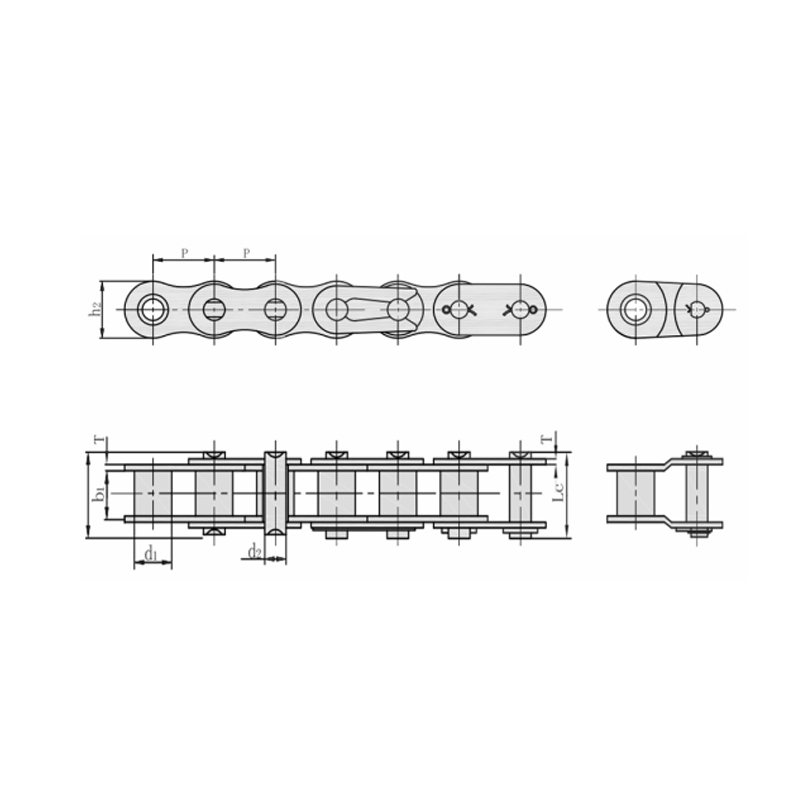 Short pitch precision roller chains ( A series ) Suppliers, FactoryHangzhou Qianjiang Chain Industries Co., Ltd is China wholesale Short pitch precision roller chains ( A series ) Suppliers and top Factor...View Product →
Main Roller Chain Types and Where Each One Fits
Once the standard and pitch are fixed, the next question is which variant suits the application. Roller chains are manufactured in several families, each one optimised for a specific combination of load, speed, environment and maintenance access.
Standard precision roller chains
Standard short-pitch chains are the workhorse of power transmission. They suit moderate loads and speeds, run quietly, and are inexpensive to replace. When you see a chain drive on a general-purpose machine, a conveyor drive shaft, or a light lifting mechanism, it is usually a standard A or B series chain.
Heavy-duty roller chains
Heavy-duty series chains use thicker side plates, larger pins and reinforced components to withstand shock loads, frequent starts and high tension. They fit crushers, excavators, mining conveyors and other equipment where service factors are severe. The extra material raises the breaking load, but proper lubrication remains just as important as the higher strength.
Double-pitch conveyor chains
Double-pitch chains use the same pin and bushing size as a standard chain but with twice the pitch. The result is a lighter, lower-cost chain for long-centre conveying at moderate speeds. With attachments such as extended pins, centre holes or K-style plates, double-pitch conveyor chains become the backbone of packaging lines, pallet conveyors and assembly automation.
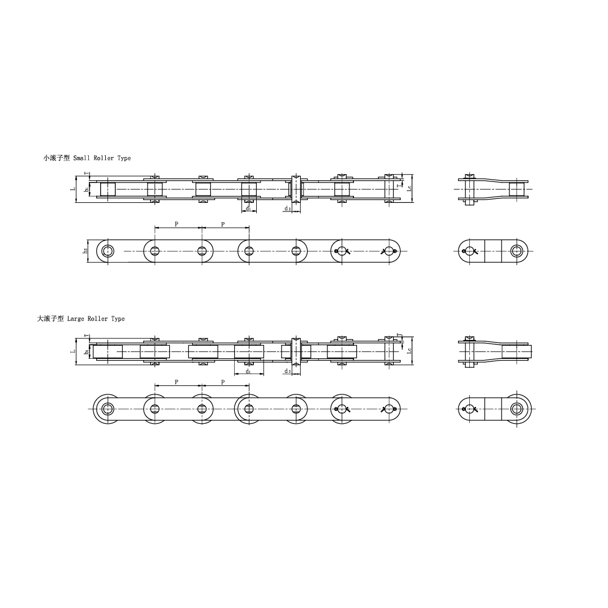 Double pitch conveyor chains Suppliers, FactoryHangzhou Qianjiang Chain Industries Co., Ltd is China wholesale Double pitch conveyor chains Suppliers and top Factory,Product Introducti...View Product →
Stainless steel roller chains
Corrosion-resistant chains are made from stainless steel grades that resist rust, washdown chemicals and moisture. Food processing, beverage lines, pharmaceutical packaging and outdoor equipment all rely on them because they keep running where carbon steel chains would seize. For wet, hygienic or mildly corrosive duty, stainless steel short-pitch precision roller chains are a direct replacement for standard carbon steel chains while adding a much longer service life in harsh environments.
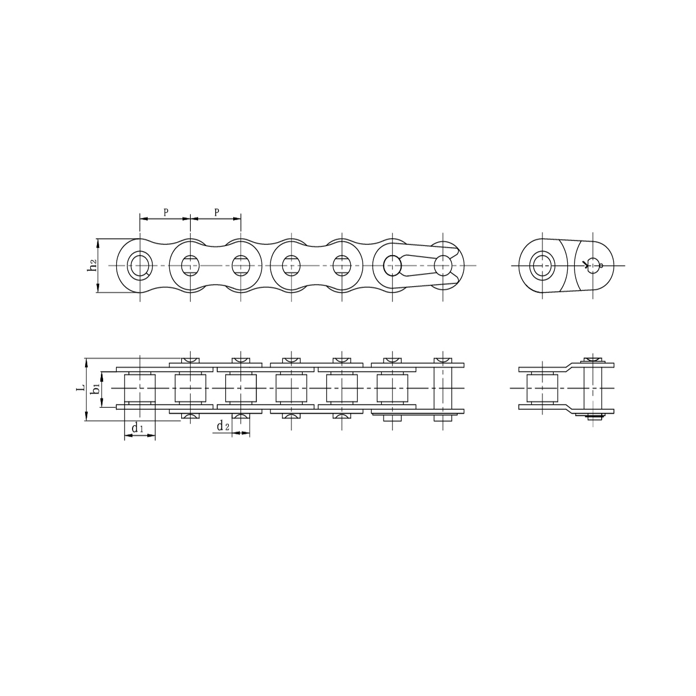 Stainless steel short pitch precision roller chains Suppliers, FactoryHangzhou Qianjiang Chain Industries Co., Ltd is China wholesale Stainless steel short pitch precision roller chains Suppliers and top Fac...View Product →
Oil-seal roller chains
Oil-seal chains incorporate O-ring or X-ring seals between the inner and outer plates. The seal traps factory lubricant inside the pin-bushing joint and keeps dirt, dust and water out. This makes them the preferred chain for motorcycles, off-road vehicles and heavy equipment exposed to contaminated environments, where external relubrication is difficult or infrequent.
Attachment and specialty chains
Beyond the main families, roller chain variations multiply: conveyor chains with welded or riveted attachments for product handling, side-bow chains for curved conveyor paths, silent chains for low-noise drives, and leaf chains for lifting without sprockets. Choosing one of these specialty products is a functional decision, not a material upgrade.
| Chain type | Key feature | Typical application |
|---|---|---|
| Standard precision | Balanced strength and cost, wide sprocket availability | General power transmission, light conveying |
| Heavy-duty | Thicker plates, higher breaking load | Crushers, excavators, shock-load machinery |
| Double-pitch conveyor | Long pitch, light weight, lower cost | Packaging lines, pallet conveyors |
| Stainless steel | Corrosion and washdown resistance | Food, beverage, pharmaceutical, outdoor |
| Oil-seal | Factory lubricant sealed inside | Motorcycles, off-road vehicles, dusty plants |
| Attachment/specialty | Purpose-built plates and connectors | Curved paths, product handling, low-noise drives |
How to Choose and Size a Roller Chain
Selection starts with the application conditions, not with the chain catalogue. Define the transmitted power, input speed, sprocket sizes, centre distance and how the load is applied. For steady, moderate loads, a standard chain is adequate; for shock loads or continuous operation, apply a service factor and move to a heavy-duty or larger pitch chain.
You also need to verify the chain number and the measuring method. The chain designation must match both pitch and series, and the roller width must fit the sprocket tooth profile. If you are inspecting an existing machine, correct measurement is the difference between a perfect replacement and a premature failure. Review the practical procedures in our guide on how to measure a roller chain and identify the chain grade.
Three rules cover most purchasing mistakes. First, never combine a new chain with worn sprockets; replace both as a set. Second, prefer a slightly larger pitch over a heavier grade when speed is low and tension is high, because larger bearings handle load better. Third, check the minimum number of sprocket teeth for the speed; a chain running too fast on a small sprocket wears quickly regardless of grade.
Lubrication, Wear and Service Life
Lubrication is the single biggest factor that determines how long a roller chain lasts. The pin-bushing joint is the critical wear surface, and without an adequate oil film, metal-to-metal contact accelerates elongation. A chain may be mechanically perfect, yet fail early simply because it was run dry.
Four lubrication methods are common in industrial service:
- Manual lubrication with a brush or oiler, suitable for slow machines and short operating hours.
- Drip lubrication, where a valve feeds oil at a controlled rate onto the chain.
- Oil-bath or oil-splash lubrication, where the chain dips into an oil sump during operation.
- Oil-spray or forced lubrication for high-speed drives.
Wear is monitored by measuring chain elongation over a fixed length. When elongation reaches about 2 percent to 3 percent of the original pitch, the chain has effectively stretched to a point where it no longer engages sprocket teeth smoothly. Replacing it at this stage protects sprockets; waiting too long damages both components. For the correct regime for your drive, follow the lubrication of roller chain drives recommendations rather than relying on guesswork.
Keep the chain clean as well as lubricated. Abrasive dirt acts like grinding paste between pins and bushings. In dry or dusty plants, oil-seal chains offer the simplest route to extended life. Better lubrication is almost always cheaper than buying a stronger chain.
Industries That Depend on Roller Chains
Roller chains are so widely used that standards have shaped entire machine categories around them. Agricultural machinery runs chains on harvesters, balers and conveyors where dust and weather are unavoidable. Motorcycles and off-road vehicles rely on sealed chains for drive and timing duty. Automotive engines use precision timing chains that must hold accurate position for hundreds of thousands of kilometres. Logistics systems depend on double-pitch conveyor chains in sorting, stacker and pallet applications. Parking systems, automatic doors, pumps and machine tools all follow the same design logic: a compact, positive drive that keeps its ratio under variable load.
Because the product families differ so much, buying the right chain is not about finding a single universal product. It is about matching the chain structure to the operating conditions, and then matching the sprocket set to the chain.
Practical Takeaway for Buyers and Engineers
Treat every roller chain as part of a drive system, not as a standalone spare part. Confirm whether the equipment needs A-series or B-series dimensions, verify pitch and roller width, choose a variant that matches the environment and duty, and check that sprockets are in good condition before installation. Then protect the purchase with the correct lubrication method and a wear-measurement routine.
When those basics are in place, a roller chain is one of the most reliable machine elements available. The products that fail are almost never the ones that were properly selected, lubricated and measured. They are the ones that were chosen on price alone — and that is a mistake you can avoid on the very next order.
News
-
I. Introduction Conveyor systems form the backbone of modern industrial automation, enabling the eff...
READ MORE -
1. Introduction 1.1 Definition and Basic Concept of Coupling Chains Coupling chains are mechanical d...
READ MORE -
1. Introduction to Leaf Chains Leaf chains are a type of mechanical chain used in a variety of indus...
READ MORE

 +86-13805752016
 +86-571-82875104/82875108
 [email protected]
 No. 80 QianNong West Road, Xiaoshan District, Hangzhou City, Zhejiang Province,China
Copyright © Hangzhou Qianjiang Chain Industries Co., Ltd. All Rights Reserved.
|
 浙公网安备33010902004043号