
 Eng
Eng  中文简体
中文简体Home / News / Industry News / A Series vs B Series Roller Chains: Standards, Dimensions, and Selection
Submit feedback
A Series vs B Series Roller Chains: Standards, Dimensions, and Selection
Update:23-03-2026
Posted by Admin
Content
- 1 A Series and B Series Roller Chains: The Two Major Standards and Why They Are Not Interchangeable
- 2 How Roller Chains Work: Construction and Components
- 3 A Series Roller Chains: ANSI Standard, Designation, and Dimensions
- 4 B Series Roller Chains: ISO and British Standard, Designation, and Dimensions
- 5 Side-by-Side Dimensional Comparison: A Series vs. B Series at Common Pitches
- 6 Why A Series and B Series Chains Are Not Interchangeable
- 7 Chain Grades and Quality Classes Within Each Series
- 8 Applications: Where A Series and B Series Chains Dominate
- 9 Specifying and Sourcing Roller Chains: Practical Guidance
A Series and B Series Roller Chains: The Two Major Standards and Why They Are Not Interchangeable
Roller chains are power transmission components used to transfer mechanical energy between two or more sprockets. They are among the most widely produced mechanical components in the world, found in everything from bicycles and agricultural machinery to automotive camshaft drives, conveyor systems, and industrial packaging equipment. Despite this apparent simplicity, roller chains are precisely standardized components, and selecting or substituting the wrong chain -- even one that appears to fit -- can result in premature failure, misalignment, noise, and safety risks in the driven machinery.
The two dominant roller chain standards in global industrial use are the ANSI (American National Standards Institute) series -- commonly called A series -- and the ISO (International Organization for Standardization) series covering British Standard chains -- commonly called B series. A series and B series roller chains of the same pitch are not interchangeable with each other: they differ in plate height, pin diameter, roller diameter, and inner and outer link geometry in ways that prevent them from running correctly on sprockets designed for the other series, even though pitch -- the center-to-center distance between pins -- is identical for chains sharing the same nominal size designation.
Understanding the dimensional differences between A and B series chains, the standards that define each, and the applications where each series dominates is essential for anyone specifying, sourcing, or maintaining roller chain drives in industrial, agricultural, or commercial power transmission equipment.
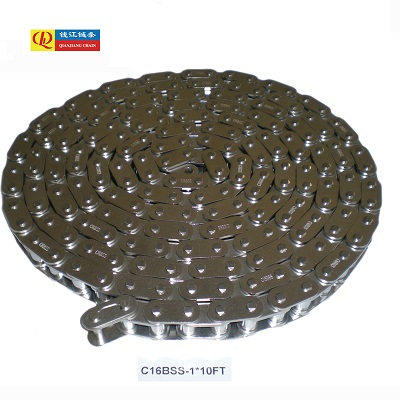
How Roller Chains Work: Construction and Components
Before examining the differences between A and B series, understanding the construction of a roller chain establishes the vocabulary and the dimensions that differentiate the two standards.
A roller chain is assembled from alternating inner links and outer links (also called pin links). Each inner link consists of two inner plates connected by two hollow bushings. Each outer link consists of two outer plates connected by two pins that pass through the bushings of the adjacent inner links. A roller -- a cylindrical element that rotates freely on the bushing -- is fitted over each bushing. The rollers are the elements that contact and engage the teeth of the driving and driven sprockets, distributing the contact load over the roller surface rather than the pin or bushing.
The key dimensional parameters of a roller chain are:
- Pitch (p): The center-to-center distance between adjacent pin centers. This is the fundamental size parameter of the chain and defines the sprocket tooth spacing required. Pitch is the same for A and B series chains of the same nominal size -- for example, both ANSI 40 (A series) and ISO 08B (B series) have a pitch of 12.7mm (1/2 inch).
- Roller diameter (d1): The outside diameter of the roller that engages the sprocket tooth. A and B series differ in roller diameter for the same pitch, which is one of the primary dimensional incompatibilities between the two standards.
- Pin diameter (d2): The diameter of the connecting pin. Differs between A and B series for the same pitch.
- Inner plate height (h2): The depth of the chain plate from roller centerline to plate edge. Differs between A and B series.
- Inner width (b1): The clearance between inner plates -- the internal dimension that accommodates the sprocket tooth. This differs between A and B series, affecting sprocket compatibility.
- Minimum tensile strength: The breaking load of the chain. For the same pitch, A series chains and B series chains differ in minimum tensile strength because their cross-sectional dimensions differ.
A Series Roller Chains: ANSI Standard, Designation, and Dimensions
A series roller chains follow the American National Standards Institute standard ANSI B29.1, which defines roller chain dimensions, tolerances, and minimum tensile strength requirements for standard single-strand chains and derived multi-strand and heavy-series variants. The ANSI standard was developed in the United States and is the predominant chain standard in North America, South America (particularly for industrial and agricultural applications), and in countries with strong historical ties to American equipment manufacturers.
ANSI A Series Chain Designation System
ANSI roller chains are designated by a number that directly encodes the pitch:
- The first one or two digits represent the pitch in eighths of an inch. For example, ANSI 40 has a pitch of 4/8 inch (1/2 inch, or 12.7mm); ANSI 60 has a pitch of 6/8 inch (3/4 inch, or 19.05mm); ANSI 80 has a pitch of 8/8 inch (1 inch, or 25.4mm).
- The last digit of the number indicates the chain type: 0 indicates a standard roller chain; 1 indicates a lightweight chain (with smaller rollers); 5 indicates a rollerless bush chain.
- An H suffix (for example, ANSI 40H) indicates heavy series -- chains with thicker plates for higher load capacity at the same pitch.
- A prefix number indicates multi-strand chains: 2 (duplex), 3 (triplex), etc. For example, 2040 is a duplex ANSI 40 chain.
The standard ANSI single-strand chain sizes most commonly encountered in industrial power transmission are ANSI 25, 35, 40, 41, 50, 60, 80, 100, 120, 140, 160, 180, and 240, covering pitches from 6.35mm (1/4 inch) to 76.2mm (3 inches).
A Series Chain Dimensional Characteristics
Relative to B series chains of the same pitch, A series (ANSI) chains generally have:
- Larger roller diameters, which distribute the sprocket contact load over a larger roller surface area
- Larger pin diameters, providing higher resistance to pin bending under transverse loads
- Wider overall chain width due to the larger roller and pin dimensions
- Higher minimum tensile strength for the same pitch, making A series chains capable of transmitting more power at equivalent pitch and speed in most comparisons
These dimensional characteristics make A series chains particularly well-suited to high-power, high-torque industrial applications where maximum load capacity per unit of chain pitch is the primary design criterion.
Heavy Series A Chains
The ANSI standard also defines heavy series (H) chains, which use the same pitch and roller dimensions as the standard series but have thicker link plates. The increased plate thickness raises the tensile strength and fatigue life of the chain significantly without changing the sprocket requirements (since pitch, roller diameter, and inner width are unchanged). Heavy series chains are specified in applications with higher shock loads, reversal loading, or where the service factor applied to the design load results in a power requirement that exceeds the capacity of the standard chain at the selected pitch.
B Series Roller Chains: ISO and British Standard, Designation, and Dimensions
B series roller chains follow ISO 606 (International Standard for Short-Pitch Transmission Precision Roller and Bush Chains), which aligns closely with the British Standard BS 228 from which it was developed. B series chains are the dominant standard in Europe, the United Kingdom, Australia, India, China, Japan, and most of Asia (where both ISO and JIS standards apply) and in countries with historical ties to British industrial equipment.
ISO B Series Chain Designation System
ISO B series chains are designated by a number followed by the letter B:
- The number represents the pitch in sixteenths of an inch. For example, 08B has a pitch of 8/16 inch (1/2 inch, 12.7mm); 10B has a pitch of 10/16 inch (5/8 inch, 15.875mm); 12B has a pitch of 12/16 inch (3/4 inch, 19.05mm); 16B has a pitch of 16/16 inch (1 inch, 25.4mm).
- The suffix B identifies the chain as belonging to the B (ISO/British Standard) series.
- Multi-strand variants use a hyphen and strand count: 08B-2 is a duplex 08B chain; 12B-3 is a triplex 12B chain.
The most common B series chain sizes in industrial use are 04B, 05B, 06B, 08B, 10B, 12B, 16B, 20B, 24B, 28B, 32B, and 40B, covering pitches from 6mm to 63.5mm.
B Series Chain Dimensional Characteristics
Relative to A series chains of the same pitch, B series (ISO) chains generally have:
- Smaller roller diameters, which reduce the roller-to-sprocket contact area but also reduce the chain's overall width for a given pitch
- Smaller pin diameters
- Lower minimum tensile strength for the same pitch, though the performance gap varies by size
- More compact overall dimensions, which can be advantageous where installation space is limited
At larger pitches (16B and above), the dimensional gap between B and A series narrows, and in some cases the B series chain is actually more robust than a direct A series comparison would suggest because the B series plate geometry at larger sizes was designed for heavier-duty service than the lighter-plate A series equivalent.
Side-by-Side Dimensional Comparison: A Series vs. B Series at Common Pitches
| Pitch (mm) | A Series (ANSI) | B Series (ISO) | Roller Dia. A (mm) | Roller Dia. B (mm) | Min. Tensile A (kN) | Min. Tensile B (kN) |
|---|---|---|---|---|---|---|
| 9.525 | ANSI 35 | 06B | 5.08 | 6.35 | 8.0 | 8.9 |
| 12.7 | ANSI 40 | 08B | 7.92 | 8.51 | 17.8 | 17.8 |
| 15.875 | ANSI 50 | 10B | 10.16 | 10.16 | 21.8 | 22.2 |
| 19.05 | ANSI 60 | 12B | 11.91 | 12.07 | 31.1 | 28.9 |
| 25.4 | ANSI 80 | 16B | 15.88 | 15.88 | 55.6 | 60.0 |
| 31.75 | ANSI 100 | 20B | 19.05 | 19.05 | 86.7 | 95.0 |
The table illustrates the critical point that even when pitch and roller diameter are close or identical, the inner link dimensions -- inner width (b1) and inner plate geometry -- differ between the two series in ways that make the chains incompatible with sprockets designed for the other series. At 12.7mm pitch (ANSI 40 vs. 08B), the roller diameters are close but not identical, and the inner width (the dimension that controls sprocket tooth engagement) differs between the two standards in a way that prevents a chain from one series from correctly engaging sprockets designed for the other.
Why A Series and B Series Chains Are Not Interchangeable
The incompatibility between A and B series chains of the same pitch is a frequent source of confusion in maintenance and purchasing, particularly when equipment sourced from one market standard is serviced using locally available chain from the other standard. Understanding exactly why they cannot be interchanged prevents costly errors.
Sprocket Tooth Profile and Inner Width
Sprocket teeth are designed to engage the rollers of a specific chain series. The tooth profile -- the shape of the gap between adjacent teeth -- is calculated from the roller diameter and inner width of the chain it is designed for. A chain with a different roller diameter will not seat correctly in the sprocket tooth gap: a roller that is too large for the tooth gap will ride high on the tooth flanks without fully seating, placing the load on the tip of the tooth rather than the full flank. A roller too small for the gap will seat too deeply and may contact the tooth root rather than the flank, concentrating stress at the root and accelerating fatigue failure of both the sprocket and the chain.
Inner Width and Tooth Thickness
The inner width of the chain (the clearance between the inner plates) must provide appropriate clearance for the sprocket tooth thickness. If the chain inner width is narrower than the tooth design requires (as would be the case if a B series chain -- which in some sizes has narrower inner width than A series -- is run on an A series sprocket), the chain will bind on the tooth flanks, generating excessive heat, accelerating wear on both the inner plate edges and the sprocket tooth faces, and potentially jamming under high load. If the inner width is wider than required, the chain will have excessive lateral play on the tooth, leading to skipping, noise, and uneven load distribution across the tooth face.
The Critical Safety Implication
A chain incorrectly matched to its sprocket -- even one that initially appears to run smoothly -- will accelerate wear on both the chain and the sprocket teeth significantly. In many cases, the wear manifests as rapid sprocket tooth wear that initially causes reduced efficiency and increased noise, progresses to tooth deformation that prevents clean chain disengagement, and ultimately results in chain skip or complete disengagement under load. In safety-critical applications -- hoists, lifts, agricultural power take-off drives, conveyor drives over which workers pass -- this failure mode can have serious consequences. Always confirm the chain series before purchasing a replacement, and verify the sprocket specification if there is any doubt about the standard the equipment was originally designed to.
Chain Grades and Quality Classes Within Each Series
Within both A and B series, roller chains are produced at different quality grades that affect dimensional precision, surface hardness, material quality, and ultimately the load capacity, fatigue life, and elongation resistance of the chain in service. The quality grade is separate from the series designation -- a B series chain can be produced at economy, standard, or precision grade just as an A series chain can be.
Standard and Precision Grades
Standard grade chains meet the minimum dimensional and strength requirements of the applicable standard (ANSI B29.1 for A series, ISO 606 for B series) and are manufactured using standard tooling and inspection protocols. Precision grade chains (sometimes marketed as high-performance, premium, or branded with a manufacturer's quality grade designation) are manufactured to tighter dimensional tolerances -- particularly in pitch variation across a set number of links -- and use higher-grade materials with more stringent heat treatment control. Precision grade chains offer significantly better fatigue life, elongation resistance, and dimensional consistency than standard grade chains, which translates directly to longer service intervals, lower replacement cost per operating hour, and more predictable maintenance scheduling in high-duty-cycle applications.
Surface Treatment and Corrosion Resistance
Standard carbon steel roller chains for indoor, oil-lubricated applications are typically supplied with a light rust-preventive oil coating, with no surface treatment for corrosion resistance beyond this. For applications involving moisture, outdoor exposure, food processing environments, agricultural use with fertilizer or chemical exposure, and marine applications, chains with specific corrosion-resistant treatments are available in both A and B series:
- Zinc-plated chains: Electroplated zinc coating provides moderate corrosion resistance for outdoor and light-moisture environments. Adequate for agricultural machinery, outdoor conveyor systems, and general-purpose drives in moist conditions.
- Nickel-plated chains: Electroplated nickel provides better corrosion and chemical resistance than zinc and a cleaner appearance, used in food processing (indirect contact), pharmaceutical, and chemical industry applications.
- Stainless steel chains: All stainless steel construction (typically AISI 304 or AISI 316 for the most aggressive environments) provides excellent corrosion and chemical resistance for food contact applications, wet processing, seawater exposure, and chemical plant service. Stainless steel chains have lower strength than equivalent carbon steel chains at the same pitch due to the lower strength of austenitic stainless steel, and are correspondingly more expensive.
- Self-lubricating chains: Pre-lubricated sintered metal bushings or oil-impregnated plates that release lubricant during operation, extending service intervals in applications where external lubrication is difficult to apply or where lubricant contamination of the product is a concern.
Applications: Where A Series and B Series Chains Dominate
The geographic and equipment-type distribution of A series versus B series roller chains broadly follows the market origin of the equipment the chains are installed in. Equipment designed and manufactured in North America, South America, and countries with close industrial ties to American manufacturers predominantly uses A series (ANSI) chains and sprockets. Equipment from Europe, the United Kingdom, India, Australia, and much of Asia predominantly uses B series (ISO) chains and sprockets.
Typical A Series Applications
- North American agricultural machinery (tractors, combines, planters, tillage equipment) -- ANSI 40, 50, 60, 80, 100 are standard in this sector
- Industrial conveyor systems in North and South America
- Construction equipment power transmission drives
- Mining and quarrying equipment manufactured in North America
- Motorcycles and small engine applications to ANSI standards (428, 520, 525, 530 are motorcycle-specific extensions of the ANSI numbering system)
Typical B Series Applications
- European agricultural machinery (tractors, harvesters, forage equipment) -- 08B, 12B, 16B, 20B are the most common agricultural B series sizes
- European and Asian industrial machinery -- packaging equipment, textile machinery, printing presses, food processing equipment, material handling
- Automotive timing chain applications to ISO standards (a significant sector that uses precision-grade B series chains)
- Bicycle drivetrains globally (bicycle chains are a specialized sub-category of B series chains defined in ISO 4210-7)
- UK, Indian, and Australian industrial equipment of all types, reflecting the British Standard heritage of ISO 606
Specifying and Sourcing Roller Chains: Practical Guidance
For maintenance engineers, purchasing managers, and equipment designers specifying roller chains, the following framework covers the information needed to specify correctly and avoid the most common sourcing errors.
- Identify the series before the size: Confirm whether the installed chain is A series (ANSI) or B series (ISO) before specifying a replacement. The series designation is marked on the chain link plates on most quality chains (for example, 40 or 80 on A series; 08B or 16B on B series). If the original chain is not marked, measure the roller diameter and inner width and compare to the dimensional tables in ANSI B29.1 and ISO 606 to determine the correct series.
- Confirm the sprocket standard matches the chain: If replacing a worn chain, inspect the sprocket teeth for the wear pattern. A correctly matched chain and sprocket will show even, gradual wear across the tooth flank. Evidence of tooth tip or root contact, or uneven lateral wear, may indicate that a mismatched chain was previously installed, and the sprocket may also need replacement if significant wear has occurred.
- Specify minimum tensile strength and service factor: The selected chain must have a minimum tensile strength sufficient to carry the design load multiplied by the appropriate service factor. Service factors account for shock loading (smooth drive = 1.0; moderate shock = 1.3 to 1.5; heavy shock = 1.7 to 2.0), multiple strands (multi-strand chains are more efficient per unit width), and duty cycle. The chain manufacturer's power rating tables, which express power capacity as a function of speed and sprocket tooth count, are the standard tool for confirming that the selected chain size meets the application requirements.
- Select quality grade appropriate to the duty cycle: For intermittent, low-duty-cycle applications with easy access for inspection and replacement, standard grade chains provide adequate service life at minimum cost. For continuous operation, difficult access, long service intervals, or applications where chain failure has high consequence (production downtime, safety risk), precision grade chains and a scheduled replacement interval based on measured chain elongation are the appropriate specification.
- Specify the correct connecting link type: Roller chains are supplied in full lengths or cut lengths, connected by a connecting link (also called a master link) that allows the chain to be assembled and disassembled without pressing out a pin. Connecting links are available as slip-fit (spring clip retention) for standard chains and press-fit (interference fit) for precision chains. The connecting link must be the same series and pitch as the chain and must be rated for the same minimum tensile strength. In high-load or high-shock applications, a press-fit connecting link provides significantly higher fatigue life at the connection point than a spring-clip type and should be specified accordingly.
News
-
I. Introduction Conveyor systems form the backbone of modern industrial automation, enabling the eff...
READ MORE -
1. Introduction 1.1 Definition and Basic Concept of Coupling Chains Coupling chains are mechanical d...
READ MORE -
1. Introduction to Leaf Chains Leaf chains are a type of mechanical chain used in a variety of indus...
READ MORE

 +86-13805752016
 +86-571-82875104/82875108
 [email protected]
 No. 80 QianNong West Road, Xiaoshan District, Hangzhou City, Zhejiang Province,China
Copyright © Hangzhou Qianjiang Chain Industries Co., Ltd. All Rights Reserved.
|
 浙公网安备33010902004043号