
 Eng
Eng  中文简体
中文简体Home / News / Industry News / Chain Conveyor Design: Chain Pull, Sprocket Selection, and Real-World Pitfalls
Submit feedback
Chain Conveyor Design: Chain Pull, Sprocket Selection, and Real-World Pitfalls
Update:14-08-2026
Posted by Admin
Content
In a packaging plant we visited last year, a new chain conveyor began skipping teeth on the drive sprocket within its first month of operation. The maintenance team blamed the chain. The real problem was the design: the chain had been selected for steady-state load rather than peak startup torque, and the take-up assembly had too little stroke to absorb the impulse. The fix was not a better chain. It was a recalculation of chain pull, a longer take-up, and a step up in chain class. For engineers working on chain conveyor design, the takeaway is simple: treat the chain as a structural and dynamic component, not as a commodity part. This guide explains the design decisions that determine whether a conveyor runs for years or fails in weeks.
What Chain Conveyor Design Actually Covers
Chain conveyor design combines the chain, sprockets, guide rails, drive unit, and take-up assembly into a machine that moves product reliably at a specified throughput. Unlike a belt conveyor, a chain conveyor transmits load through positive engagement. That gives it higher load capacity, better abrasion tolerance, and the ability to index or accumulate product precisely. The same positive engagement also creates pulsation, alignment constraints, and wear mechanisms that must be addressed from the start of the design.
Components That Define How the Conveyor Behaves
Five components dominate the behavior of any chain conveyor. The chain carries the load and transmits the driving force. The sprockets, drive and idler, provide positive engagement and set the speed ratio. Guide rails support the loaded and return strands and control tracking. The drive unit, usually a motor, gearbox, and shaft coupling, delivers torque. The take-up assembly maintains tension and absorbs chain elongation over the life of the line. Understanding the structural characteristics of conveyor chain ties all of these together: link geometry, pin-bushing clearance, and attachment form control stiffness, wear behavior, and how the chain seats on the sprocket teeth.
| Design input | Example value | Why it matters |
|---|---|---|
| Material or product conveyed | Bagged cement, 40 kg per bag | Sets chain load, attachment form, and width |
| Throughput | 120 bags per minute | Determines chain speed and flight spacing |
| Conveyor length | 60 m | Increases chain pull and required take-up travel |
| Incline angle | 10 degrees | Adds a gravitational component to chain pull |
| Operating environment | Outdoor dust | Dictates sealed or stainless chain selection |
Core Calculations in Chain Conveyor Design
Chain Pull Drives Every Component Decision
Total chain pull is the starting point. A practical engineering approximation is total pull equals load friction plus chain friction plus a gravity component on an incline plus a dynamic factor for startup and impact. On a horizontal conveyor, friction dominates. As the incline angle grows, the weight of the chain and load, multiplied by the sine of the angle, adds directly to the pull. Once the running pull is estimated, apply a service factor of 1.2 to 1.5 for impact levels, then check the chain against its allowable working load using a safety factor of 6 to 8, which is common conveyor practice. The most frequent error in chain conveyor design is sizing for average running conditions and ignoring peak startup torque. A conveyor that restarts under full load, or that encounters a jammed product at a transfer point, can see two to three times the running tension for several seconds. That spike is what breaks chain and shears sprocket keys.
A quick example shows how the method works. A horizontal conveyor carries 900 kg of product on 30 m of chain weighing about 4 kg per meter. The running chain pull, using friction coefficients of about 0.12 for the loaded strand and 0.1 for the return, is roughly 1.3 kN. Multiply by a 1.3 service factor and a 6 to 1 safety margin, and the required minimum breaking load comes to about 10.5 kN. A standard 08B chain, with a breaking load around 18 kN, provides comfortable margin. A smaller 06B class, at roughly 9 kN, would fall short the moment a startup peak is added. The calculation is simple, but it is exactly the step that gets skipped when a conveyor is copied from an existing line without verifying the load.
Speed, Pitch, and Sprocket Teeth Are Linked
Chain speed is bounded by chain type, pitch, and lubrication method. As a general rule, smaller pitch and more sprocket teeth give smoother running at higher speed. A double-pitch conveyor chain at 30 to 45 meters per minute is common for unit handling. Short-pitch precision chains can run faster, but they need controlled lubrication and tighter alignment. Sprocket tooth count deserves special attention. Below six teeth, chordal action creates visible speed variation and increases the articulation angle, which raises pin-bushing pressure. Eight to twelve teeth are the practical zone for most conveying lines. Larger tooth counts run smoother and measurably extend chain life, and the extra sprocket diameter is usually worth the space it takes.
Selecting the Chain Type That Fits the Application
Double-Pitch or Short-Pitch
The first selection decision is chain pitch class. Double-pitch conveyor chains use the same link height and roller diameter as standard roller chain but with roughly double the pitch. They are lighter, less expensive, and well suited to long-center conveying lines with moderate speed, which is why most unit-handling, drag, and scrap conveyors run on double-pitch conveyor chains. Short-pitch precision roller chains are the better choice when the conveyor must index to a position, accumulate product, or run at higher speed with minimal pulsation. If the line runs below roughly 45 meters per minute over long centers with moderate load, double-pitch usually wins on total cost once sprockets and take-up travel are included.
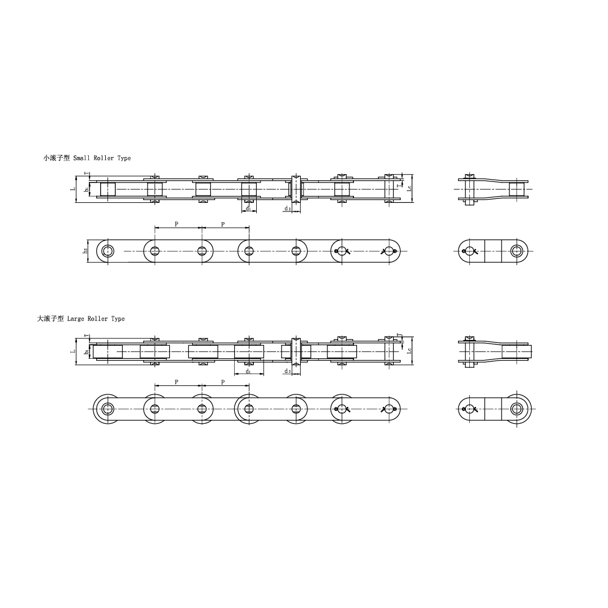 Double pitch conveyor chains Suppliers, FactoryHangzhou Qianjiang Chain Industries Co., Ltd is China wholesale Double pitch conveyor chains Suppliers and top Factory,Product Introducti...View Product →
Attachments Convert Chain Into a Conveyor
Most conveyor chains carry product through attachments rather than through the bare chain rollers. K-type bent attachments on one or both sides are the most common, but extended pins and central-hole plates are widely used to mount rollers, dogs, flights, and pushers. When the layout needs a wide product path or a custom flight spacing, double-pitch conveyor chains with attachments give the design freedom to match the product footprint without moving to an expensive custom-link solution. Two checks matter here. First, verify bending stress at the attachment-to-plate connection under the worst product-impact case. Second, check the allowable moment on an extended pin when side load is applied. A flight that looks rigid in CAD can bend a pin enough to crack the link plate after a few months of cyclic loading. Keep the load application point as close to the chain centerline as possible and choose hardened or plated pins when side loads are high.
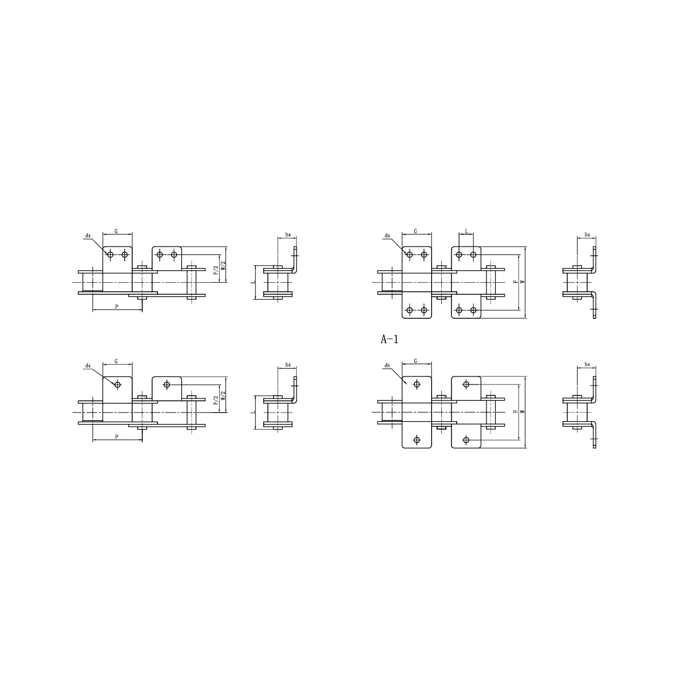 Double pitch conveyor chains attachments Suppliers, FactoryHangzhou Qianjiang Chain Industries Co., Ltd is China wholesale Double pitch conveyor chains attachments Suppliers and top Factory,Produc...View Product →
Environment Decides Material and Sealing
Conveyor chains work in dust, washdown, chemicals, and temperature extremes. The advantages of alloy steel in industrial conveyor applications include higher tensile strength and better wear resistance, but alloy steel still needs protection in wet or corrosive service. For food, pharmaceutical, and outdoor lines, stainless steel double-pitch conveyor chains prevent rust staining and keep joints free in washdown service. In dusty or gritty conditions, the alternative is a sealed chain: O-ring or X-ring seals keep lubricant inside the joint and abrasives out. The practical result is a five to ten times longer joint life compared with unsealed chain in the same environment.
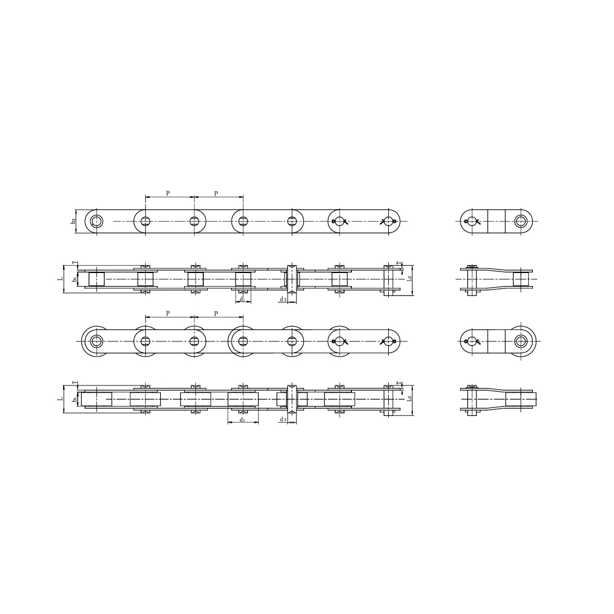 Stainless steel double pitch conveyor chains Suppliers, FactoryHangzhou Qianjiang Chain Industries Co., Ltd is China wholesale Stainless steel double pitch conveyor chains Suppliers and top Factory,Pr...View Product →
Design Mistakes That Show Up in the Field
Most conveyor failures follow predictable patterns. The list below shows the ones that appear repeatedly in root-cause analyses and emergency replacement orders.
- Sizing the chain for steady-state pull only, not for peak startup and impact loads.
- Using sprockets with too few teeth, which creates speed pulsation and accelerates pin and bushing wear.
- Omitting enough take-up stroke to absorb normal chain elongation between maintenance intervals.
- Allowing sprocket misalignment, which concentrates load on one side of the link plates.
- Welding attachments in a way that creates stress risers at the link plate edge.
- Assuming that a conveyor chain does not need lubrication because it moves slowly.
Each mistake leaves a recognizable signature. Too few sprocket teeth produce visible chatter in the loaded strand. A short take-up stroke lets the chain run slack as it elongates, so the return strand whips and slaps the frame. Misaligned sprockets polish one side of the pins and create asymmetric link-plate wear. These are the common causes of conveyor chain failure that can be traced back to a design decision weeks before the actual breakdown.
Working With a Chain Manufacturer
Every chain conveyor design eventually reaches the limit of the catalog. Non-standard attachment spacing, unusual pitches, special steels, heavy-duty plates, and corrosion-resistant finishes fall outside published tables. That is when a manufacturer that makes both chain and sprockets adds real value, because it can validate the chain-sprocket pair as a system rather than as two independently sourced parts. The same logic applies when a conveyor must match an existing line: chain and sprocket from one source eliminate tooth-profile and width mismatch that accelerate wear.
When you approach a chain maker, share the same inputs used in your calculation. Product characteristics, throughput, conveyor length, incline, speed, drive arrangement, starts per hour, and washdown or dust conditions. A good engineering supplier checks the chain pull, recommends the pitch class and attachment form, and tells you whether hardened pins, stainless steel, or seals are justified by the data. That verification step is inexpensive compared with the cost of a conveyor that stops production at full load.
Chain conveyor design rewards a system-level view. Calculate chain pull honestly with peak loads included, choose the pitch class and attachments for the product and the environment, and give the take-up and lubrication the attention they need for real conditions. The hours spent on these decisions are trivial next to the cost of a field failure, and they are the difference between a conveyor that runs for years and one that never leaves the maintenance log.
News
-
I. Introduction Conveyor systems form the backbone of modern industrial automation, enabling the eff...
READ MORE -
1. Introduction 1.1 Definition and Basic Concept of Coupling Chains Coupling chains are mechanical d...
READ MORE -
1. Introduction to Leaf Chains Leaf chains are a type of mechanical chain used in a variety of indus...
READ MORE

 +86-13805752016
 +86-571-82875104/82875108
 [email protected]
 No. 80 QianNong West Road, Xiaoshan District, Hangzhou City, Zhejiang Province,China
Copyright © Hangzhou Qianjiang Chain Industries Co., Ltd. All Rights Reserved.
|
 浙公网安备33010902004043号