
 Eng
 中文简体
Home / News / Industry News / How Do You Select and Maintain the Right Bucket Elevator Chain and Sprocket System?
Submit feedback
How Do You Select and Maintain the Right Bucket Elevator Chain and Sprocket System?
Update:23-11-2026
Posted by Admin
Content
- 1 What Is a Bucket Elevator Chain?
- 2 How the Chain Travels Through the Elevator
- 3 Common Bucket Elevator Chain Types
- 4 Design Details That Decide Service Life
- 5 Matching the Chain to Your Industry
- 6 Sprockets, Alignment and the Rest of the System
- 7 Installation, Tensioning and Maintenance
- 8 Choosing a Bucket Elevator Chain Supplier
A bucket elevator is often the simplest way to lift bulk material straight up, and the chain is the part that makes it work. Two strands carry a series of buckets in a continuous loop around a head and a boot sprocket, scooping at the bottom and discharging at the top. Buckets, casings and take-ups can all be replaced on a planned shutdown. When the chain fails, the whole line stops without warning.
We have been building chains at Hangzhou Qianjiang Chain Industries since 1987, and vertical elevator duty is one of the toughest applications we supply. This guide explains how bucket elevator chains work, which types fit which duties, and what to check before you place an order.
What Is a Bucket Elevator Chain?
A bucket elevator chain is a heavy-duty conveyor chain that runs vertically, or at a steep incline, in a closed loop while carrying buckets filled with bulk material. In most designs two parallel strands are used, joined by the buckets themselves, so the chain does more than transmit motion. It supports the full weight of the buckets and their payload over the entire height of the machine.
That combination creates a very specific set of demands. The chain moves slowly, typically between 0.3 and 1.5 metres per second, but the load on each link is high and constant. Abrasive dust works its way into every joint. In cement, clinker and fertiliser plants the fines can be chemically aggressive as well. Outdoors, the chain has to tolerate moisture and wide temperature swings. Elevator chains are therefore built with thicker link plates, hardened pins and bushings, and a larger wear allowance than a standard drive chain of the same pitch.
How the Chain Travels Through the Elevator
The layout of an elevator is simple, but every element affects chain life:
- The boot sprocket at the bottom guides the chain and is normally fitted with a take-up that removes slack as the chain elongates.
- The head sprocket at the top drives the chain and discharges material by centrifugal or positive action, depending on speed and bucket shape.
- Buckets are bolted to attachments at a fixed spacing, which is usually a multiple of the chain pitch.
- The casing protects the moving parts and controls the airflow that carries dust away from the discharge.
Because the chain travels in two directions inside one casing, alignment, tension and lubrication must be right on both strands. A chain that is too tight overloads the head shaft bearings; one that is too loose climbs the sprocket teeth and wears them rapidly.
Common Bucket Elevator Chain Types
There is no single chain for every elevator. The right choice depends on the material, the bucket spacing, the centre distance and, above all, the abrasiveness of the product. The table below summarises the types we see most often in the field.
| Chain type | Typical pitch range | Typical duty | Design highlights |
|---|---|---|---|
| Double pitch conveyor chain with attachments | 25.4 to 101.6 mm | Grain, feed, light aggregates | Standard rollers, bent or straight attachments for bucket mounting |
| Heavy-duty series roller chain, cottered | 19.05 to 76.2 mm | Cement, clinker, fertiliser | Hardened pins and bushings, thicker plates, cottered pin retention |
| Welded steel cranked link mill chain | 78 to 152 mm | Mining, lump material, severe abrasion | Cranked link geometry, large wear zone, keeps running after joint wear |
| Stainless steel conveyor chain with attachments | 25.4 to 76.2 mm | Food, chemical, wet or salty environments | Corrosion resistance, open geometry for cleaning and washdown |
| Short pitch precision roller chain with attachments | 12.7 to 31.75 mm | Small elevators, light powders | Accurate pitch, high fatigue strength, compact footprint |
Double pitch conveyor chains with standard attachments cover a large share of grain, feed and light aggregate elevators. Matching the attachment type to the bucket back plate is the detail that causes most installation problems, so it is worth confirming before the first bucket is bolted on.
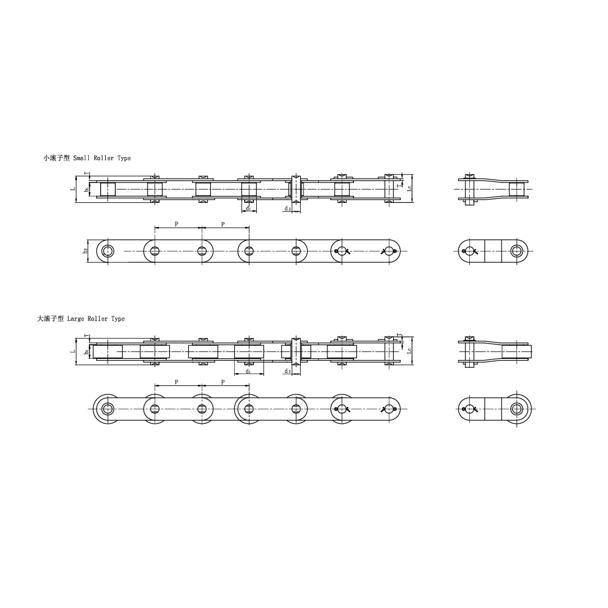 Double pitch conveyor chainsProduct Introduction:View Product →
Design Details That Decide Service Life
Pins, bushings and articulation
Every joint is a wear pair. Hardened pins and case-hardened bushings keep the wear rate low and predictable, while soft pins let the chain elongate quickly, and elongation is what destroys sprockets. In dusty service, sealed joints are rarely practical on elevator chains, so surface hardness and controlled clearance do the work instead.
Pitch and elongation
Measure the chain over a defined number of links and compare the result with the original pitch. Most elevators tolerate roughly 1.5 to 2 percent elongation before replacement becomes necessary, because beyond that the chain rides high on the tooth profile and the buckets begin to foul the casing.
Tensile strength versus working load
Chain tensile strength is a breaking figure, not a working figure. A safety factor of at least 7:1 against the calculated chain pull is a practical starting point for elevator duty, and higher where the boot section takes shock loading from large lumps.
Matching the Chain to Your Industry
Conditions vary enormously between plants, and a chain that performs well in one will fail early in another. A few practical pairings:
- Cement and clinker: welded steel cranked link mill chains or heavy-duty roller chains with hardened pins, chosen for abrasion resistance rather than speed.
- Grain, feed and oilseed: double pitch conveyor chains with attachments, often plated or lubricated for outdoor storage.
- Fertiliser and chemicals: corrosion resistant grades, including stainless steel, because moisture plus salts attack plain carbon steel joints quickly.
- Mining and quarrying: high strength plate and bushed chains that tolerate shock loading at the boot.
- Food processing: stainless steel elevator chains with open, easily cleaned geometry.
Where the product is aggressive, corrosion resistance deserves as much attention as wear resistance. Our work on special stainless steel chain applications grew out of exactly that problem, and the same reasoning applies to elevator chains in wet or salty plants.
Material selection has a cost side too. Alloy steel conveyor chains cost more per metre than plain carbon steel, but in abrasive duty they often last long enough to reduce the total cost per tonne conveyed, which is the figure that matters in a bulk handling plant.
For the severest abrasion, a welded steel cranked link design is frequently the most economical answer, because it keeps working even after substantial joint wear has taken place.
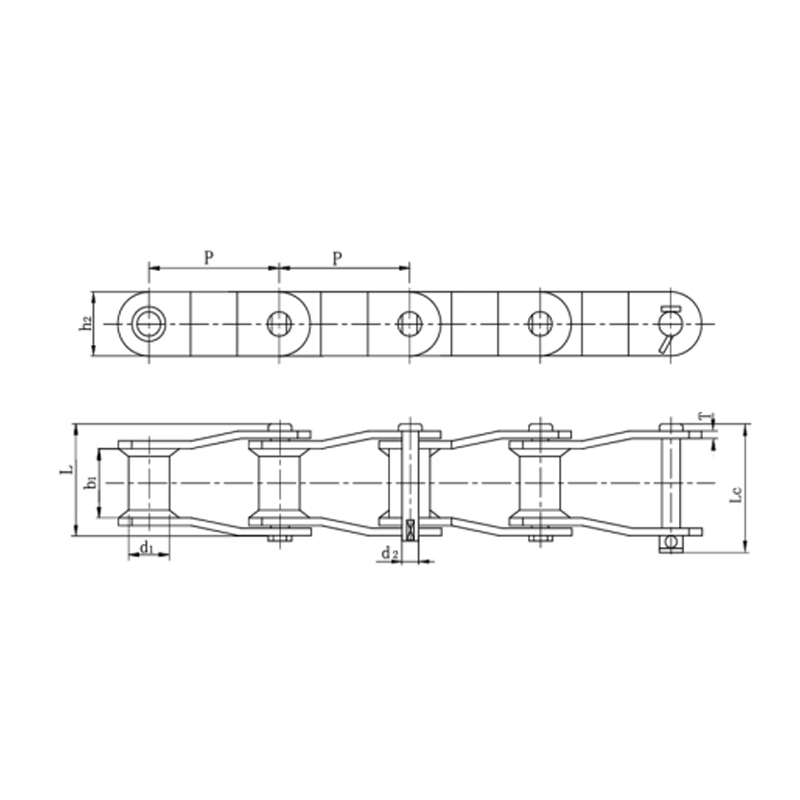 Welded steel type cranked link mill chainsProduct Introduction:View Product →
Sprockets, Alignment and the Rest of the System
Chain life is decided as much by the sprockets as by the chain itself. Head and boot sprockets should be matched to the chain pitch and to the number of teeth the chain was selected for, because changing the tooth count changes both chain speed and load per link. Hardened teeth and a correct tooth profile reduce the chordal action that produces shock at every engagement.
Alignment matters just as much. Head and boot shafts should be parallel, both strands should sit at equal tension, and the take-up should be adjusted in small increments rather than in one heavy pull. Where a system is being rebuilt, replacing sprockets together with the chain prevents a new chain from being worn into the profile of an old, hooked tooth.
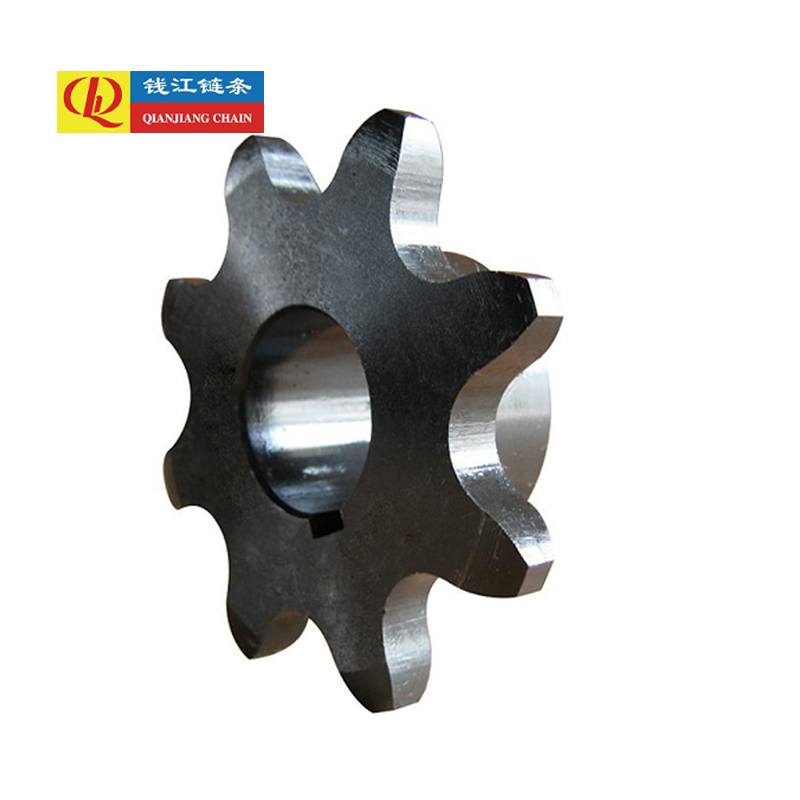 Double pitch sprocketsProduct Introduction:View Product →
Installation, Tensioning and Maintenance
- Measure the new chain over a set number of links before installation and record the reading as a baseline.
- Assemble the strands with the correct link count so bucket spacing stays an exact multiple of the pitch.
- Set initial tension so the chain hangs with a small, controlled sag at the boot, never drum tight.
- Lubricate at the interval the duty requires; in dusty service use a light penetrating lubricant rather than a heavy film that traps grit.
- Inspect monthly for elongation, cracked plates, seized rollers and worn sprocket teeth, and re-tension gradually.
Two habits prevent most failures. Record elongation at every inspection so you can read the trend rather than a single number, and keep a spare strand of the correct length and attachment type in store.
Choosing a Bucket Elevator Chain Supplier
Elevator chains are usually bought in small quantities against a specific machine, so a supplier's ability to match an existing chain matters more than the size of the catalogue. We manufacture A and B series precision roller chains, conveyor chains, sealed chains, stainless steel chains, plate chains and matching sprockets, and we build special or non-standard chains to drawing when a standard product does not fit.
Our production is controlled through an ERP system, supported by digital measuring equipment and automated visual inspection, so components are checked individually rather than by sampling. Where a plant is dealing with an unusual duty, we are glad to review the material, the bucket spacing and the boot arrangement before recommending a chain.
Bucket elevator chains are a small part of a bulk handling system and a large part of its reliability. Get the chain type right for the material, keep sprockets and alignment in good condition, and tension both strands with care, and the elevator will run for years between rebuilds. Get any one of those wrong, and chains will be replaced far more often than expected.
If you would like help matching a chain to an existing elevator, send us the pitch, the link count, the attachment type and a description of the material being handled. That is usually enough for a confident recommendation.
News
-
I. Introduction Conveyor systems form the backbone of modern industrial automation, enabling the eff...
READ MORE -
1. Introduction 1.1 Definition and Basic Concept of Coupling Chains Coupling chains are mechanical d...
READ MORE -
1. Introduction to Leaf Chains Leaf chains are a type of mechanical chain used in a variety of indus...
READ MORE

 +86-13805752016
 +86-571-82875104/82875108
 [email protected]
 No. 80 QianNong West Road, Xiaoshan District, Hangzhou City, Zhejiang Province,China
Copyright © Hangzhou Qianjiang Chain Industries Co., Ltd. All Rights Reserved.
|
 浙公网安备33010902004043号