
 Eng
Eng  中文简体
中文简体Home / News / Industry News / Conveyor Chain Selection Guide: Types, Pitch, Attachments, and Maintenance
Submit feedback
Conveyor Chain Selection Guide: Types, Pitch, Attachments, and Maintenance
Update:28-08-2026
Posted by Admin
Content
- 1 How a conveyor chain is built
- 2 Main conveyor chain types for different jobs
- 3 Pitch, sprockets, and the polygon effect
- 4 Attachments turn a chain into a conveyor
- 5 Materials: match the chain to the environment
- 6 Lubrication and maintenance: where conveyor chains wear out
- 7 Conveyor chains in automated warehousing
- 8 Specify as a system, then verify
A filling line starts dropping cartons at irregular intervals. The maintenance log shows that the same conveyor chain was replaced twice in one season, and the sprocket teeth on the drive shaft are worn on one flank only. This is a familiar pattern in plants that handle unit loads: the chain does not fail suddenly, it fails quietly, through elongation, attachment misalignment, and uneven sprocket engagement. The cause, in most cases, is a conveyor chain chosen for price or availability rather than for the conveyor's actual load, speed, and cleaning routine.
A conveyor chain, in short, is a series of journal bearings joined by side plates, engineered to move products, pallets, or workpieces along a fixed path. It differs from a power-transmission roller chain in one important way: it is designed to carry or pull a controlled load at a controlled speed, not to transmit high torque between shafts. Because that difference affects pin size, roller diameter, plate shape, and attachment spacing, the selection decision should start with the application, not the catalogue.
How a conveyor chain is built
Every conveyor chain repeats the same basic unit. A pin passes through a bushing, and a roller is pressed over the bushing. Inner plates hold the bushing; outer plates hold the pin. The assembly forms an articulated joint that can flex around a sprocket while supporting a load on the rollers. Pitch, the distance between corresponding points on adjacent joints, determines the chain's step and the sprocket geometry it matches.
The components carry different duties. The pin takes shear and wear from articulation; the bushing is the bearing surface; the roller transfers load to the rail and the sprocket; the plates resist tension and fatigue. This is why the quality of a conveyor chain is not visible in one component but in the consistency of hardness, clearance, and surface finish across thousands of joints.
Main conveyor chain types for different jobs
The largest practical difference between chains is pitch length and roller design. Double-pitch chains use twice the standard roller-chain pitch, which halves the number of joints and the cost per metre while remaining strong enough for most package handling and light industrial conveyors. Short-pitch conveyor chains keep the joint spacing close, which suits heavier loads and applications where attachments must sit at narrow intervals. For rough service, welded steel cranked-link mill chains handle abrasive and impact-laden environments better than precision chains. Sharp-top chains add gripping action for precise positioning, and double-plus chains are common on accumulation conveyors.
For most intralogistics lines, double-pitch conveyor chains offer the best balance of cost and durability, while the broader conveyor chain product range also covers short-pitch, sharp-top, and welded-steel types for more demanding layouts.
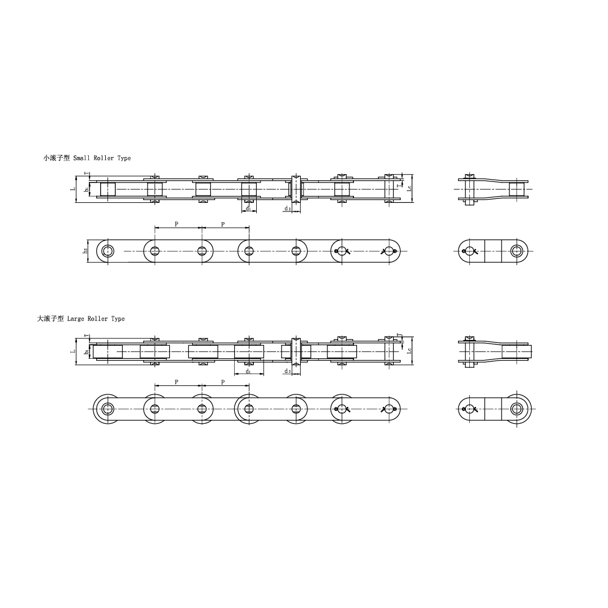 Double pitch conveyor chains Suppliers, FactoryHangzhou Qianjiang Chain Industries Co., Ltd is China wholesale Double pitch conveyor chains Suppliers and top Factory,Product Introducti...View Product →
| Chain type | Pitch characteristic | Best suited for |
|---|---|---|
| Double-pitch conveyor chain | Twice the standard roller-chain pitch | Package handling, unit-load conveyors, light to medium loads |
| Short-pitch conveyor chain | Standard roller-chain pitch | Heavier loads and close attachment spacing |
| Welded steel cranked-link mill chain | Coarse link-and-pin construction | Abrasive, high-impact service such as wood, scrap, and mill duty |
| Sharp-top conveyor chain | Short or medium pitch with pointed top plates | Precision positioning and anti-slip conveying |
| Double-plus chain | Wide-pitch double-roller design | Accumulation conveyors where the product rests directly on the chain |
Pitch, sprockets, and the polygon effect
Pitch is the most consequential dimension because it decides how smoothly the chain seats onto the sprocket. A long pitch means fewer joints and lower cost, but it increases chordal action, the rise and fall of the chain as each roller enters a tooth pocket. At slow speed this is harmless; as speed increases, chordal action becomes vibration and noise. High-speed conveyors should therefore use a shorter pitch and a higher tooth count.
The sprocket must match the pitch and roller diameter of the chain. When it does not, wear concentrates on the leading flank of the teeth. Choose tooth profile, number of teeth, and bore type together: finished-bore and taper-bushed sprockets differ in how they mount and how firmly they grip the shaft. For double-pitch systems, matching double-pitch sprockets keep engagement quiet and wear even.
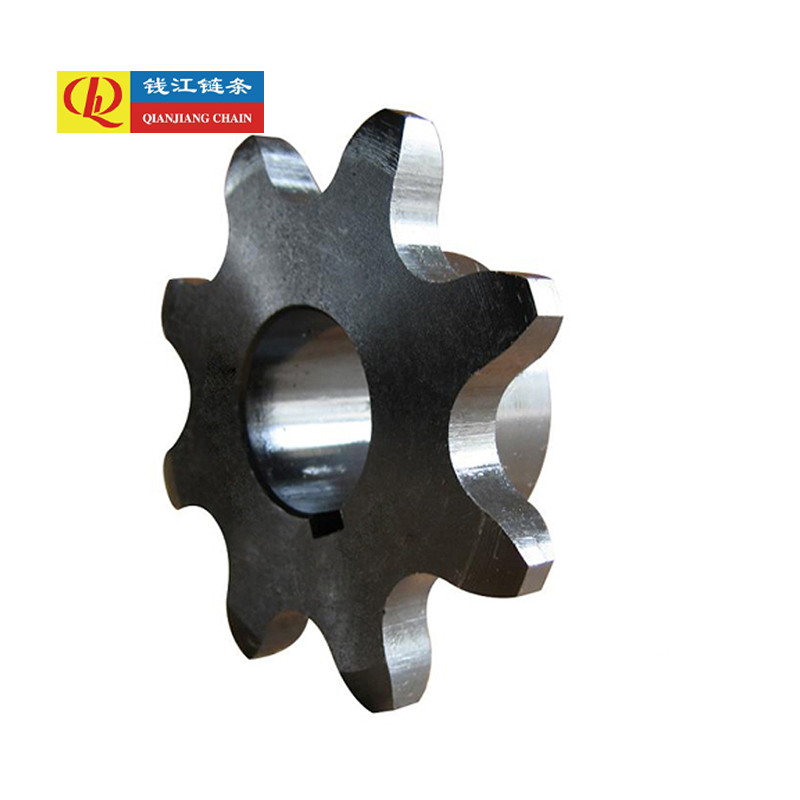 Double pitch sprockets Suppliers, FactoryHangzhou Qianjiang Chain Industries Co., Ltd is China wholesale Double pitch sprockets Suppliers and top Factory,Product Introduction: Do...View Product →
Attachments turn a chain into a conveyor
A bare chain can only pull. Attachments allow it to carry, push, stop, or index. The most common options are extended pins, which support carriers or rollers, and attachment-link chains with holes or plates that accept bolts for flights and product carriers. Attachment spacing and orientation must align with the conveyor layout; an attachment mounted at the wrong interval produces vibration even when the chain itself is accurate.
For lines that push or carry products, double-pitch conveyor chains with attachments keep weight low while providing the fixing points the conveyor designer needs. Custom attachment designs are available, and a manufacturer that controls machining and heat treatment in-house can build them to the customer's drawing.
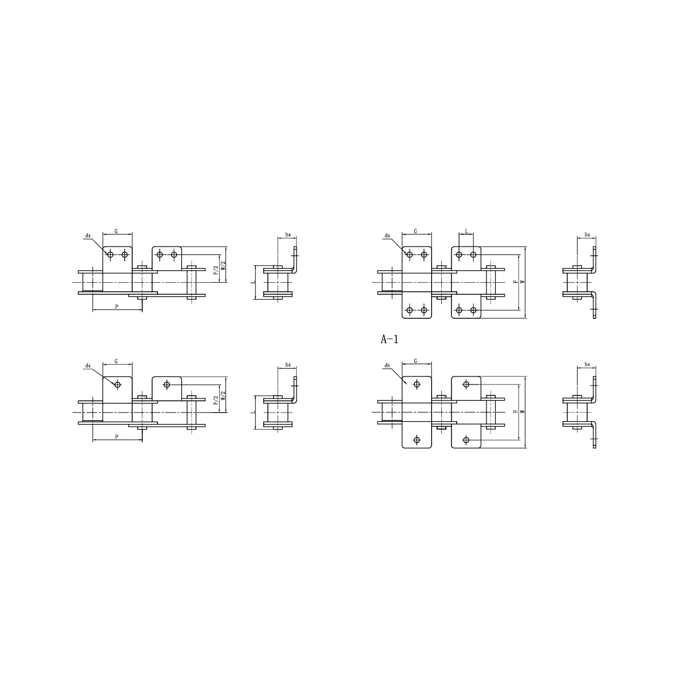 Double pitch conveyor chains attachments Suppliers, FactoryHangzhou Qianjiang Chain Industries Co., Ltd is China wholesale Double pitch conveyor chains attachments Suppliers and top Factory,Produc...View Product →
Materials: match the chain to the environment
The clean, dry conveyor in a packaging hall is a different problem from a washdown line in food production or a dusty transfer in an aggregate plant. Carbon steel is the economic choice when the environment is controlled. When wear resistance matters, alloy steel adds hardness where the pin and bushing work hardest. Stainless steel suits wet, corrosive, or food-contact areas; it trades some strength and wear resistance for corrosion resistance, which is a fair trade only when the application demands it.
The distinction matters enough to look at separately: the advantages of alloy steel in industrial conveyor service explain why hardness and corrosion resistance are not the same thing, and how the trade-off appears in the life-cycle cost of a conveyor.
Lubrication and maintenance: where conveyor chains wear out
Conveyor chains rarely break. They wear out at the pin-and-bushing joint, then stretch, and only then cause attachment misalignment. Because every joint is a plain bearing, oil must reach the interface between pin and bushing.
Lubrication methods
Lubrication scales with speed and duty: manual application for slow, light conveyors; drip and bath lubrication for moderate speeds; forced lubrication for the fastest lines. Frequency matters more than the product used; a thin penetrating oil applied regularly protects better than a thick grease applied occasionally.
Wear monitoring
Measure elongation across a fixed number of links at identical points on the conveyor. Replace the chain when it stretches beyond roughly 2 to 3 percent of its original length, and replace the sprockets if the teeth show hooking or a wear step. Running a new chain on worn sprockets transfers the old wear pattern to the new parts.
Conveyor chains in automated warehousing
Automated warehouses are a good test case. Stacker cranes use horizontal and vertical drives that see repeated start-stop cycles, high acceleration, and occasional overload. Conveyor chains with attachments handle the horizontal transfers, while plate chains carry vertical lifting; the two are selected and maintained differently.
The application notes on QJ stacker chain and plate chain applications show how these components were refined for the same conditions that wear out generic conveyor chains ahead of schedule: high start-stop frequency, shock loads, and tight dimensional constraints.
Specify as a system, then verify
Conveyor chains follow recognized dimensional standards such as ISO 1977, with ANSI-style designations in common use in many markets. Standard pitch and attachment dimensions keep spare parts interchangeable and sprockets affordable. What standards do not define is the quality inside the joint: pin hardness, bushing press-fit, and the pre-stress of the assembly. That is why a manufacturer that controls material, heat treatment, and final inspection removes the risk of buying a chain that matches the drawing but fails in service.
- Chain family and roller type
- Pitch and number of sprocket teeth
- Attachment type, spacing, and orientation
- Material or surface treatment for the environment
- Lubrication method and maintenance access
A conveyor chain is the least visible part of a conveyor, yet it defines the reliability of the whole line. Choose the chain family by load and attachment interval, the pitch by speed and sprocket size, the material by environment, and the sprockets as part of the same system. Make these four decisions together, and the chain becomes a predictable, low-maintenance component. Make them separately, and it becomes a recurring line item in the maintenance budget.
News
-
I. Introduction Conveyor systems form the backbone of modern industrial automation, enabling the eff...
READ MORE -
1. Introduction 1.1 Definition and Basic Concept of Coupling Chains Coupling chains are mechanical d...
READ MORE -
1. Introduction to Leaf Chains Leaf chains are a type of mechanical chain used in a variety of indus...
READ MORE

 +86-13805752016
 +86-571-82875104/82875108
 [email protected]
 No. 80 QianNong West Road, Xiaoshan District, Hangzhou City, Zhejiang Province,China
Copyright © Hangzhou Qianjiang Chain Industries Co., Ltd. All Rights Reserved.
|
 浙公网安备33010902004043号