
 Eng
Eng  中文简体
中文简体Home / News / Industry News / Choosing the Right Conveyor Chain Monitoring System: A Practical Buyer's Guide
Submit feedback
Choosing the Right Conveyor Chain Monitoring System: A Practical Buyer's Guide
Update:04-09-2026
Posted by Admin
Content
A conveyor line that moves heavy cases through an automatic palletizer can lose several hours of production when the chain begins to skip on the drive sprocket. The typical cause is chain elongation reaching the 1.5% wear limit that most roller chain standards use as a replacement threshold. At a 50.8 mm pitch, that means each link has grown by about 0.76 mm, which across a 10 m return run represents roughly 150 mm of total slack. A conveyor chain monitoring system tracks this stretch continuously and gives the maintenance team time to plan a replacement instead of responding to a sudden breakdown. This article explains the main technologies, the selection criteria, and why the chain specification still sets the baseline for every monitoring program.
Why Conveyor Chains Fail Without Early Warning
Chain elongation is a slow and cumulative process. In a standard roller chain, the pin and bushing wear as the chain articulates under load. That wear opens the joint clearance and lengthens the effective pitch. The chain may still move and sound normal even after considerable growth, but the seating on the sprocket changes. Load concentrates on the leading teeth, which further accelerates wear on the chain and on the sprocket. In dusty or wet environments, lubrication is contaminated by dust, water, and cleaning chemicals. This leads to corrosion on the pin surfaces and dramatically shortens the chain's service life. Shock loads from jams, misalignment, or start-stop cycles add mechanical stress that a properly designed maintenance plan should catch before failure. Manual measurement is laborious and often inconsistent. A monitoring system gives a continuous wear profile, allowing the process to stay ahead of the failure mode.
What a Conveyor Chain Monitoring System Measures
The most common monitoring approach for elongation is the through-beam infrared photoelectric method. A sensor at a fixed reference point measures each chain link as it passes, using a precise optical path. The system averages these readings over the full chain loop. Because it samples every link, a single damaged link will not distort the overall measurement. In practice, these instruments offer a repeatable accuracy of roughly 0.2 to 0.5 mm on pitch length.
Vibration sensors can be added to detect the impacts that come from a chain that is already loose or from a sprocket with worn teeth. Thermal sensors can identify dry-running conditions by spotting temperature increases on the chain return run. Machine vision can inspect attachments and connector links for deformation, but it is more sensitive to dust and lighting conditions. The right monitoring setup often combines one main elongation sensor with a secondary technology.
| Technology | Primary reading | Typical accuracy | Best suited for | Practical limitation |
|---|---|---|---|---|
| Infrared photoelectric | Chain pitch, elongation | ±0.3 mm | High-speed conveyors | Requires a clean optical path |
| Vibration analysis | Impact energy from the chain/sprocket | Qualitative | Wear acceleration, misalignment | Background conveyor noise |
| Thermal monitoring | Chain and lubrication temperature | Qualitative | Dry-run and friction detection | Late-stage warning only |
| Machine vision | Attachments, pin condition | Pixel-based | Packaging and sorting lines | Sensitive to dust and lighting |
How to Choose the Right Monitoring System for Your Conveyor
The first step is to define which failure mode actually poses the highest risk. For vertical conveying or heavy horizontal transfer sections where the chain is the critical wearing part, an infrared photoelectric system gives the clearest early signal. For applications with significant attachment wear, for example on certain double-pitch conveyor chains, the monitoring layout may need to be placed so that it also detects missing or damaged attachments. For a simple, low-speed conveyor, a vibration sensor set can still be an effective first line of defense.
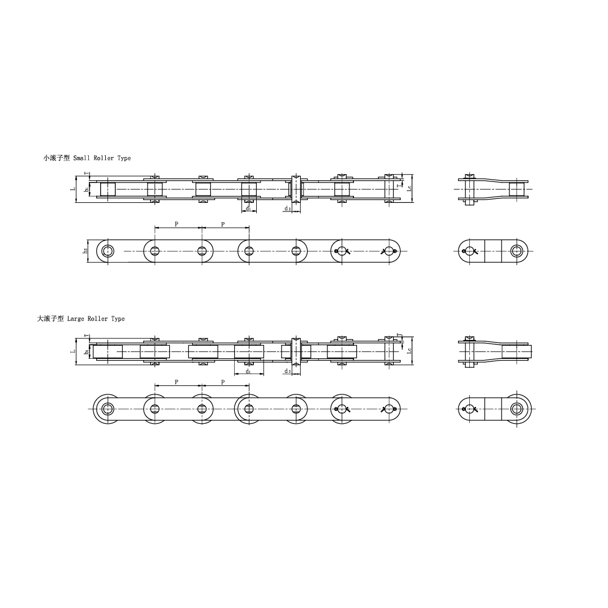 Double Pitch Conveyor Chains for Extended Reach and Lower MaintenanceWith a longer pitch than standard roller chains, these chains reduce joints and sprockets, cutting costs while offering corrosion-resistant options for light to medium-duty conveying.View Product →
Environment is the next factor. Dusty conditions can coat optical lenses and degrade the measurement, so sealed enclosures or a vibration-based approach may be better. High washdown areas demand sensors with a high ingress protection rating. Temperature extremes can affect the calibration of photoelectric instruments. The operating speed and the total length of the chain run also matter. A 100 m conveyor might need multiple measurement stations to give a complete picture, while a short in-line transfer can be covered by one sensor.
Integration with the plant's control systems is also important. The monitoring system should be able to send alarms to a PLC, SCADA, or local maintenance dashboard. Custom alert thresholds let you set the warning point to match your own replacement policies. Over time, the historical trend data can guide procurement and reduce safety stock. The real comparison for selection is not the sensor price alone, but the cost of unplanned downtime versus the total installed cost of monitoring. Even a single avoided hour of production loss can justify a system.
Integrating Monitoring Data into Maintenance Planning
Monitoring data changes the maintenance of conveyor chains from time-based to condition-based. The elongation curve of a chain is not linear. The chain may stay under 0.5% for most of its life and then accelerate quickly. By tracking elongation continuously, maintenance teams can set thresholds that match their own risk tolerance.
- At 0.5% elongation, add the chain to the planned inspection schedule.
- At 1.0% elongation, order a replacement chain and plan for it in a scheduled changeover.
- At 1.5% elongation, replace the chain before the next production shift, because the chain can no longer seat properly on the sprocket.
The thresholds should be checked against the manufacturer's recommendations for the specific chain type and load profile. A chain in a high-impact application may need to be replaced at 1.0%, while a lightly loaded horizontal conveyor may be able to run to 1.5%. The recorded trend from each chain also feeds back into supply chain planning. By knowing which chains are approaching their wear limit, the maintenance department can order spare parts in good time and avoid emergency express deliveries. For complete control of the chain system, understanding the control requirements of chain system management provides a solid basis for a proactive policy.
Chain Quality Still Sets the Baseline
A monitoring system cannot compensate for a chain that is not suitable for the operating conditions. The wear resistance of a chain is determined first by material quality, heat treatment, and manufacturing tolerance. A standard precision chain made from high-grade alloy steel can outlast a generic carbon steel chain under the same load and lubrication conditions. For harsh environments, specially processed chains such as stainless steel chains or sealed chains reduce the impact of corrosion and contamination. The combination of the right chain material and a monitoring system provides a far better maintenance position than either factor alone.
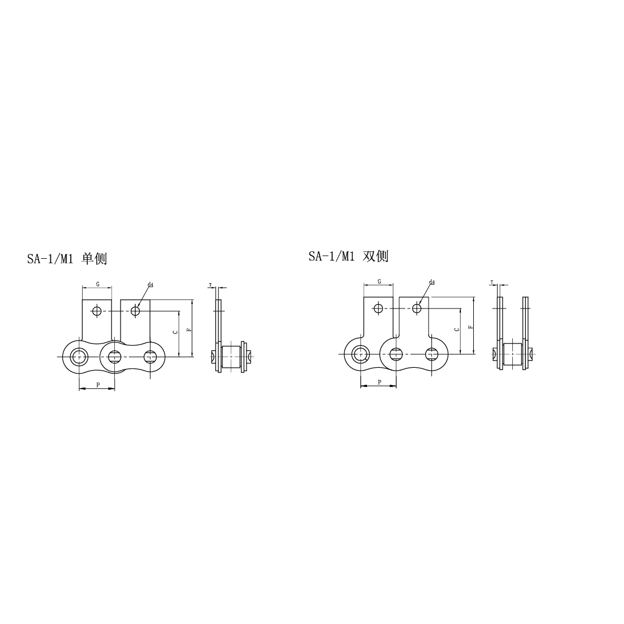 Short Pitch Conveyor Chains with Customizable AttachmentsIdeal for space-limited applications, these compact-pitch chains provide high strength and wear resistance, with versatile attachments customizable for various loads and industries.View Product →
Special attachments also influence the choice of chain. A conveyor carrying heavy cartons with sharp edges may need a chain with a hardened roller and a thicker link plate. A washdown line handling food products may benefit from a chain with vulcanised elastomer profiles, which reduce impact and protect the chain from direct contact with the product. These application-specific designs are essential for a long service life, and they should be part of any monitoring scenario planning.
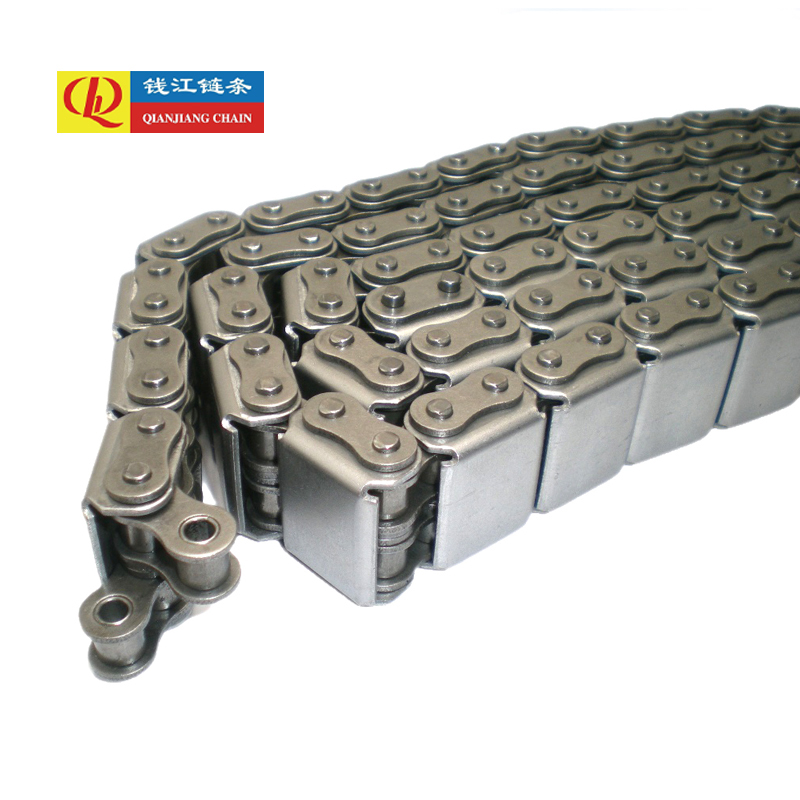 Roller Chains with Vulcanised Elastomer Profiles for Shock AbsorptionThese composite chains combine metal strength with a bonded elastomer layer, offering slip resistance, noise reduction, and hygiene benefits for food and packaging conveyors.View Product →
When selecting a chain for a monitored conveyor, the main considerations are the chain pitch, the attachment type, the material, and the operating environment. High-grade alloy steel chains are a reliable choice where elongation is the main issue, and their performance can be reinforced through a suitable micro-lubrication and inspection routine. If a chain is already matched to the conveyor's load and environment, the monitoring system becomes a powerful tool to predict and control its remaining life. To understand how alloy steel affects chain performance, it is useful to review the advantages of alloy steel in industrial conveyor chains.
At Hangzhou Qianjiang Chain Industries, we have manufactured chains since 1987, with a focus on precision roller chains, conveyor chains, vehicle chains, and special-purpose chains for automation and material handling equipment. For a conveyor monitoring program to deliver its full value, it starts with a chain that fits the actual working conditions. If you are reviewing a conveyor monitoring project, consider the chain specification, the sensor type, and the maintenance policy as one integrated system. That is the most practical way to avoid unplanned downtime and keep your line moving.
News
-
I. Introduction Conveyor systems form the backbone of modern industrial automation, enabling the eff...
READ MORE -
1. Introduction 1.1 Definition and Basic Concept of Coupling Chains Coupling chains are mechanical d...
READ MORE -
1. Introduction to Leaf Chains Leaf chains are a type of mechanical chain used in a variety of indus...
READ MORE

 +86-13805752016
 +86-571-82875104/82875108
 [email protected]
 No. 80 QianNong West Road, Xiaoshan District, Hangzhou City, Zhejiang Province,China
Copyright © Hangzhou Qianjiang Chain Industries Co., Ltd. All Rights Reserved.
|
 浙公网安备33010902004043号