
 Eng
 中文简体
Home / News / Industry News / Asphalt Plant Sprockets: How to Choose, Fit and Maintain Them Properly
Submit feedback
Asphalt Plant Sprockets: How to Choose, Fit and Maintain Them Properly
Update:12-11-2026
Posted by Admin
Content
- 1 Where Asphalt Plant Sprockets Sit in the Process
- 2 Reading Wear Before It Becomes a Breakdown
- 3 Matching the Sprocket to the Chain and the Duty
- 4 Teeth, Hardness and the Bush Question
- 5 Replacement, Reverse Engineering and Custom Work
- 6 Maintenance That Pays for Itself
- 7 Questions We Hear From Plant Engineers
Anyone who has spent a night shift beside a drum mixer knows how an asphalt plant is really judged: by how rarely it stops. Sprockets are a small line item in that equation, yet they sit exactly where torque meets abrasive dust, heat and vibration all day long. When an asphalt plant sprocket is wrong — the wrong pitch, the wrong tooth count, a hardness that does not suit the duty — the symptom usually appears somewhere else. A chain keeps climbing out of the tooth pockets, a drag slat conveyor runs a little louder every week, or a drive motor quietly draws more current than it should.
We build chains and sprockets for equipment that runs continuously, and most of what we know about asphalt plant sprockets came from customers who sent back a worn part with a photo and a simple question. What follows is that experience put in order: where these sprockets sit in the process, how wear announces itself before it becomes a breakdown, and what to measure so a replacement fits the first time.
Where Asphalt Plant Sprockets Sit in the Process
An asphalt mixing plant is a sequence of material handling steps, and most of those steps are driven or carried by chain. The sprockets fall into a handful of recognisable duties.
Drum mixer and pugmill drives
Roller chain drives on the drum, the pugmill shafts or the RAP feeder take the heaviest shock loads in the plant, because they start under load and never get a gentle ramp-up. Here the sprocket needs a true bore, a properly cut keyway and teeth that hold their profile. A sprocket running a fraction out of concentricity will stretch a chain long before its wear life is used up.
Drag slat conveyors
The drag slat conveyor lifting hot mix toward the silo normally uses double pitch conveyor chain with attachments, running on sprockets whose tooth spacing has to agree with the slat spacing. Spilled mix, mud and wash-down water all collect around the lower sprockets, so this is usually where abrasive wear shows up first.
Hot aggregate and bucket elevators
Elevators handling hot aggregate run slowly but carry grit into every tooth pocket. Larger tooth counts and hardened teeth are common, and head shaft runout matters as much as the tooth profile — a tired head bearing will wear a sprocket faster than the chain ever could.
Reading Wear Before It Becomes a Breakdown
Worn sprockets rarely fail without warning. What they do is change the way the drive behaves, and those changes are visible during an ordinary walk-around.
- Hooked teeth. When the tooth face curves over at the tip, the chain is dragged out of the pocket instead of rolling out of it, which loads the pin and bush.
- Polished or dished faces. A bright, hollowed tooth face means the chain is running too high or too low on the tooth, often from a mismatched tooth count or a stretched chain.
- Wear concentrated on one side. Uneven width wear is nearly always misalignment rather than a faulty sprocket.
- Cracks at the tooth root or in the web. Fatigue, usually from shock loading or from a sprocket that has been running loose on its shaft.
- Rocking on the shaft. A worn keyway or tired taper bush lets the sprocket move, the tooth spacing changes under load, and the chain pays for it.
Matching the Sprocket to the Chain and the Duty
Most replacement problems trace back to four numbers: pitch, tooth count, roller width and hub fit. Pitch is measured across a span of pins rather than guessed from a description; on a worn chain, measure an unused section or trust the stamped designation. Tooth count sets the ratio and the chain speed, and an odd tooth count helps spread wear around the ring instead of repeating the same contact pattern.
| Plant location | Usual sprocket style | What matters most |
|---|---|---|
| Drum mixer or pugmill drive | Single or double strand roller chain sprocket, hardened teeth | Bore and keyway fit, concentricity, tooth profile |
| Drag slat conveyor | Double pitch conveyor sprocket | Pitch accuracy and attachment spacing |
| Hot aggregate elevator | Larger tooth counts, hardened teeth | Wear resistance and head shaft runout |
| Dust collector or screw conveyor | Standard roller chain sprocket | Alignment and sealing against grit |
| RAP feeder | Heavy-duty roller chain sprocket | Shock load and tooth root strength |
Once the numbers agree, the question becomes style. Conveyor duty is usually served by
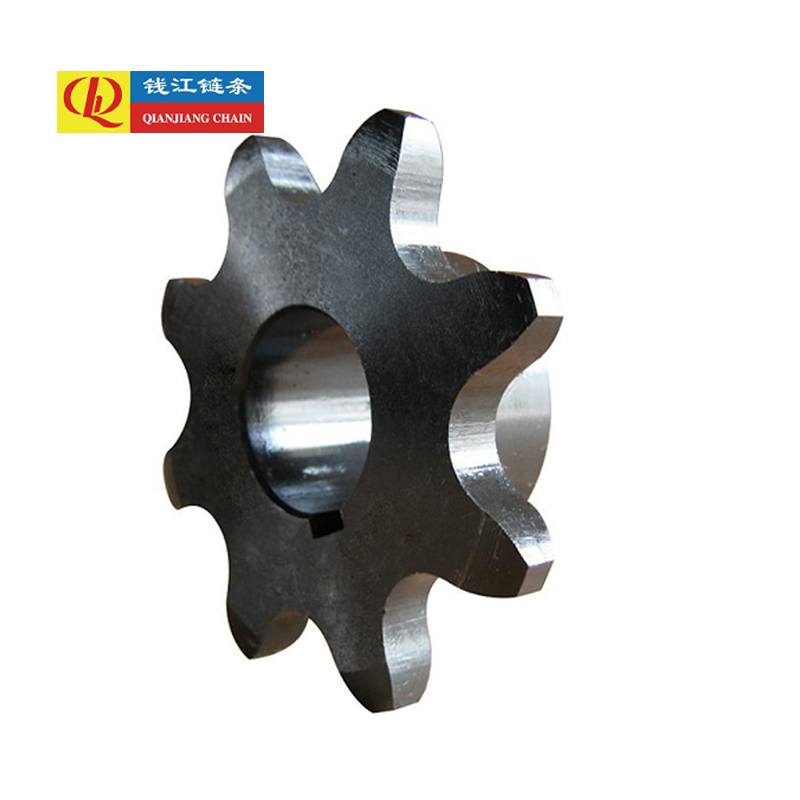 Double Pitch Sprockets for Conveyor DutyExtended-pitch sprockets are built for slower, high-load conveyors, with attachment spacing or finished-bore shaft-and-key mounting.View Product →
matched to the attachment spacing of the chain, while straightforward shaft-and-key mounting suits finished bore designs.
Teeth, Hardness and the Bush Question
Induction hardened teeth in the region of 40 to 50 HRC are a sensible choice where the chain is lubricated and the load is steady. In very abrasive positions, some plant engineers deliberately choose a slightly softer tooth: it wears in a predictable way instead of chipping at the tip, and the wear pattern is easier to read. What matters more than the headline number is consistency — teeth hardened evenly all the way round run quieter and last longer.
Mounting style deserves the same attention. A taper bush clamps firmly, releases easily and tolerates a little shaft wear, which is why it is popular on conveyors that are stripped down during every shutdown. Our
 Taper Bushed Sprockets for Maintenance-Friendly Conveyor DrivesTaper-bush mounting simplifies removal and refitting during conveyor shutdowns, while precision manufacture supports alignment and consistent torque transmission.View Product →
are made for exactly that kind of service, where a puller is the last thing anyone wants to look for at two in the morning.
Finished bore sprockets with a keyway are simpler and cheaper, but they need a good fit, because a loose keyway will destroy a sprocket long before the teeth are worn.
Replacement, Reverse Engineering and Custom Work
Many asphalt plants run equipment that is twenty years old or more, with drawings long gone. In that situation we work from the part itself or from a handful of measurements: pitch, number of teeth, outside diameter, tooth width, hub length, bore and keyway size, plus the position of any attachments. A photo with a caliper held across the tooth tips saves a great deal of email. Small batches are as welcome as long runs, and
 OEM Sprockets for Replacement and Custom ProductionOEM sprockets support exact replacement or custom production, with small batches measured from samples or made to customer drawings.View Product →
cut to a customer drawing are a normal part of our production.
Maintenance That Pays for Itself
Half an hour of inspection during a planned shutdown is cheaper than an unplanned stop with a silo full of hot mix. Our recommended routine looks like this:
- Measure chain elongation over a fixed number of pitches and write the figure down, so next time you have a trend rather than an impression.
- Check the tooth profile against a new sprocket or a profile gauge; hooked tips mean replacement, not adjustment.
- Check runout on the shaft with a dial indicator and confirm the bush or key is snug.
- Align the two sprockets with a straight edge across both faces, then re-tension the chain.
- Clean compacted material out of the tooth pockets — packed grit behaves like grinding paste.
- Record which positions wear fastest; that pattern points to where alignment or lubrication needs attention.
For a wider view of the same subject, our notes on industrial sprocket maintenance cover cleaning, repair and replacement in more detail.
Questions We Hear From Plant Engineers
Should chain and sprockets be replaced together?
A new chain on a hooked sprocket wears out quickly, and a new sprocket under a badly stretched chain does the same. If the chain has passed roughly 1.5 percent elongation, replace both and start the wear record again.
Can we change the tooth count to change conveyor speed?
Yes, but check the chain speed limit and the torque margin of the drive first, because a small change in tooth count changes both speed and tooth load.
Why does a sprocket wear on one side only?
Almost always alignment, a bent shaft or a frame that has shifted. Fix the cause before fitting a new sprocket, or the replacement will follow the same path.
What information do you need for a quotation?
Pitch, tooth count, outside diameter, bore and keyway, hub dimensions and the application. A photo of the worn part usually shortens the conversation considerably.
None of this is complicated, but it is easy to postpone until something stops turning. If you are planning a shutdown and want a second opinion on a worn sprocket, send the measurements and a photo. Hangzhou Qianjiang Chain Industries has been making chains and their mating sprockets since 1987, and we are always glad to look at a part with you.
News
-
I. Introduction Conveyor systems form the backbone of modern industrial automation, enabling the eff...
READ MORE -
1. Introduction 1.1 Definition and Basic Concept of Coupling Chains Coupling chains are mechanical d...
READ MORE -
1. Introduction to Leaf Chains Leaf chains are a type of mechanical chain used in a variety of indus...
READ MORE

 +86-13805752016
 +86-571-82875104/82875108
 [email protected]
 No. 80 QianNong West Road, Xiaoshan District, Hangzhou City, Zhejiang Province,China
Copyright © Hangzhou Qianjiang Chain Industries Co., Ltd. All Rights Reserved.
|
 浙公网安备33010902004043号