
 Eng
 中文简体
Home / News / Industry News / asphalt plant sprocket: Applications, Selection Criteria, and Practical Guidance
Submit feedback
asphalt plant sprocket: Applications, Selection Criteria, and Practical Guidance
Update:19-11-2026
Posted by Admin
Content
Asphalt plants are hard on chain drives. Hot aggregate, limestone dust, wash-down water and long shifts combine into an environment where a component either wears predictably or fails without warning. The sprocket usually sits right in the middle of that story: small enough to be overlooked, inexpensive enough to be bought in a hurry, and important enough to stop a whole plant when its teeth hook or its bushing seizes on the shaft.
We have spent decades around chain and sprocket assemblies for heavy material handling equipment, and the same questions come back from plant managers, maintenance fitters and purchasing teams. What follows is a practical look at what an asphalt plant sprocket actually does, where it wears, and how to choose and replace one without turning a two-hour job into a two-day shutdown.
Where an Asphalt Plant Sprocket Earns Its Keep
In a drum mix plant or a batch plant, chain drives appear at nearly every transfer point. The dryer discharge and hot aggregate elevator move material at temperature. The drag slat conveyor lifts a heavy bed of hot stone toward the mixer. The pugmill drive transmits high torque through a short, stiff chain run. The baghouse screw, filler elevator and reclaimed asphalt feed lines work in a permanent cloud of fines. A single plant can carry a dozen or more sprockets, and each position asks for something slightly different.
| Drive position | Usual chain type | What the sprocket needs |
|---|---|---|
| Hot aggregate elevator | Double pitch conveyor chain | Large diameter, hardened teeth, accurate pitch match |
| Drag slat conveyor | Double pitch or heavy fabricated chain | Split or taper bushed hub for shaft access |
| Pugmill / mixer drive | Heavy-duty roller chain, multi-strand | Triple or double row, high torque capacity |
| Baghouse screw conveyor | Short pitch precision roller chain | Finished bore with keyway and set screws |
| Reclaimed asphalt feed | Double pitch conveyor chain | Abrasion-resistant tooth surfaces |
The pairing matters more than either part on its own. A double pitch conveyor chain running on a sprocket cut for standard roller chain will damage both members within weeks. A brand-new hardened sprocket fitted to a badly stretched chain simply pushes the wear back into the chain, which is usually the more expensive half of the assembly.
Sprocket Styles You Will Meet on Plant Equipment
Most sprockets in an asphalt plant fall into a handful of families. Recognising which family you are looking at makes a conversation with a supplier much shorter, and it helps avoid ordering something that technically fits the chain but not the shaft.
Double pitch sprockets
Double pitch conveyor chains dominate hot aggregate elevators and slat conveyors because the extended pitch keeps the chain lighter for a given strength. The sprocket that drives them is not a standard roller chain sprocket: tooth form, root radius and even the number of available tooth counts differ. Large diameters are normal here, and a slightly thicker tooth section buys useful wear allowance on an elevator head shaft.
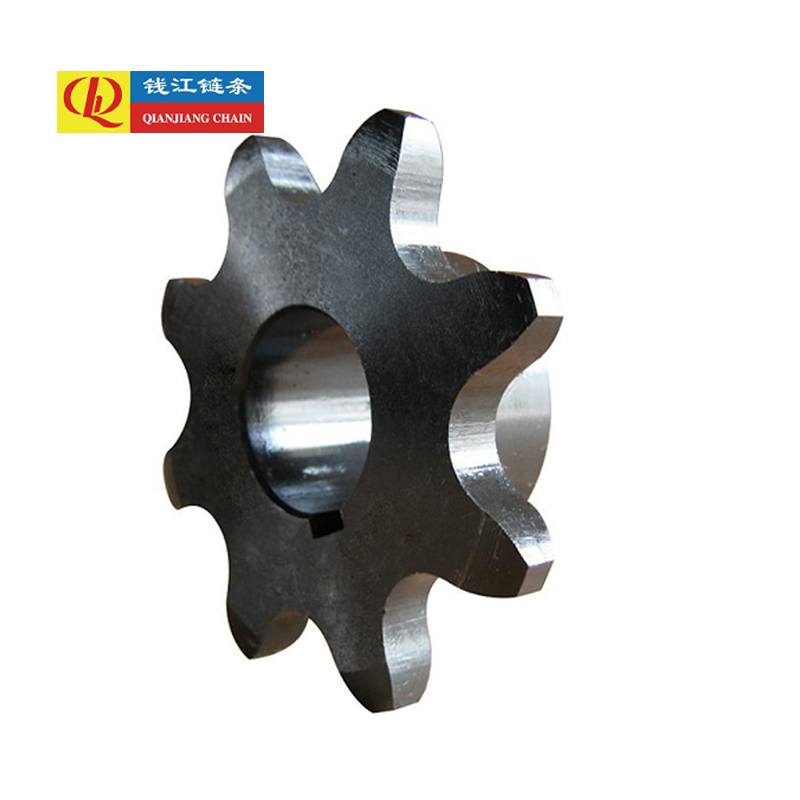 Double Pitch Conveyor Chain SprocketsFor extended-pitch conveyor chains in heavy-duty elevators and slat conveyors, with a larger tooth profile intended for slow-speed, high-load drives.View Product →
Taper bushed sprockets
On a large head or tail shaft, the sprocket is often mounted through a tapered bushing clamped by cap screws. The advantage shows up years later, when heat cycling and fine dust have effectively welded a plain bored hub to its shaft. A taper bushed sprocket releases with a few turns of the mounting screws, which can save an entire maintenance shift on a drag conveyor head.
 Taper Bushed Sprockets for Conveyor DrivesMounted through a taper bush for quick, secure fitting without machining, these sprockets simplify maintenance and release more easily from large head shafts.View Product →
Finished bore and multi-row sprockets
Smaller screws, rotary feeders and fan drives usually take a finished bore sprocket with a machined keyway and set screws, mounted straight onto the shaft with no additional machining. Where a pugmill or heavy mixer has to transmit high torque across a short centre distance, a triple row or double row sprocket spreads the load over several strands and reduces the load per tooth.
OEM and non-catalogue designs
Plant builders regularly specify sprockets that appear in no published catalogue: a split hub for shaft access, a weld-on design, an unusual tooth count to suit a fixed centre distance, or a hub length dictated by an existing bearing arrangement. These are best handled from a drawing or a measured sample rather than from a generic description.
Why Sprockets Wear Faster Here Than the Catalogue Suggests
A catalogue life figure assumes clean conditions and steady load. An asphalt plant offers neither. The main mechanisms we see are consistent:
- Abrasive paste. Aggregate fines mix with grease and act as a grinding compound on the tooth flanks and at the root.
- Heat. Radiant heat from hot aggregate and hot housings thins lubricant, hardens seals and can soften a tooth surface that was never specified for elevated temperature.
- Chain stretch. A worn chain rides higher on the tooth, so fewer teeth carry the load. Tooth hooking accelerates sharply after the chain passes roughly one to two percent elongation.
- Misalignment and tension. Take-up adjustments on slat conveyors are easy to postpone, and a shaft that is out of parallel loads one side of every tooth.
- Corrosion. Wash-down water and damp, slightly acidic dust attack the tooth roots, particularly on sprockets that sit idle overnight.
- Material build-up. Hardened fines compacted into the tooth root effectively change the pitch, causing the chain to climb and jump.
In practice, most sprocket failures are recorded as chain failures. The sprocket was already worn when the chain was replaced, and the new chain then ran on hooked teeth and failed early. Replacing both members together, or at least inspecting the sprocket at every chain change, avoids repeating that cycle.
Matching a Replacement Sprocket to the Chain and the Shaft
The safest approach is to treat the sprocket as one half of a matched pair rather than as a standalone part. Before ordering, work through the following:
- Identify the chain by standard and number, not by eye. Pitch, roller diameter and internal width all need to correspond.
- Count the teeth on the existing sprocket, and confirm whether the ratio matters for the process speed.
- Measure the bore, keyway width and depth, and the hub length on site. Shaft diameters on older plants are frequently not what the manual says.
- Decide on the mounting style. A taper bushing, split hub or finished bore changes both the price and the time needed to fit it.
- Check the tooth hardness requirement. Abrasive positions justify hardened teeth; light screw conveyors often do not.
Tooth counts are worth a second look. Where the ratio allows, choosing a tooth count that shares no common factor with the chain pitch spreads wear more evenly around the sprocket. Measure chain wear across several links rather than one, since a single stretched section will mislead you. A worn chain on a new sprocket is a short-lived combination either way.
A Practical Inspection Routine
What to check, and how often
- Look at the tooth profile on every lubrication round. A hooked or sharpened tooth tip is the clearest early signal.
- Feel for a step at the tooth root where the chain roller seats. A visible ridge means the pitch seat has moved.
- Check chain sag and take-up position; a drive that has run out of adjustment is usually overdue for a chain and sprocket review.
- Listen for a rhythmic knock at low speed, which often indicates a worn tooth or a tight joint rather than a chain problem.
- Record running hours for each drive so replacement planning is based on history rather than on a breakdown.
Our own industrial sprocket maintenance tips cover cleaning, lubrication and alignment in more detail, and the same principles apply almost unchanged to hot, dusty plant equipment.
When to plan a replacement
Tooth wear of roughly one third of the tooth thickness, a hooked profile, or repeated chain jumping all justify scheduling a change. Plan it for a maintenance window rather than waiting for a failure; a sprocket replaced during a planned stop costs a fraction of one replaced mid-production, when the mixer is full and the haul trucks are queued.
Spares, Drawings and Lead Time
The plants that recover fastest from a sprocket failure are the ones that keep a small, well-chosen spares kit and a dimensioned drawing of each drive. A single spare for the hot elevator head shaft and one for the drag conveyor is often enough to cover the two positions that stop production entirely. Tag the spares with the drive position and the date received so nobody has to guess later.
Where the original design is unavailable or no longer suits the duty, a sprocket can be produced to the shaft and chain actually present in the plant. Our experience with heavy-duty material handling chain applications in stacker and conveyor equipment translates directly to asphalt plant drives, where access, heat and grit set the real design limits.
 OEM Sprockets for Direct ReplacementBuilt to original equipment specifications for direct compatibility, with custom options when the existing shaft and chain call for a made-to-fit sprocket.View Product →
It also helps to think in pairs. A sprocket ordered together with its chain, both from the same specification, removes the most common cause of premature wear and makes warranty conversations far simpler.
An asphalt plant sprocket is not a glamorous part, and it does not need to be. It needs to match the chain it drives, fit the shaft it turns on, and hold its tooth form long enough to reach the next planned shutdown. Get those three things right, keep a spare on the shelf, and the drive stops being something you think about at three in the morning.
If you are working through a replacement on a hot elevator, a drag conveyor or a mixer drive, send us the chain number, tooth count and a photo of the shaft. Matching an existing assembly is usually quicker than starting from a catalogue page, and it is the part of the job we know best.
News
-
I. Introduction Conveyor systems form the backbone of modern industrial automation, enabling the eff...
READ MORE -
1. Introduction 1.1 Definition and Basic Concept of Coupling Chains Coupling chains are mechanical d...
READ MORE -
1. Introduction to Leaf Chains Leaf chains are a type of mechanical chain used in a variety of indus...
READ MORE

 +86-13805752016
 +86-571-82875104/82875108
 [email protected]
 No. 80 QianNong West Road, Xiaoshan District, Hangzhou City, Zhejiang Province,China
Copyright © Hangzhou Qianjiang Chain Industries Co., Ltd. All Rights Reserved.
|
 浙公网安备33010902004043号