
 Eng
 中文简体
Home / News / Industry News / Silent Chain Guide: Types, Noise Reduction, Selection and Maintenance Tips
Submit feedback
Silent Chain Guide: Types, Noise Reduction, Selection and Maintenance Tips
Update:27-10-2026
Posted by Admin
Content
- 1 What Exactly Is a Silent Chain?
- 2 Why the Inverted-Tooth Design Runs Quieter
- 3 Silent Chain vs. Roller Chain: A Side-by-Side Comparison
- 4 Where Silent Chains Earn Their Keep
- 5 Matching the Right Silent Chain to Your Drive
- 6 Installation, Tensioning and Maintenance Essentials
- 7 What We Bring to Silent Chain Manufacturing
Stand next to a high-speed production line and you will notice something interesting: the loudest component is rarely the motor. It is usually the chain drive. For a long time that rattle and whine was accepted as the price of dependable power transmission, until engineers turned to a completely different tooth geometry.
A silent chain, also called an inverted-tooth chain, was developed for exactly that reason. Instead of rollers, it uses toothed link plates that mesh with the sprocket a little like a flexible gear, so the drive runs more smoothly, more quietly and, in many cases, faster. At Hangzhou Qianjiang Chain Industries we have been building chain drives since 1987, and silent chains are one of the families we know best, from the drawing board through to the test bench.
This guide covers how silent chains work, how they compare with roller chains, where they perform best, and what to check before you specify one for your machine.
What Exactly Is a Silent Chain?
A silent chain is a series of toothed link plates assembled on pins. The teeth face inward toward the sprocket, and as the chain wraps around the wheel those teeth engage the sprocket teeth in a way that is closer to gear meshing than to a conventional chain drive. Because the load is shared across several teeth at once and contact is continuous, the drive generates far less impact noise and vibration than a roller chain running at the same speed.
Flank Contact and Sprocket-Groove Contact
Two families dominate industrial practice. In flank contact designs, the working load is carried by the flanks of the link teeth against the sprocket tooth flanks, which gives a generous contact area and excellent wear life. In sprocket-groove contact designs, the pins or the noses of the links seat into machined grooves in the sprocket, guiding the chain positively and holding alignment even under reversing or pulsating loads.
Both designs can be supplied with side guide or centre guide plates, so the chain is located either along its outer edges or through the middle of the joint, depending on how much lateral room your housing allows.
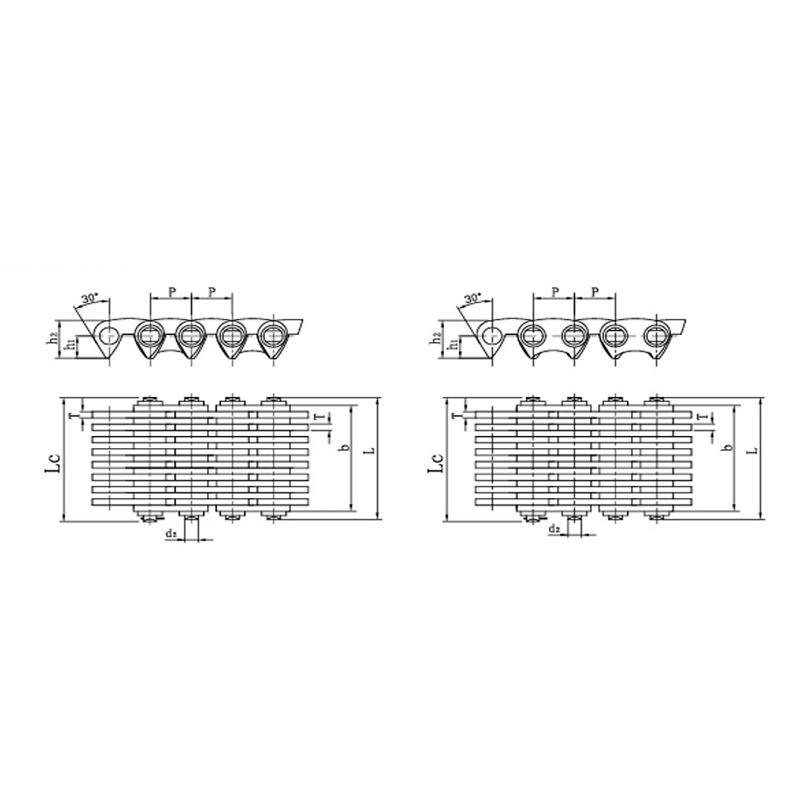 Flank contact silent chainsProduct Introduction:View Product →
Why the Inverted-Tooth Design Runs Quieter
Noise in a chain drive comes mainly from two sources: the impact of each joint as it lands on a sprocket tooth, and the polygonal effect created by the chain wrapping around a finite number of teeth. A silent chain softens both.
- Several teeth share the load at any moment, so the impact energy per tooth is much lower.
- Rolling joints let successive link plates articulate with very little sliding, which cuts friction-generated noise.
- The fine pitch relative to sprocket diameter reduces the chordal rise and fall that produces whine.
- Close tooth spacing spreads engagement across a longer arc of the sprocket.
If you would like a deeper technical walkthrough, our engineers have published a dedicated article on how silent chains reduce noise in industrial drive systems.
Silent Chain vs. Roller Chain: A Side-by-Side Comparison
Roller chains remain the workhorse of industrial transmission, and for plenty of applications they are still the right answer. The real question is when the extra cost of a silent chain pays for itself. The table below summarises the differences our customers ask about most often.
| Selection Factor | Silent Chain | Roller Chain |
|---|---|---|
| Engagement | Tooth flanks mesh directly with sprocket teeth | Rollers seat into sprocket pockets |
| Noise level | Low across the whole speed range | Rises quickly as speed increases |
| Speed capability | High, often chosen for high-speed drives | Moderate, limited by joint impact |
| Load sharing | Several teeth carry the load at once | One or two rollers carry the load |
| Drive width | Narrow for a given power rating | Wider drives for equal torque |
| Lubrication | Needs clean, well-directed oil feed | Tolerates simpler lubrication |
| Typical duties | Engine timing, machine tool and pump drives | Conveyors, agricultural and general drives |
Where Silent Chains Earn Their Keep
Because they combine high speed capability with low noise and a compact envelope, silent chains appear wherever a roller chain would be either too loud or too bulky:
- Automotive and motorcycle engine timing drives, where camshaft accuracy and long service intervals matter.
- Machine tool spindle and feed drives that must run smoothly at several thousand revolutions per minute.
- Industrial reducers, compressors and pump drives where vibration transfer has to stay low.
- Agricultural automation equipment, including harvesting and grading lines that run continuously through the season.
- Heavy machinery with reversing or shock loads, where a guided chain keeps alignment stable.
Matching the Right Silent Chain to Your Drive
Selecting a silent chain is a system decision rather than a catalogue lookup. Four parameters usually settle the question:
- Pitch, driven by the torque to be transmitted and the sprocket diameter you can physically fit.
- Width and strand count, since more plates across the joint raise tensile capacity without changing pitch.
- Contact style, with flank contact for maximum load area and sprocket-groove contact for positive guidance and reversing duty.
- Lubrication method, whether oil stream, bath or manual, each with its own speed ceiling.
Sprocket tooth form, tooth count, alignment and housing clearance influence chain life just as much as the chain itself, which is why we prefer to review the whole drive rather than quote a chain in isolation.
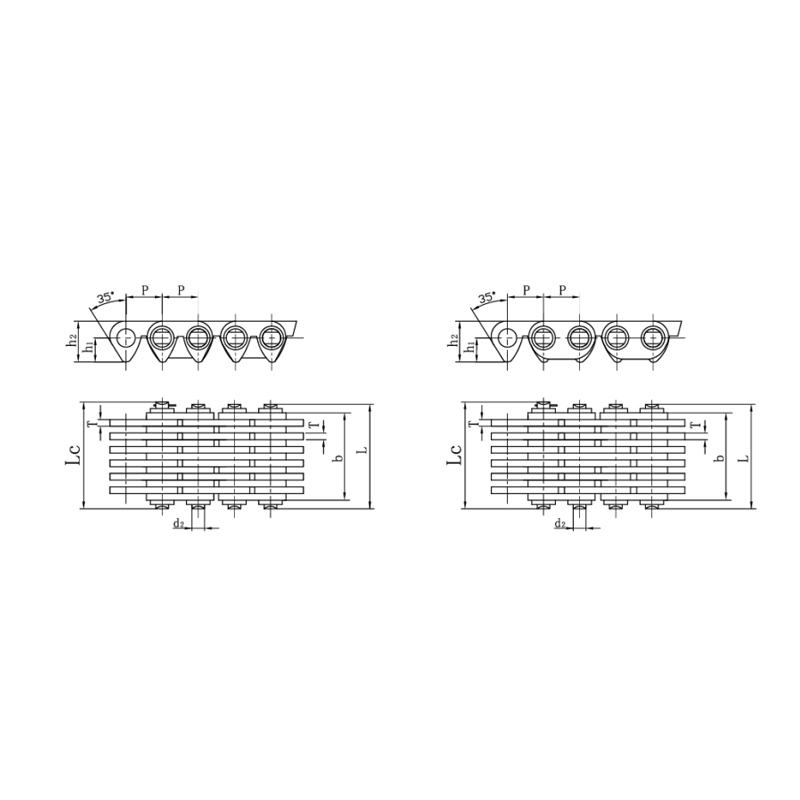 Crotch contact silent chainsProduct Introduction:View Product →
Installation, Tensioning and Maintenance Essentials
The service life of a silent chain is largely decided during installation. These are the steps we recommend to customers:
- Verify sprocket alignment with a straight edge or dial indicator before the chain goes on.
- Check that both sprockets are parallel and that shaft deflection under load stays within tolerance.
- Set initial tension with a small amount of slack on the free span; tighter is not better.
- Confirm the lubrication feed reaches the joints as the chain enters the sprocket, not after it leaves.
- Re-check tension after the first few hours of running and again after the first week.
- Record elongation at fixed intervals and replace once it reaches the drive designer's limit.
A quiet, well-lubricated chain is a chain that is being treated correctly. If noise rises or the drive starts to vibrate, tension, lubrication and sprocket wear are the first three items to inspect.
What We Bring to Silent Chain Manufacturing
Hangzhou Qianjiang Chain Industries has been producing chain drives since 1987, and silent chains sit at the centre of our technical work. Since 1991 we have cooperated with the Chain Transmission Research Institute of Jilin University of Technology to optimise and upgrade our CL series silent chains and our PIV variable-speed chain range, the same programme that later fed into our sealed motorcycle chains and heavy-duty roller chain series.
That work is backed by a complete quality management system, ERP based production planning, digital measuring instruments and automated vision inspection, with 100% inspection of all parts before assembly. Alongside silent chains we manufacture A and B series precision roller chains, sealed motorcycle and engine timing chains, conveyor chains for logistics equipment, stainless steel chains, agricultural chains, leaf chains and matching sprockets, so a customer can order a complete transmission set instead of chasing components from several suppliers.
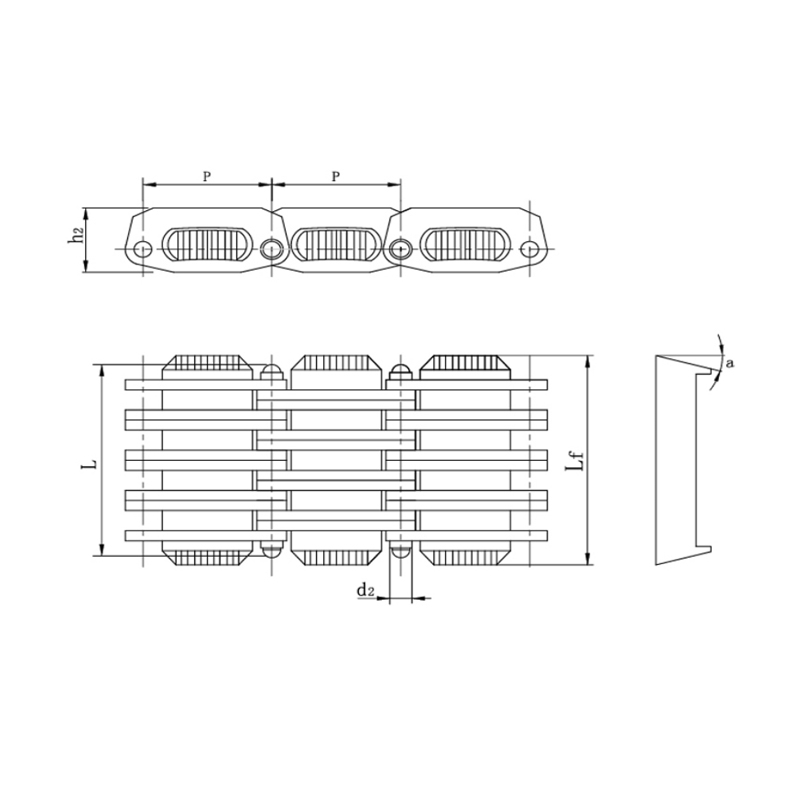 PIV infinitely variable speed chains with slide leafsProduct Introduction:View Product →
If you are working on a drive that has to run faster, quieter or in a tighter envelope than your current chain allows, send us the pitch, sprocket details and duty cycle. Our engineers will come back with a recommendation, and if a standard silent chain does not fit, we can develop a non-standard one. You can start with an overview of what we make at Hangzhou Qianjiang Chain Industries, or simply tell us what the machine has to do and we will take it from there.
News
-
I. Introduction Conveyor systems form the backbone of modern industrial automation, enabling the eff...
READ MORE -
1. Introduction 1.1 Definition and Basic Concept of Coupling Chains Coupling chains are mechanical d...
READ MORE -
1. Introduction to Leaf Chains Leaf chains are a type of mechanical chain used in a variety of indus...
READ MORE

 +86-13805752016
 +86-571-82875104/82875108
 [email protected]
 No. 80 QianNong West Road, Xiaoshan District, Hangzhou City, Zhejiang Province,China
Copyright © Hangzhou Qianjiang Chain Industries Co., Ltd. All Rights Reserved.
|
 浙公网安备33010902004043号