
 Eng
Eng  中文简体
中文简体Submit feedback
How Silent Chains Reduce Noise in Industrial Drive Systems
Update:08-12-2025
Posted by Admin
Content
- 1 Fundamental reasons silent chains produce less noise
- 2 Design features of silent chains that lower vibration and noise
- 3 Sprocket design and its role in noise reduction
- 4 Precision installation and alignment practices
- 5 Lubrication, contamination control and operational factors
- 6 Mounting, damping and structural considerations
- 7 Measurement, diagnostics and maintenance actions to preserve low-noise operation
- 8 Practical retrofit and design choices for quieter systems
- 9 Summary comparison table: measures vs expected noise impact
- 10 Concluding practical recommendations
Reducing noise from power transmission is a common design requirement in modern industrial systems. Silent chains (inverted-tooth or toothed-link chains) are engineered specifically to run with lower radiated noise than roller chains by improving tooth engagement, distributing load, and minimizing impact and vibration. This article explains the practical design features, installation practices, and maintenance actions that reduce noise in industrial drives using silent chains, with clear guidance engineers and maintenance teams can apply.
Fundamental reasons silent chains produce less noise
Silent chains lower noise primarily by controlling the dynamics of tooth engagement and reducing impulsive forces. Key mechanisms include smoother meshing geometry that reduces impact at engagement, continuous contact over multiple teeth that spreads load and lowers local stress spikes, and the elimination of rolling-impact transitions that create impulse noise in roller chains. Combined, these factors convert potential impulsive energy into lower-frequency, lower-amplitude vibrations that are easier to damp.
Reduced impact at tooth engagement
Tooth profiles on silent chains are designed to engage gradually rather than collide. This reduces the instantaneous force peak when a new tooth pair comes into load. Lower peak forces mean less broadband acoustic energy is generated at each engagement event, particularly in the high-frequency bands that contribute to perceived noisiness.
Load distribution across multiple contact points
Silent chains typically contact the sprocket across several links and teeth simultaneously. Distributing load reduces deformation and local acceleration of components; because the energy input is spread over a larger mass and duration, radiated noise from each contact event falls significantly compared with a single-point shock.
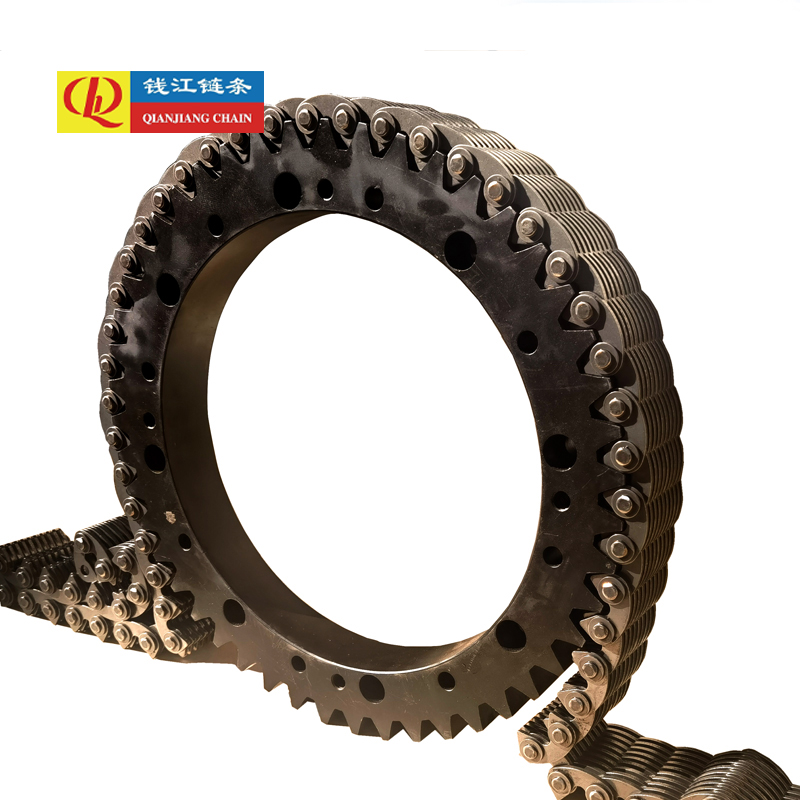
Design features of silent chains that lower vibration and noise
Manufacturers intentionally tune geometry, materials and link construction to minimize vibratory excitation. Understanding the contributions of each design feature helps when selecting or specifying a chain for low-noise applications.
Tooth profile and pitch accuracy
Precise pitch and carefully profiled tooth flanks reduce chordal error and smooth velocity fluctuations as the chain wraps and unwraps the sprocket. Lower chordal variation reduces cyclic radial forces and thus lowers tonal noise at rotational harmonics.
Link stiffness and mass distribution
Optimized link stiffness reduces local bending and vibration, while considered mass distribution shifts resonances to less sensitive frequencies. Heavier links can lower peak acceleration but may increase low-frequency noise; modern designs use geometry and selective reinforcement to get the damping benefits without excessive mass.
Interlink damping and bushless constructions
Some silent chains use bushless or specially designed interlinks and guide elements that reduce micro-slip and frictional stick-slip, a common source of squeal. Integrated damping features or resilient inserts at contact interfaces dissipate vibrational energy before it radiates as noise.
Sprocket design and its role in noise reduction
Sprocket geometry must match chain design; mismatches cause edge loading, accelerated wear and increased noise. Correct sprocket design reduces impact, improves engagement conformity, and extends quiet running life.
Matched tooth form and manufacturing tolerance
Use sprockets precisely manufactured to the chain's tooth profile and pitch. Tight tolerances lower uneven contact and minimize small misalignments that excite vibrations. Avoid worn replacement sprockets with degraded profiles, as they increase meshing noise even if the chain is new.
Surface finish and chamfering
Smooth, burr-free tooth edges reduce transient contact noise during engagement. Slight chamfers on leading edges guide the link into engagement and reduce abrasive impacts, lowering both noise and wear.
Precision installation and alignment practices
Noise performance depends heavily on installation. Even the best chain and sprocket will be noisy if misaligned, poorly tensioned, or mounted on resonant structures. Follow precise installation procedures for quiet operation.
Alignment and co-planarity
Ensure sprocket shafts are parallel and sprocket faces are co-planar. Angular misalignment introduces lateral forces that cause chatter and impact between link and sprocket. Use laser alignment tools where possible and verify alignment at operating temperature if thermal growth is significant.
Proper tensioning to avoid slack and shock loads
Maintain tension within manufacturer-specified ranges. Excess slack allows chain lash and impact when the chain engages under load; over-tensioning increases internal friction and bearing loads, which can transmit more vibration to the structure. Use tensioners or idlers designed for silent-chain systems to maintain stable tension dynamically.
Lubrication, contamination control and operational factors
Adequate lubrication reduces metal-to-metal friction and micro-impacts that generate high-frequency noise. Contaminants and abrasive particles amplify wear and introduce irregularities that increase noise over time.
Selecting the right lubricant and delivery method
Use lubricants specified for silent-chain applications; these often have additives that reduce stick-slip and suppress squeal. Choose an application method (splash, drip, centralized automatic lubrication) that provides consistent film without excess fling, which can attract contaminants.
Contamination control and sealing
Install guards and seals to keep debris out of the meshing area. Abrasive ingress causes surface pitting and uneven contact, both of which increase noise dramatically. Regular cleaning and filter maintenance preserve the low-noise performance.
Mounting, damping and structural considerations
Noise radiates not just from the chain but from the supporting structure. Designing mounts and frames to absorb and damp vibration reduces radiated sound even when internal meshing forces exist.
Isolation mounts and damping materials
Use elastomeric mounts, tuned mass dampers, or constrained-layer damping on gearbox housings and frames to prevent transmission of chain-induced vibration into large radiating panels. Small reductions in structural vibration can yield large perceptual noise gains.
Avoiding structural resonances
Perform modal analysis in critical installations to identify and mitigate resonant modes that coincide with chain excitation frequencies. Stiffening or adding damping at resonance nodes prevents amplification of small meshing forces into loud tonal noise.
Measurement, diagnostics and maintenance actions to preserve low-noise operation
Ongoing measurement and targeted maintenance are essential to sustain quiet operation across a chain's life. Use both subjective listening and objective instruments to detect early signs of noise-increasing wear or misalignment.
What to measure and how to interpret results
Use sound level meters and vibration sensors to track changes over time. Sudden increases in high-frequency content often indicate tooth or surface damage; rising low-frequency tonal components can point to tension issues or structural coupling. Trend data helps plan corrective maintenance before noise becomes problematic.
Routine maintenance checklist
- Check alignment and co-planarity at regular intervals and after any disassembly.
- Inspect sprocket teeth for wear, burrs or pitting; replace worn sprockets to prevent increased meshing noise.
- Maintain recommended lubrication schedules and verify lubricant condition to prevent grit-induced noise.
- Monitor chain elongation and replace chains that exceed manufacturer elongation limits to avoid lash noise.
Practical retrofit and design choices for quieter systems
When upgrading an existing roller-chain drive to a silent-chain or when designing a new quiet drive, consider a systems approach: combine matched sprockets, precision installation, proper lubrication, and structural damping to achieve the best results.
Cost-effective retrofit steps
- Replace worn sprockets and chains simultaneously to restore correct tooth engagement.
- Add or improve tensioning devices to remove slack and reduce lash noise.
- Introduce local damping (pads, constrained-layer treatments) on panels that radiate noise.
Summary comparison table: measures vs expected noise impact
Use this quick reference to prioritize actions based on expected noise reduction effectiveness and typical implementation cost.
| Measure | Noise Impact | Implementation Effort |
| Use matched silent chain & sprockets | High | Medium |
| Precise alignment and correct tension | High | Low |
| Proper lubrication and contamination control | Medium–High | Low–Medium |
| Structural damping and isolation | Medium | Medium |
| Replace worn components promptly | Medium | Low |
Concluding practical recommendations
For quieter industrial drives, treat silent chains as one part of a systems solution. Start with properly specified chain and matched sprockets, install with precision, maintain correct lubrication and tension, and manage structural vibration through damping or isolation. Routine measurement and preventive maintenance preserve low-noise operation over the life of the drive. When noise is a critical requirement, invest in precision components and alignment — these yield the greatest and most reliable reductions in radiated noise.
News
-
I. Introduction Conveyor systems form the backbone of modern industrial automation, enabling the eff...
READ MORE -
1. Introduction 1.1 Definition and Basic Concept of Coupling Chains Coupling chains are mechanical d...
READ MORE -
1. Introduction to Leaf Chains Leaf chains are a type of mechanical chain used in a variety of indus...
READ MORE

 +86-13805752016
 +86-571-82875104/82875108
 [email protected]
 No. 80 QianNong West Road, Xiaoshan District, Hangzhou City, Zhejiang Province,China
Copyright © Hangzhou Qianjiang Chain Industries Co., Ltd. All Rights Reserved.
|
 浙公网安备33010902004043号