
 Eng
 中文简体
Home / News / Industry News / Industrial Sprockets: Selection, Installation, and Maintenance Guidance
Submit feedback
Industrial Sprockets: Selection, Installation, and Maintenance Guidance
Update:20-10-2026
Posted by Admin
Content
Industrial sprockets are easy to overlook in a chain drive system, but after years of manufacturing chains and sprockets, we can tell you that they deserve more attention. The sprocket's teeth control every engagement, every shock, and every micron of relative motion between chain and wheel. A good sprocket makes a chain drive quiet, efficient, and long-lasting; a poor one leads to vibration, premature wear, and unplanned downtime. This guide shares practical knowledge from our workshop in Hangzhou, where we produce roller chains, conveyor chains, and matched sprockets for customers around the world. You will learn the common types, the selection criteria, and the maintenance habits that keep industrial sprockets performing at their best.
What Are Industrial Sprockets?
An industrial sprocket is a toothed wheel used in combination with a chain. The teeth enter the chain's rollers and pull it along, so power is transferred from one shaft to another without sliding. Unlike gear pairs, sprockets do not touch each other; the chain forms the flexible link between them.
Sprockets are manufactured from a range of materials. Carbon steel is typical for general-purpose transmissions because it provides a good balance of strength and cost. Alloy steel is chosen when the drive is subjected to shock, high speed, or heavy loads; heat treatment hardens the tooth surface and increases wear resistance. Stainless steel is specified for washdown, corrosion, and high-hygiene environments.
Tooth geometry is tied to a specific chain pitch and roller diameter. A sprocket made for a 1/2-inch pitch roller chain will not work with a 5/8-inch pitch chain. Similarly, conveyor chains with extended pins or attachments require a sprocket designed for that specific chain family. Matching chain and sprocket is not an option; it is a technical requirement.
We recommend that customers identify the chain standard and part number first, then select the sprocket from drawings or tables. If you have a worn sprocket and no documentation, carefully measure the pitch and roller width before ordering.
Common Types of Industrial Sprockets
Industrial sprockets can be classified by hub arrangement, bore style, or chain type. In our daily production, the most common requests fall into the categories shown below.
| Sprocket Style | Key Feature | Typical Use |
|---|---|---|
| Type A plate sprocket | No hub, thin one-piece plate | Compact drives, flanged mountings |
| American B-type sprocket | Hub on one side, standard stock type | General power transmission |
| Plain stock bore | Bore left for user machining | When custom shaft fit is required |
| Finished-bore sprocket | Pre-machined bore, keyway, set screw | Quick installation on machined shafts |
| Taper-bushed sprocket | Split taper bushing locks sprocket to shaft | Frequent disassembly, reliable grip |
| Double-pitch sprocket | Designed for double-pitch conveyor chains | Lighter conveyors with long centers |
| Multiple-strand sprocket | Two or more rows of teeth | High torque and high load drives |
Tooth count is one of the most important selection variables. A low tooth count gives a compact drive but creates more pulsation as the chain wraps around a smaller polygon. A high tooth count smooths the motion and reduces load per tooth, but requires more space and usually a larger shaft center distance. We often recommend at least 17 to 21 teeth for high-speed drives, while slower conveyors can operate with fewer teeth.
Another common variation is multiple-strand sprockets. A double-row or triple-row sprocket is machined with two or three sets of teeth, all on the same blank, so a wide chain engages all rows simultaneously. This is a practical way to transmit higher torque without increasing sprocket diameter.
For mainstream industrial drives, American B-type sprockets are one of the most reliable standards. They have a hub on one side, which adds rigidity to the tooth ring and simplifies keyway machining. We supply them in single and multiple rows, with stock or custom bores.
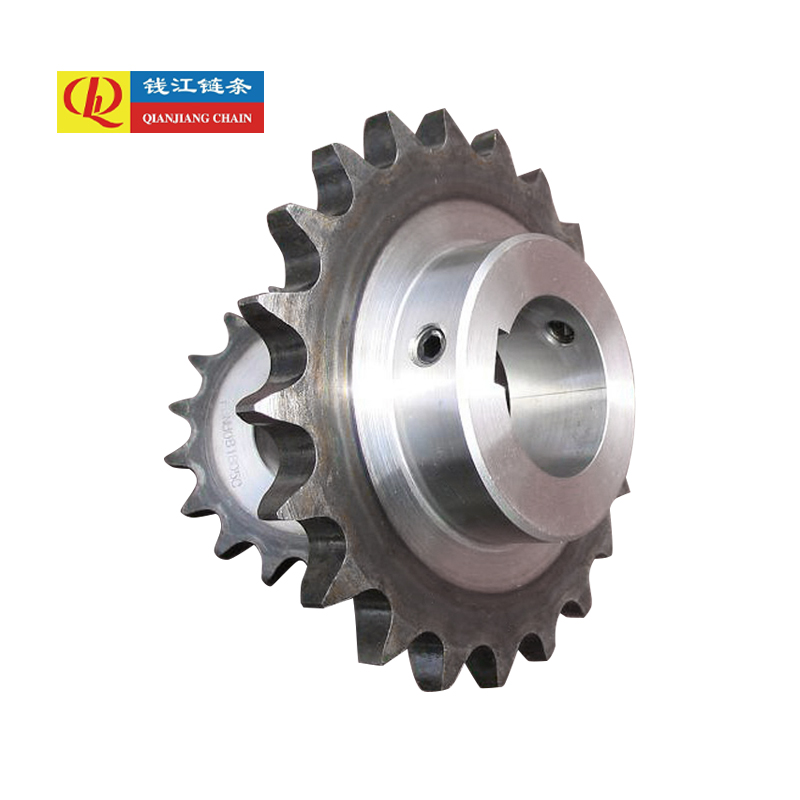 American B-Type Sprockets with One-Sided Hub for Industrial DrivesThese sprockets feature a flat hub on one side for easy alignment and rigid tooth support. They suit single or multiple row configurations and accept stock or custom bores, making them a dependable choice for conveyors and automation.View Product →
How to Select the Right Industrial Sprocket
Choosing the correct industrial sprocket is the key to maximizing the life of the whole drive. Here are the factors we check with every customer before cutting metal.
Start with the Chain
Every sprocket is designed around a particular chain. If the chain number is stamped on the side plate, the sprocket can usually be selected from a catalogue. Never assume that an A-series chain and a B-series sprocket are interchangeable; their roller widths differ in many pitch sizes. The safest path is to order the sprocket and chain from the same source, where the matching has already been verified.
Tooth Count and Speed Ratio
Speed ratio is the ratio between the number of teeth on the driven sprocket and the number on the driver sprocket. Count the existing teeth before deciding what to replace. As a general rule, keep the number of teeth as high as space permits, because larger sprocket teeth reduce chordal action and distribute load more evenly.
Bore Style and Hub
The shaft bore must fit the actual shaft diameter. A loose bore leads to vibration and keyway hammering; an overly tight bore is nearly impossible to fit without damaging the shaft. Plain stock bore sprockets let your workshop finish the bore to the exact dimension. Finished-bore sprockets save time when the shaft size is known.
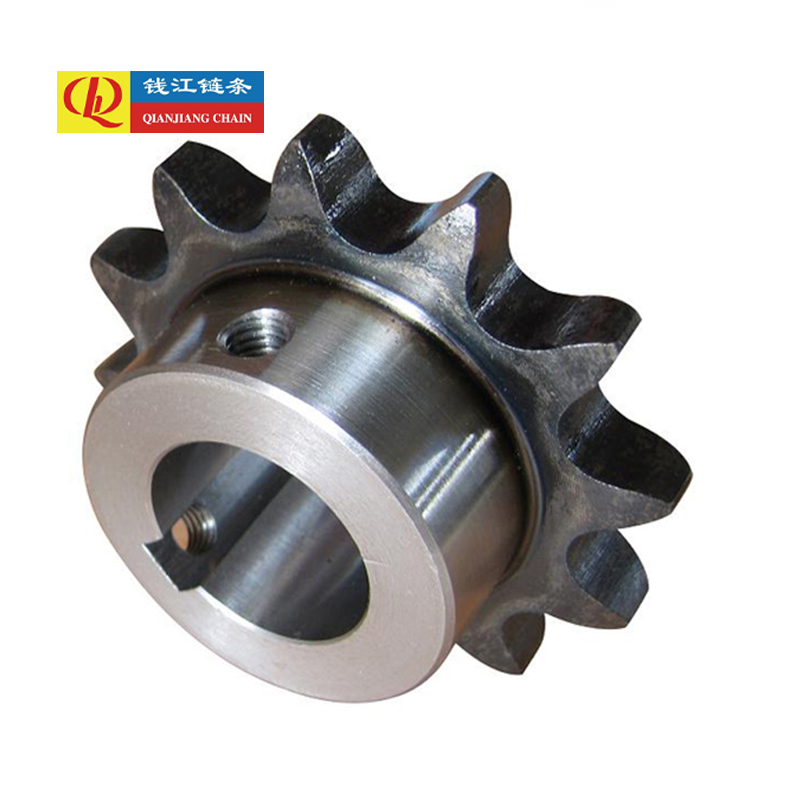 Ready-to-Install Finished Bore Sprockets with Keyways and Set ScrewsPre-machined bores, keyways, and set screws eliminate on-site machining, saving time and ensuring accurate fit. Available in many sizes and materials, they reduce wear and are ideal for manufacturing, agriculture, and material handling.View Product →
Taper-bushed sprockets are the easiest option for end users who do not want to measure or machine. The split bushing grips the shaft as bolts are tightened, and removal is equally quick. They are especially practical for large bores and for machines with regular component changeovers.
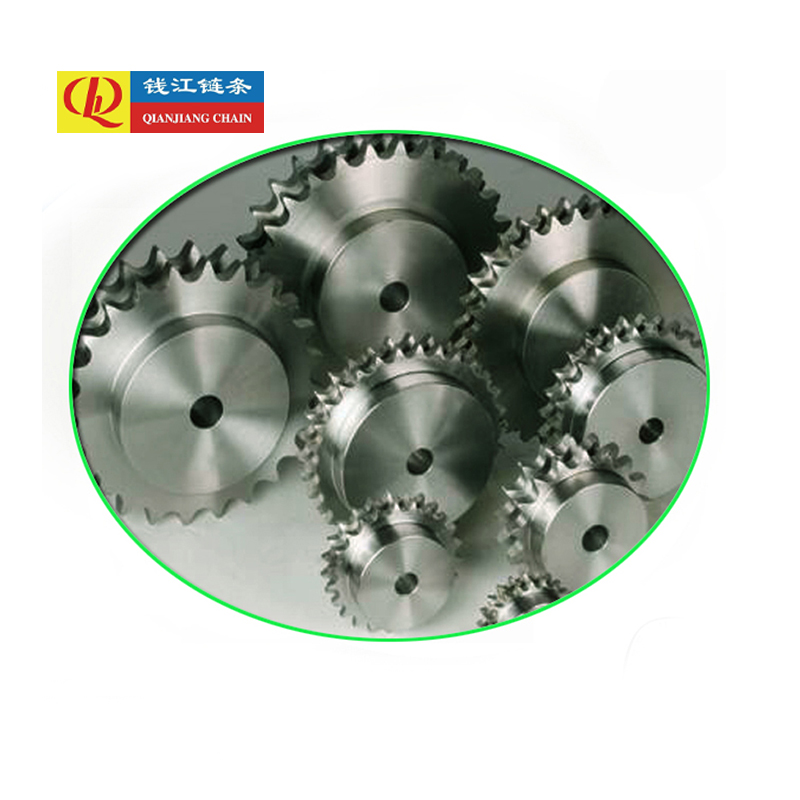 Taper-Bushed Sprockets for Quick, Tool-Free Shaft MountingDesigned with a split taper bushing, these sprockets grip the shaft securely without extra machining, allowing fast installation and removal. Their precise manufacturing ensures alignment and is practical for frequent changeovers in industrial machinery.View Product →
Material and Environment
Carbon steel is the default for most drives. If the environment contains abrasive particles, specify sprockets with hardened teeth. If moisture or chemicals are present, stainless steel sprockets are worth the additional cost because they prevent corrosion and contamination. In food processing, the smooth surface of stainless steel is also easier to clean.
Installation and Maintenance Best Practices
Correct installation starts with alignment. Use a straightedge or laser to make sure the faces of both sprockets are in the same plane. Shafts should be parallel when the drive is intended for parallel shafts. If the sprockets are not aligned, the chain will be forced sideways at each tooth and accelerated wear will follow.
Chain tension is the next checkpoint. A chain that is too loose will flutter and skip teeth. A chain that is too tight will put excessive load on bearings, stretch the pins, and accelerate sprocket wear. Aim for a small amount of slack on the slack strand, typically about 2% of the center distance, unless the machine manual specifies otherwise.
Lubrication cannot be overemphasized. Oil must reach the chain pins and the interface between the rollers and sprocket teeth. Without lubrication, metal-to-metal contact generates heat, wear particles, and progressive damage. Select an oil or grease that suits the speed and the environmental conditions; for dusty or wet locations, choose a lubricant that remains in place.
During scheduled inspections, look for wear on the sprocket tooth profile. When the load flank becomes hooked or concave, the sprocket must be replaced. Also check the chain for elongation; if the chain has stretched more than the manufacturer's limit, both chain and sprocket should be renewed as a set. For deeper guidance, we have summarized many field-proven procedures in our industrial sprocket maintenance tips.
Why Match Sprockets with the Same Manufacturer?
At Hangzhou Qianjiang Chain, we manufacture both the chain and the sprocket. This means the pair is designed to work together from the start. We can verify tooth profile against actual chain rollers, measure pitch accuracy, and adjust the design for special chain attachments. This reduces the communication gap that sometimes occurs when a chain is bought from one factory and the sprocket from another.
Our product range covers roller chains, conveyor chains, heavy-duty chains, stainless chains, and the matching sprockets. For OEM projects, we offer custom bores, special tooth counts, modified hub designs, and material selections based on the application. For distributors, we provide stable quality, packaging, and technical support.
From a supply chain point of view, ordering chain and sprockets together simplifies inventory. There are no compatibility surprises, no doubled documentation, and no risk of mismatched pitch arriving at the assembly line. We believe this integrated approach is one of the reasons global customers choose us as a long-term partner.
News
-
I. Introduction Conveyor systems form the backbone of modern industrial automation, enabling the eff...
READ MORE -
1. Introduction 1.1 Definition and Basic Concept of Coupling Chains Coupling chains are mechanical d...
READ MORE -
1. Introduction to Leaf Chains Leaf chains are a type of mechanical chain used in a variety of indus...
READ MORE

 +86-13805752016
 +86-571-82875104/82875108
 [email protected]
 No. 80 QianNong West Road, Xiaoshan District, Hangzhou City, Zhejiang Province,China
Copyright © Hangzhou Qianjiang Chain Industries Co., Ltd. All Rights Reserved.
|
 浙公网安备33010902004043号