
 Eng
 中文简体
Home / News / Industry News / Amusement Park Chain: Corporate Groups and the Ride Chains That Keep Them Running
Submit feedback
Amusement Park Chain: Corporate Groups and the Ride Chains That Keep Them Running
Update:05-11-2026
Posted by Admin
Content
- 1 The Two Meanings, and Why Both Matter
- 2 Where Chain Actually Lives Inside a Park
- 3 What Park Equipment Actually Asks of a Chain
- 4 Materials, Sealing and the Weather
- 5 A Short Checklist Before You Specify
- 6 Sprockets, Wear Pairs and Spares Rationalisation
- 7 What a Manufacturer Brings to a Group's Purchasing Plan
- 8 Choosing a Partner Rather Than a Part Number
Type "amusement park chain" into a search box and most of what comes back is a list: which groups own how many parks, which operator drew the biggest attendance last season, which portfolio is rumoured to be for sale. Useful reading if you are planning a trip. Rather less useful if you are standing in a service corridor at seven in the morning, listening to a lift hill and wondering whether that faint tick is normal.
We have been making chain in Hangzhou since 1987, and a good number of the chains that leave our floor end up doing quiet work inside parks — on ride drives, on guest conveyors, on the gates that count visitors in and out. So this is written from that side of the fence: the mechanical half of the phrase, with an eye on what the corporate half means for the people who actually buy the parts.
The Two Meanings, and Why Both Matter
A park chain in the corporate sense is an operating group: one management structure, one balance sheet and a shared playbook across several sites. Industry rankings and attendance tables are dominated by these groups, and the trend has been consolidation for years, with multi-site operators spreading capital across regions and brands.
A park chain in the mechanical sense is a length of linked steel that pulls something heavy and stops when told to. Lift hills, transfer tables, dark-ride vehicles, luggage conveyors, car-park stackers — all of it moves because a chain moves.
The two meanings meet in procurement. The larger the group, the more it benefits from standardising the hardware it buys: one chain specification recognised across every property, one spares holding, one set of inspection intervals. That is where a conversation with a manufacturer starts to pay for itself.
Where Chain Actually Lives Inside a Park
Walk a park from the front gate to the maintenance yard and you pass half a dozen different chain duties without noticing any of them.
Lift Hills, Launch Systems and Ride Drives
Many coaster lift hills still depend on a heavy-duty roller chain running over a matched sprocket set, chosen for tensile strength and resistance to fatigue rather than for speed. The number that matters most in service is elongation: once a lift chain stretches beyond the ride manufacturer's limit, typically in the region of one and a half to two percent, the tooth engagement changes and the whole drive starts working harder than it was designed to. Pin and bushing wear, not plate breakage, is what usually ends a chain's life. In dusty or coastal locations, a sealed chain with retained lubricant is often the difference between a comfortable inspection and an expensive one.
 Heavy Duty Series Roller ChainsAlloy steel roller chains for high-load power transmission, relevant where lift-hill drives need fatigue resistance and attention to elongation.View Product →
Conveyors, Queues and Guest Flow
Behind the scenery sit the workhorses: double-pitch conveyor chains carrying station conveyors, baggage runs, transfer belts and dark-ride vehicle return lines. Attachments matter more than most spec sheets admit — a well-chosen attachment keeps a boat hull or a ride car located without a secondary guide, which simplifies the whole assembly. Where a product must not be scuffed, vulcanised elastomer rollers or a smooth top plate do the job. Roller engagement and running noise deserve early attention too, since a conveyor under a queue line is heard by thousands of people a day.
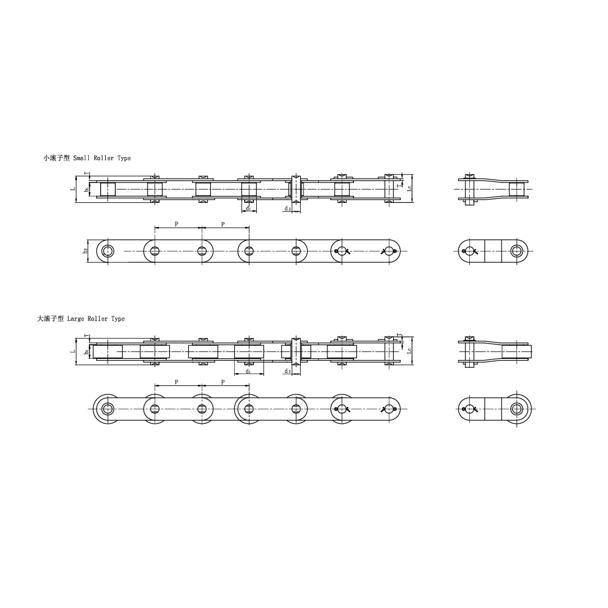 Double Pitch Conveyor Chains SeriesLonger-pitch conveyor chains with fewer joints and sprockets, suited to light-to-medium conveying where reduced wear and maintenance matter.View Product →
Gates, Doors and Access Control
Entrance turnstiles, sliding doors, maintenance shutters and queue-line gates lean on anti-sidebow chain, which is designed to flex sideways on a curved track without wearing the pin and bushings out of shape. It is a small component in a big system, and it is also the one that jams on a busy Saturday. Fine workmanship and ageing resistance count for more here than raw tensile strength, especially on outdoor installations exposed to sun and rain.
 Aging-Resistant Anti-Sidebow Chains for Automatic DoorsPrecision-built anti-sidebow chains for automatic doors and windows, intended to resist lateral wear and keep curved-track operation smooth.View Product →
Parking, Lifts and Back-of-House
The unglamorous side of a park is arguably the most chain-intensive. Mechanical parking stackers use dedicated parking chain with purpose-made connectors; lift tables and stage rigging use leaf chain for high tensile capacity in a narrow space; coupling chain handles torque transfer where a shaft coupling would be awkward. None of it is visible from the midway, and all of it stops the day if it fails.
What Park Equipment Actually Asks of a Chain
Duty cycles in a park are unusual: long idle periods, sudden heavy use, and cleaning regimes that remove more lubricant than they leave behind. The table below is the shorthand we use when a park engineer sends over a mixed list of part numbers.
| Chain type | Typical park duty | Properties that matter |
|---|---|---|
| Double-pitch conveyor chain | Station conveyors, baggage runs, vehicle return lines | Attachment range, smooth roller engagement, low running noise |
| Heavy-duty roller chain | Lift hills, transfer tables, ride drives | Tensile strength, fatigue resistance, controlled elongation |
| Anti-sidebow chain | Entrance gates, sliding doors, queue barriers | Lateral flexibility, wear life on curves, quiet operation |
| Leaf and lift chain | Lift tables, rigging, maintenance hoists | High tensile capacity in a narrow profile, secure anchorage |
| Stainless steel chain | Water rides, splash zones, wash-down areas | Corrosion resistance, cleanability, food-grade handling |
| Sealed O-ring or X-ring chain | Outdoor drives facing dust, grit and rain | Retained lubricant, wear life, longer re-lubrication intervals |
| Sprockets | Every chain above | Matched tooth profile, accurate bore and keyway, correct material |
Materials, Sealing and the Weather
Outdoor rides age faster than indoor ones, and not only because of rain. Sunscreen, spilled drinks, chlorinated water from a nearby splash zone, grit blown off a path and aggressive wash-down chemicals all find their way onto a chain. Three choices usually settle the argument.
- Base material. Carbon steel with a sound heat treatment covers most dry drive duties. For splash zones, stainless steel removes the corrosion problem entirely, though at a lower load rating for the same size.
- Sealing. An O-ring or X-ring chain keeps factory lubricant where it belongs. On outdoor drives that cannot be re-lubricated weekly, the extra cost is usually recovered within a season.
- Lubrication access. Where guards make routine greasing impractical, specify for long intervals from the start rather than discovering the problem mid-season.
Alloy steel has quietly become the default for conveyor and drive chain in heavy industrial settings, and park equipment follows the same logic: better through-hardening means slower elongation, which means fewer mid-season surprises. Our technical notes on alloy steel in conveyor applications go into more detail if you are weighing the trade-offs.
A Short Checklist Before You Specify
Most of the specification work happens before anyone opens a catalogue. These steps save more money than a discount ever will.
- Get the original equipment drawing: pitch, roller diameter, inner width, link count, and any attachment spacing.
- Describe the environment honestly — indoor, coastal, splash zone, dust, cleaning chemicals, ambient temperature.
- Decide on sealing and lubrication strategy, and write the re-lubrication interval into the maintenance plan.
- Replace chain and sprocket as a pair where wear is advanced; a new chain on a worn sprocket ages quickly.
- Agree an elongation limit and an inspection frequency with the ride or equipment manufacturer, then record measurements.
- Confirm documentation, traceability and spare-part lead times before the season starts, not during it.
Sprockets, Wear Pairs and Spares Rationalisation
A chain never wears alone. Tooth form, bore accuracy and material choice on the sprocket decide how evenly load is shared across the rollers, and a mismatched pair can halve the life of both parts. For a group running several properties, the sensible move is to rationalise: a small number of chain sizes and sprocket patterns held centrally, with OEM-specified parts produced to drawing where the original geometry is unusual. Fewer line items, faster swaps, less training for the maintenance team.
What a Manufacturer Brings to a Group's Purchasing Plan
Hangzhou Qianjiang Chain Industries has been producing A and B series precision roller chain, sealed motorcycle chain, conveyor chain, leaf chain, silent chain, variable-speed chain, stainless steel chain and matching sprockets since 1987. Alongside standard catalogue ranges, we build to drawing, which is generally what a park needs when a ride is fifteen years old and the original part number has been superseded twice.
We have worked with the chain transmission research institute at Jilin University of Technology since 1991, refining PIV variable-speed chain and silent chain designs and developing high-end sealed motorcycle chain and heavy-duty precision roller chain. Recent work includes a 420VO-X high-strength oil-sealed motorcycle chain that passed provincial new-product appraisal, plate chain for rock-bolt drilling rigs and stainless steel clamping chain for handling lines — a selection worth browsing in our new products and technologies section if you are curious about where the development effort goes.
On the shop floor, production planning runs on an ERP system and every part passes automated visual inspection before it is packed. It is not a glamorous claim, and it is exactly the kind of claim that matters when a chain sits behind a barrier and cannot be watched.
Choosing a Partner Rather Than a Part Number
The amusement park chain that keeps a park running is rarely the one anyone photographs. It is a conveyor under a queue, a drive above a lift hill, a small side-bow unit in a gate that opens ten thousand times a day. Getting those right is mostly a matter of asking good questions early: what does the equipment maker require, what does the site actually look like in July, and who is going to measure elongation in six months.
If you are working through those questions for a ride, a conveyor line or a parking system, we are always glad to look at a drawing and talk it through. That conversation usually costs nothing and occasionally saves a season.
News
-
I. Introduction Conveyor systems form the backbone of modern industrial automation, enabling the eff...
READ MORE -
1. Introduction 1.1 Definition and Basic Concept of Coupling Chains Coupling chains are mechanical d...
READ MORE -
1. Introduction to Leaf Chains Leaf chains are a type of mechanical chain used in a variety of indus...
READ MORE

 +86-13805752016
 +86-571-82875104/82875108
 [email protected]
 No. 80 QianNong West Road, Xiaoshan District, Hangzhou City, Zhejiang Province,China
Copyright © Hangzhou Qianjiang Chain Industries Co., Ltd. All Rights Reserved.
|
 浙公网安备33010902004043号