
 Eng
Eng  中文简体
中文简体Home / News / Industry News / Agricultural Chains: How to Select, Maintain, and Prevent Field Failures
Submit feedback
Agricultural Chains: How to Select, Maintain, and Prevent Field Failures
Update:09-09-2026
Posted by Admin
Content
- 1 Why Agricultural Chains Work Harder Than Industrial Chains
- 2 Common Types of Agricultural Chains and Their Jobs
- 3 Materials and Construction That Determine Service Life
- 4 How to Select an Agricultural Chain
- 5 Installation, Lubrication, and Wear Management
- 6 Corrosion, Storage, and Seasonal Care
- 7 A Practical Outlook on Agricultural Chain Reliability
A combine harvester loses a full day of work in late July because a conveyor chain snapped under a load it had carried all season. A baler operator replaces the same drive chain twice in one month and blames the supplier, only to find that the chain pitch did not match the sprocket. These failures are not rare in farming. Agricultural chains run in dust, plant debris, moisture, changing speeds, and shock loads that most industrial drives never face. The practical conclusion is simple: choose the chain by load class, material, and sealing level, match it with the correct sprocket, and maintain it on a fixed schedule. That combination prevents most field failures before they interrupt the harvest.
Why Agricultural Chains Work Harder Than Industrial Chains
An agricultural chain works in a different world from a chain on a stationary machine. Combines, forage harvesters, balers, grain augers, fertilizer spreaders, and tractors expose chains to abrasive soil dust, crop residue, rain, temperature swings, and intermittent heavy loads. Many farm machines run at variable speeds, so a chain must handle rapid acceleration as well as steady high-speed rotation without developing excessive elongation.
Three failure modes matter most in the field. Fatigue starts when a chain repeatedly flexes around sprockets and eventually cracks a pin or plate. Wear elongation happens when pin and bushing surfaces slowly lose material, making the chain longer and looser. Corrosion attacks unprotected steel whenever the chain stays damp overnight or for weeks of off-season storage. Understanding these three mechanisms makes it easier to compare chains and to justify a slightly higher investment in hardened pins, shot-peened plates, and sealed joints.
Common Types of Agricultural Chains and Their Jobs
Farm machinery uses a small number of chain families, each built for a specific role. Roller chains carry power from the engine to drive axles, rotors, cleaning fans, and other driven units. Conveyor chains move crop material through the machine and frequently carry attachments such as flights, extended pins, or center holes for mounting. Pintle chains remain in use on some low-speed conveying and spreading equipment, while leaf chains and silent chains appear in lifting positions and low-noise drives. Most of these categories overlap, so buying an agricultural chain starts with the pitch, breaking load, and attachment layout rather than the product name. For common positions on harvesters and tractors, agricultural machinery chains are manufactured in both roller and conveyor forms, with optional sealed pins for dusty running.
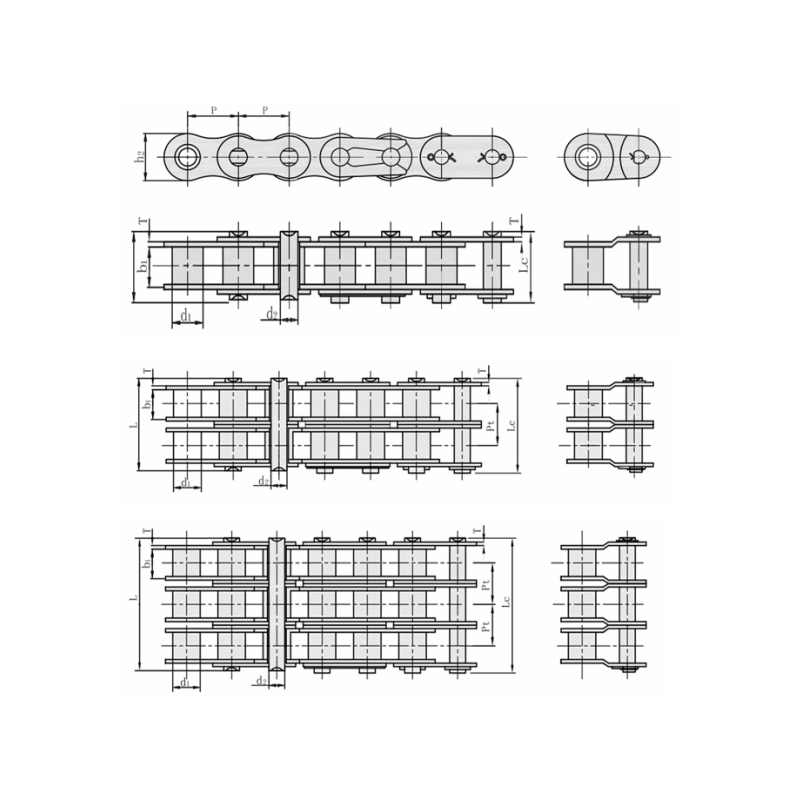 Various Specifications Agricultural machinery chains Suppliers, FactoryHangzhou Qianjiang Chain Industries Co., Ltd is China wholesale Various Specifications Agricultural machinery chains Suppliers and top Fa...View Product →
The table below shows the main families and the design priorities that should guide the choice.
| Chain family | Typical role | Design priority |
|---|---|---|
| Roller chain, single or multiple strand (ANSI 40, 50, 60, 80) | Power transmission on tractors, combines, balers | Tensile strength, fatigue resistance, sprocket fit |
| Double-pitch conveyor chain | Grain elevators, augers, product conveyors | Wear life, attachment spacing, elongation control |
| Conveyor chain with attachments | Flight-and-slat conveyors, cleaning conveyors | Attachment strength, accuracy of spacing |
| Pintle chain | Low-speed conveying and spreading equipment | Impact resistance in dirty conditions |
| Leaf chain | Lifting and tensioning positions | High tensile strength without rollers |
| Silent chain | Low-noise drives in agricultural automation | Noise reduction, smooth meshing |
For elevator and product-carrying positions, double-pitch conveyor chains offer a practical combination of lower cost and dependable wear life because the longer pitch reduces the number of joints over a given length. Their attachments can be spaced to match specific flight layouts, which makes them common in grain handling and cleaning sections.
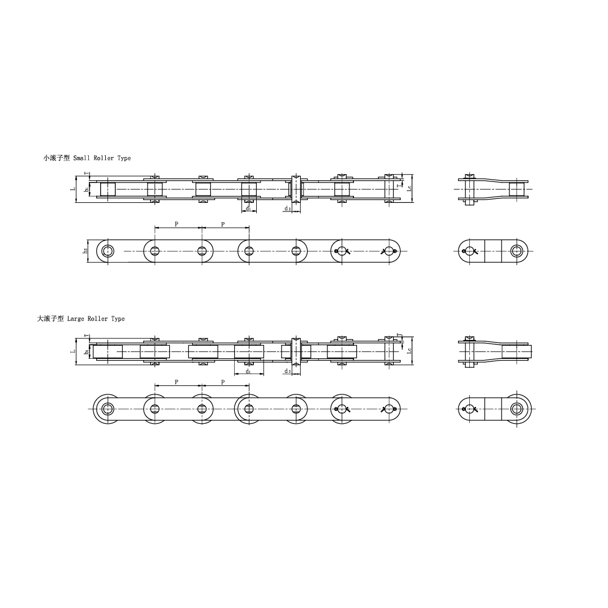 Double pitch conveyor chains Suppliers, FactoryHangzhou Qianjiang Chain Industries Co., Ltd is China wholesale Double pitch conveyor chains Suppliers and top Factory,Product Introducti...View Product →
Materials and Construction That Determine Service Life
Steel grade and manufacturing processes set the ceiling on chain life. High-tensile alloy steel raises the breaking load for a given pitch, which is critical when a harvester imposes dynamic loads on a drive. Heat treatment of pins and bushings increases surface hardness and slows the wear that leads to elongation. Shot peening the plates and pre-stressing the assembled chain distribute internal stresses, so the chain reaches the field already settled and less likely to stretch in the first hours.
Sealing is the second deciding factor. An open roller chain in dusty field conditions draws fine soil particles into the pin-bushing gap, where they work like grinding paste. O-ring chains use elastomer seals to keep lubrication inside and abrasive dust outside; X-ring seals reduce friction further by improving the contact area. In combines and forage harvesters that run in dust for days, the extra cost of a sealed chain is usually recovered by avoiding a mid-season change. Where wash water and storage moisture are unavoidable, stainless steel chains resist corrosion but cost more and generally provide lower fatigue strength than hardened alloy steel.
When peak loads are the main risk, high-strength agricultural machinery chains are engineered with heavier link plates and hardened pins so the chain absorbs shock instead of passing all of it to the driven component.
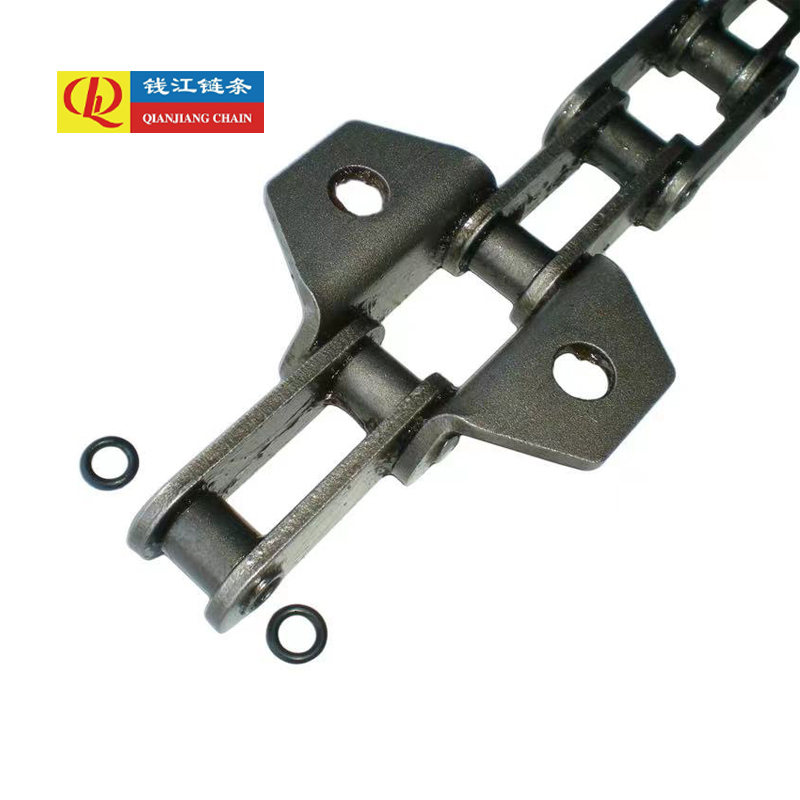 High Strength Wear Resistant Agricultural Machinery Chains Suppliers, FactoryHangzhou Qianjiang Chain Industries Co., Ltd is China wholesale High Strength Wear Resistant Agricultural Machinery Chains Suppliers and ...View Product →
How to Select an Agricultural Chain
Selection is a sequence of checks that starts with geometry and ends with the operating environment. Working through the list in order prevents the common mistake of choosing a chain that fits mechanically but cannot handle the duty.
- Measure the pitch, width, and number of strands from the existing chain or the parts book. Changing the pitch is not a simple upgrade because the sprocket contact geometry changes completely.
- Confirm the breaking load. Compare it with peak loads, including start-up torque and shock from uneven ground. Choose a grade that exceeds the calculated requirement rather than matching it exactly.
- Define the attachment format. For conveying positions, decide whether extended pins, attachment plates, or a center-hole design are needed for flights and carriers.
- Match the sealing level to the environment. Open chains suit clean and dry positions; dusty harvest work favors sealed chains.
- Order matching sprockets at the same time. A worn sprocket or one with an incorrect tooth profile will wear out a new chain quickly.
Supplier consistency is part of selection. Agricultural chains follow common dimensional standards such as ANSI B29.1 and ISO 606, so a chain of a given pitch engages with a matching sprocket regardless of the brand. That standard-based interchangeability makes heat treatment, plate quality, and batch-level inspection the real differences between products. Asking how a manufacturer verifies those factors is a better purchasing test than comparing price alone.
Installation, Lubrication, and Wear Management
Installation errors create early failures that are often blamed on the chain. Fit the chain with the correct tension: enough slack to avoid pulling on bearings, but not so much that it slaps or jumps teeth. Align the sprockets carefully, because misalignment produces edge wear on the link plates and a visible polished stripe on the side plates.
Lubrication is the most cost-effective way to extend chain life. Standard agricultural chains need a penetrating oil that reaches the pin-bushing interface; the best time to apply it is when the chain is warm from running, so the oil flows into the clearances. In dusty conditions, avoid heavy external lubrication because it attracts abrasive soil. Sealed chains need less frequent lubrication but still need surface film where rollers meet sprocket teeth.
Track wear with a simple repeatable measurement. Measure a fixed number of links with the chain under tension and compare the result with the original value. When elongation reaches 2% to 3%, the chain no longer engages the sprocket cleanly and should be replaced before it jumps teeth or damages the sprocket. That limit is important: a chain that skips a tooth on a rotor or elevator can stop the entire machine for hours.
Corrosion, Storage, and Seasonal Care
Corrosion is one of the most common reasons why agricultural chains fail in the field, yet it is the easiest cause to prevent. Storing a combine with a damp chain overnight, or leaving the machine through the off-season without protection, starts rust on pins and plates. Rust pits the bearing surfaces and accelerates wear, and in severe cases it reduces the plate cross-section enough to cause fatigue breaks. The practical routine is to dry and relubricate the chains after wet use and to apply a rust-preventive film before long storage.
A short review of how agricultural chains resist wear, corrosion, and rust in outdoor environments can help an operator identify the right indicators to check. Before the first heavy use of the season, inspect every chain for stiff links, visible rust, elongation, and sprocket wear. Replacing a chain at the right moment costs less than replacing both the chain and the sprockets after an emergency failure.
A Practical Outlook on Agricultural Chain Reliability
An agricultural chain is not the most expensive component on a combine or baler, but it is the component most likely to stop the machine at the worst moment. A chain chosen only by pitch, installed without alignment, and run without lubrication will fail regardless of brand. The opposite is also true: a chain selected with a realistic load margin, sealed for the local dust and moisture, and monitored against a wear limit can often outlast the season and reach its replacement window on schedule.
Manufacturers such as Hangzhou Qianjiang Chain Industries have produced roller chains, conveyor chains, and agricultural chains since 1987, supported by long-term cooperation with the China Chain Transmission Research Institute on heavy-duty and sealed chain development. That combination of production experience and research gives buyers a practical advantage: catalogs from different suppliers look similar, but heat treatment, plate quality, and inspection consistency determine whether the chain survives a harvest. When comparing suppliers, evaluate those details and ask how the factory tests quality. The chain that fits, seals, and stands up to the season is the one worth installing before harvest begins.
News
-
I. Introduction Conveyor systems form the backbone of modern industrial automation, enabling the eff...
READ MORE -
1. Introduction 1.1 Definition and Basic Concept of Coupling Chains Coupling chains are mechanical d...
READ MORE -
1. Introduction to Leaf Chains Leaf chains are a type of mechanical chain used in a variety of indus...
READ MORE

 +86-13805752016
 +86-571-82875104/82875108
 [email protected]
 No. 80 QianNong West Road, Xiaoshan District, Hangzhou City, Zhejiang Province,China
Copyright © Hangzhou Qianjiang Chain Industries Co., Ltd. All Rights Reserved.
|
 浙公网安备33010902004043号