
 Eng
Eng  中文简体
中文简体Submit feedback
X-Ring vs O-Ring Motorcycle Chains: What's the Real Difference?
Update:23-04-2026
Posted by Admin
Content
- 1 Understanding Sealed Motorcycle Drive Chains
- 2 How the O-Ring Chain Seal Works
- 3 How the X-Ring Chain Seal Works
- 4 Direct Comparison: X-Ring vs O-Ring Chain Performance
- 5 Lubrication Inside the Chain: What the Seal Is Actually Protecting
- 6 Which Riders Benefit Most From X-Ring Chains
- 7 When an O-Ring Chain Is the Better Choice
- 8 Practical Tips for Choosing and Maintaining Either Chain Type
Understanding Sealed Motorcycle Drive Chains
Modern motorcycle drive chains are not the simple open roller chains found on bicycles. High-performance and street motorcycles use sealed chains that enclose lubricant inside each link, dramatically extending service life and reducing the maintenance burden on the rider. The seal sits between the inner and outer link plates, surrounding each pin-and-bushing assembly, and keeps factory-packed grease inside the pivot joint while preventing road grit, water, and contamination from entering. The two most widely used sealed chain designs in the motorcycle market are the O-ring chain and the X-ring chain — named after the cross-sectional shape of the rubber seal used in each design. Understanding what separates these two technologies helps riders make a practical, cost-effective choice when it is time to replace a worn drive chain.
Both O-ring and X-ring chains represent a significant upgrade over standard unsealed roller chains, which require frequent cleaning and re-lubrication and wear out quickly under road riding conditions. However, the two sealed designs are not interchangeable in terms of performance, friction characteristics, or price. The differences are rooted in geometry, contact area, and the engineering principles that govern how rubber seals interact with metal surfaces under dynamic load and continuous rotation.
How the O-Ring Chain Seal Works
The O-ring chain gets its name from the circular cross-section of the rubber torus — or donut-shaped ring — that seats between each inner and outer link plate. When the chain is assembled, the O-ring is compressed between the link plates, creating a radial seal around the pin. This compression holds the grease inside the pin-bushing interface and blocks contaminants from reaching the bearing surfaces. The O-ring material is typically made from nitrile butadiene rubber (NBR) or neoprene, chosen for resistance to petroleum-based lubricants, heat, and mechanical wear.
The fundamental limitation of the O-ring design is the geometry of the seal itself. A round cross-section contacts both the inner and outer link plates along a relatively wide, curved surface. Under the side load and articulation forces generated as the chain wraps around sprockets and flexes through its path, the O-ring deforms and generates friction at these two contact points. This friction is small in absolute terms, but across the dozens of links in a motorcycle drive chain moving at high speed, the cumulative frictional loss becomes measurable — typically in the range of 1 to 3 percent of total power throughput compared to an unsealed chain. This is the power loss commonly referred to as chain friction or seal drag in performance discussions.
How the X-Ring Chain Seal Works
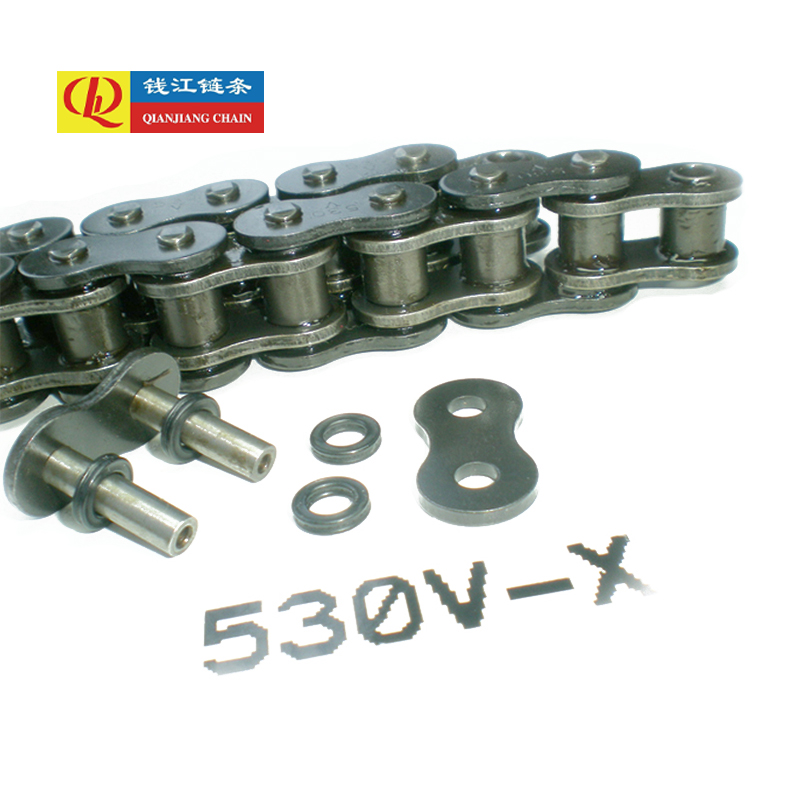
The X-ring seal — also called a quadrilateral seal or quad-ring — has a cross-sectional profile shaped like the letter X rather than a circle. This four-lobed geometry is the engineering innovation that distinguishes X-ring chains from their O-ring predecessors. When an X-ring is installed between the link plates and compressed, only the two outermost lobes of the X make contact with the plate surfaces — one lobe contacts the inner plate and the opposite lobe contacts the outer plate. The two inner lobes of the X do not contact any surface; instead, they create a small cavity that can retain additional lubricant within the seal itself.
This two-point contact geometry, compared to the broad curved contact of an O-ring, produces significantly less seal drag. Because the contact area between the X-ring and the link plates is reduced to two narrow lobe tips rather than a wide curved band, the friction generated per link during articulation is lower. Independent testing and manufacturer data consistently show that X-ring chains generate 15 to 20 percent less frictional loss than equivalent O-ring chains. Over a long chain run at highway speeds, this difference translates into marginally better power delivery to the rear wheel, slightly lower chain operating temperatures, and reduced seal wear — all of which extend chain service life.
Direct Comparison: X-Ring vs O-Ring Chain Performance
The practical differences between O-ring and X-ring chains can be summarized across several performance dimensions that matter to everyday riders and serious enthusiasts alike.
| Characteristic | O-Ring Chain | X-Ring Chain |
| Seal Cross-Section | Round (circular) | X-shaped (quad-lobe) |
| Contact Points Per Seal | 2 broad curved surfaces | 2 narrow lobe tips |
| Friction / Power Loss | Moderate (baseline) | 15–20% lower than O-ring |
| Lubricant Retention | Good | Excellent (inner cavity retains extra grease) |
| Contaminant Exclusion | Good | Very good |
| Seal Wear Rate | Moderate | Lower (reduced contact stress) |
| Expected Service Life | 20,000–30,000 km typical | 30,000–50,000 km typical |
| Price Relative to O-Ring | Lower cost baseline | 10–25% more expensive |
The service life figures in the table above assume regular chain maintenance — periodic cleaning with a suitable chain cleaner and application of a compatible chain lubricant to the outer surfaces, even on sealed chains — as well as correct initial tension adjustment and proper sprocket alignment. A poorly maintained X-ring chain will wear faster than a well-maintained O-ring chain, regardless of the seal geometry advantage.
Lubrication Inside the Chain: What the Seal Is Actually Protecting
A common misconception is that the chain lubricant applied externally by the rider penetrates inside the pin-bushing joint and lubricates the internal bearing surface. This is not how sealed chains work. The factory-packed grease inside the pin-bushing interface — applied during chain manufacturing under pressure — is the only lubricant that ever reaches the critical inner bearing surface of the link. The seal's purpose is to keep this factory grease inside the joint for the life of the chain.
The lubricant applied by the rider to a sealed chain primarily serves to lubricate the contact between the chain roller and the sprocket teeth, reduce corrosion on the outer link plates and rollers, and keep the outer surfaces of the seal pliable and resistant to cracking. Using the wrong lubricant — particularly petroleum-based solvents, WD-40, or any cleaner that is not specified as seal-safe — can degrade the rubber seal material and accelerate grease loss from the inner joint, ultimately reducing chain life despite appearing to lubricate the chain externally. Both O-ring and X-ring seals should be maintained using a dedicated motorcycle chain lubricant — typically a wax-based or semi-dry lubricant formulated to be compatible with rubber seal compounds.
Which Riders Benefit Most From X-Ring Chains
The X-ring chain's advantages are real but context-dependent. Not every rider will notice or benefit equally from the differences in friction and longevity that X-ring technology offers over a quality O-ring chain.
High-Mileage Touring and Commuter Riders
Riders who cover 15,000 km or more per year benefit the most from the extended service life of X-ring chains. The longer replacement interval — potentially 30,000 to 50,000 km versus 20,000 to 30,000 km for an O-ring chain — means fewer chain-and-sprocket replacement sets over the life of the motorcycle. When the cost of the sprocket set is factored in alongside the chain, the higher initial cost of an X-ring chain is frequently recovered within a single replacement cycle through reduced total replacement frequency.
Performance and Sport Bike Riders
On high-power sport bikes and naked streetfighters, the reduced friction of an X-ring chain delivers a marginal but genuine improvement in rear-wheel power transmission efficiency. While the absolute power gain is unlikely to be perceptible in normal riding, the reduced heat generation in the chain at sustained high speeds — during track days or extended motorway riding — extends seal life and reduces the rate of grease breakdown inside the pin joints. Many sport-focused chain manufacturers, including DID, RK, and Renthal, position their premium X-ring offerings specifically for this market segment.
Off-Road and Adventure Riders
Adventure motorcycles and dual-sport bikes that mix on-road and off-road use expose drive chains to mud, sand, water crossings, and extreme articulation angles. In these conditions, the superior contaminant exclusion of the X-ring seal's dual-lobe contact interface makes a meaningful difference. The inner lubricant cavity of the X-ring also provides a buffer of additional grease that sustains lubrication during extended off-road sections where re-lubrication is impractical. Purpose-built X-ring chains for off-road applications are typically made from higher-grade steel with nickel or zinc plating to resist corrosion in wet, muddy environments.
When an O-Ring Chain Is the Better Choice
Despite the technical advantages of X-ring chains, O-ring chains remain a sensible and popular choice in several specific situations. Riders on smaller displacement commuter motorcycles — 125cc to 300cc — where the drive chain operates at lower loads and temperatures will find that a quality O-ring chain from a reputable manufacturer provides entirely adequate service life at a lower purchase price. The power efficiency difference between O-ring and X-ring chains is most significant at high power levels and high chain speeds; at the modest outputs of small-displacement engines, the practical difference is negligible.
O-ring chains are also the appropriate choice for budget-conscious riders replacing a chain on an older motorcycle that may itself be approaching the end of its useful life, or for riders who prefer to replace their chain more frequently as part of a deliberate maintenance strategy. In these cases, the lower purchase cost of an O-ring chain makes more financial sense than investing in the longevity premium of an X-ring chain.
Practical Tips for Choosing and Maintaining Either Chain Type
Regardless of whether you choose an O-ring or X-ring chain, the following maintenance and selection practices apply equally and have a significant impact on how long the chain actually lasts in service.
- Always replace the chain and both sprockets together: Installing a new chain on worn sprockets accelerates chain wear dramatically. The worn sprocket tooth profile loads the chain rollers unevenly, causing accelerated elongation and seal stress. A chain-and-sprocket kit replacement is always more cost-effective than replacing components individually at different intervals.
- Use a chain wear indicator tool: Chain elongation due to pin and bushing wear is the primary cause of chain replacement. A dedicated chain wear gauge — a simple tool available for a few dollars — accurately measures whether the chain has reached the replacement threshold of approximately 0.5% to 1% elongation beyond nominal pitch length, eliminating guesswork.
- Set tension correctly and check it regularly: Excessive chain tension accelerates wear on the chain, sprockets, and transmission output shaft bearings. Insufficient tension causes the chain to slap and potentially derail. Check your motorcycle's specific slack specification — typically 20mm to 35mm of free play measured at the midpoint of the lower run — and adjust after every 500 to 1,000 km.
- Clean with a seal-safe cleaner only: Use a dedicated motorcycle chain cleaner or plain kerosene applied sparingly with a brush. Never use high-pressure washing directed at the chain seals, and never use aerosol brake cleaner or carburetor cleaner, which will swell and degrade both O-ring and X-ring seals within minutes of contact.
- Apply lubricant to a warm chain: Lubricant penetrates and adheres more effectively when the chain is warm from a short ride. Apply lubricant to the inner edge of the chain — where the rollers contact the sprocket teeth — while slowly rotating the rear wheel by hand, then allow the lubricant to penetrate before riding. Avoid applying lubricant to the outer link plates, which adds nothing to lubrication and simply flings lubricant onto the tire and rear brake disc.
- Buy from established manufacturers: Chain quality varies enormously between brands. Reputable manufacturers including DID, RK, EK, Regina, and Renthal produce both O-ring and X-ring chains to consistent dimensional and metallurgical standards, with reliable seal integrity. Budget chains from unknown manufacturers frequently use inferior rubber compounds that harden and crack prematurely, negating the sealing benefit entirely regardless of whether the seal profile is O or X shaped.
News
-
I. Introduction Conveyor systems form the backbone of modern industrial automation, enabling the eff...
READ MORE -
1. Introduction 1.1 Definition and Basic Concept of Coupling Chains Coupling chains are mechanical d...
READ MORE -
1. Introduction to Leaf Chains Leaf chains are a type of mechanical chain used in a variety of indus...
READ MORE

 +86-13805752016
 +86-571-82875104/82875108
 [email protected]
 No. 80 QianNong West Road, Xiaoshan District, Hangzhou City, Zhejiang Province,China
Copyright © Hangzhou Qianjiang Chain Industries Co., Ltd. All Rights Reserved.
|
 浙公网安备33010902004043号