
 Eng
Eng  中文简体
中文简体Submit feedback
What Should You Know Before Choosing a New Chain for Your Motorcycle?
Update:23-06-2026
Posted by Admin
Content
- 1 Why Your Motorcycle Chain Choice Matters More Than You Think
- 2 Understanding Chain Sizing: Pitch, Width, and the Number Code
- 3 Standard, O-Ring, X-Ring, and Z-Ring Chains: What the Seal Type Means
- 4 Tensile Strength and Load Ratings: Matching Chain Strength to Engine Output
- 5 Choosing by Riding Style and Application
- 6 Chain Length: Getting the Link Count Right
- 7 Master Link Selection and Installation
Why Your Motorcycle Chain Choice Matters More Than You Think
The drive chain is the final link between your engine's power and the rear wheel. Every time you open the throttle, the chain transmits that torque under tension, through acceleration forces, cornering loads, and the constant stress of road vibration. A chain that is the wrong size, the wrong type, or simply too weak for the application will stretch prematurely, wear out sprockets faster, and in a worst case, snap — with serious consequences for both the motorcycle and the rider. Conversely, choosing a high-quality chain matched precisely to your bike's specifications and riding style will reward you with crisp power delivery, longer sprocket life, lower maintenance frequency, and better overall drivetrain efficiency. This guide breaks down every variable that determines the correct chain for your motorcycle so you can make the right decision the first time.
Understanding Chain Sizing: Pitch, Width, and the Number Code
Motorcycle chains are identified by a three or four digit number that encodes two critical dimensions: pitch and roller width. The pitch is the distance between the centers of adjacent pins, measured in eighths of an inch. The last two digits indicate the inner width of the chain in eighths of an inch as well. The most common motorcycle chain sizes are 420, 428, 520, 525, 530, and 630, and each corresponds to a specific combination of pitch and width.
| Chain Size | Pitch (inches) | Inner Width (inches) | Typical Application |
| 420 | 1/2" | 1/4" | 50–150cc dirt bikes, mini bikes |
| 428 | 1/2" | 5/16" | 125–250cc road and off-road bikes |
| 520 | 5/8" | 1/4" | 250–600cc sport and off-road bikes |
| 525 | 5/8" | 5/16" | 600–1000cc sport and naked bikes |
| 530 | 5/8" | 3/8" | Large displacement road and touring bikes |
| 630 | 3/4" | 3/8" | Heavy cruisers and older large-displacement bikes |
Always verify the chain size specified in your owner's manual or stamped on the original chain before purchasing a replacement. The chain, front sprocket, and rear sprocket are a matched system — all three must share the same pitch and width, or the chain will not seat correctly on the sprocket teeth, causing accelerated wear and potential derailment.
Standard, O-Ring, X-Ring, and Z-Ring Chains: What the Seal Type Means
Beyond sizing, the most important choice you will make is the chain's seal type. This determines how the chain retains lubricant internally, which directly controls wear rate, maintenance interval, and service life.
Non-Sealed (Standard) Chains
Standard chains have no seals between the inner and outer plates. They are lighter and less expensive than sealed alternatives and produce slightly less frictional loss — an advantage on competition bikes where every fraction of a horsepower counts. The trade-off is that they rely entirely on external lubrication applied by the rider. In dry, clean conditions with disciplined lubrication intervals (every 300–500 km on a road bike, after every moto on a dirt bike), standard chains can last reasonably well. In wet or muddy conditions, or when lubrication is neglected, they wear rapidly. Standard chains are the correct choice for closed-course competition where minimum weight and maximum power transfer are priorities and the chain is replaced frequently regardless of wear.
O-Ring Chains
O-ring chains introduced a circular rubber seal between the inner and outer side plates at each pin location. This seal traps factory-applied grease around the pin and bushing, dramatically reducing internal wear even when external lubrication is infrequent or imperfect. O-ring chains represented a major advance in chain longevity when introduced and remain a reliable, cost-effective upgrade over standard chains for street bikes. Their limitation is that the circular O-ring contact patch creates a relatively high friction surface, producing a measurable drag penalty — typically quoted at 1–3% of drivetrain efficiency — compared to non-sealed chains.
X-Ring and Z-Ring Chains
X-ring chains replaced the circular O-ring with an X-shaped (quadrilateral) seal. The four-lipped profile creates two sealing surfaces per pin rather than one, improving lubricant retention and contamination exclusion while reducing the contact area between the seal and the side plate. The result is lower friction than an O-ring chain, combined with equal or better sealing performance and longer service life. Z-ring chains use a similar concept with a slightly different seal geometry optimized by individual manufacturers. X-ring and Z-ring chains are the current gold standard for street, touring, and adventure riding. For a motorcycle covering 10,000–20,000 km annually across varied conditions, the additional upfront cost of an X-ring chain — typically 20–40% more than an equivalent O-ring chain — is easily justified by the extended replacement interval and reduced sprocket wear.
Tensile Strength and Load Ratings: Matching Chain Strength to Engine Output
Tensile strength is the maximum load a chain can sustain before breaking, measured in kilonewtons (kN) or pounds-force (lbf). It is not the same as the working load — chains should never be operated near their tensile limit. As a practical rule, the chain's minimum tensile strength should be at least five to eight times the maximum tension it will experience in service, accounting for shock loads during aggressive acceleration and downshifting.
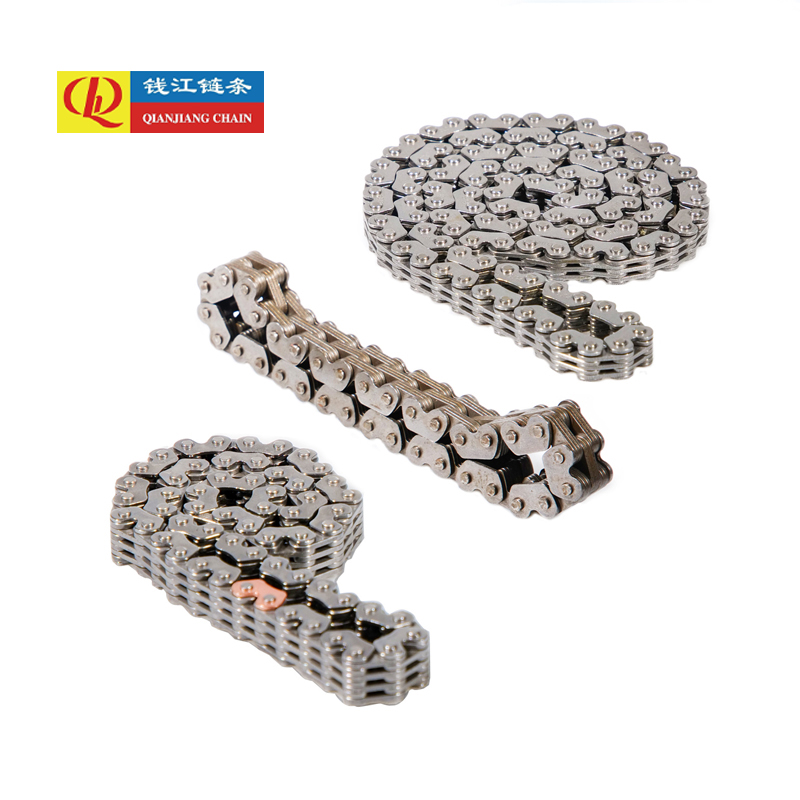
For most street bikes, the manufacturer's original equipment specification already accounts for engine output, so matching the OEM chain specification provides adequate strength. Where riders deviate from stock — fitting a larger engine, adding forced induction, or heavily modifying a motocross bike — the chain's tensile strength must be recalculated. High-performance chains in the 520 size class from manufacturers such as RK, DID, EK, and Regina are available in standard and heavy-duty variants with tensile strengths ranging from approximately 23 kN for a standard 520 up to 35 kN or more for a reinforced racing specification in the same pitch. For high-horsepower superbikes and drag racing applications, some builders convert from a 530 to a 520 pitch using sprockets with more teeth to maintain the same final drive ratio, gaining weight savings while using a competition-specification 520 chain with sufficient tensile strength for the application.
Choosing by Riding Style and Application
The best chain for a commuter is not the best chain for a motocross racer, and the best chain for an adventure tourer is not the best chain for a track day enthusiast. Matching the chain type to the actual use case produces better results than defaulting to the most expensive option regardless of context.
- Daily commuting and urban riding: An X-ring chain in the correct OEM size is the ideal choice. Low maintenance requirements, good resistance to rain and road grime, and a long service life suit the stop-start nature of urban riding. Prioritize a reputable brand with a clear tensile strength specification over buying the cheapest option available.
- Long-distance touring: An X-ring or Z-ring chain with the highest tensile strength available in the correct size. Touring bikes carry passenger and luggage loads that significantly increase chain tension, and long trips in varied weather demand maximum sealing performance. Consider a chain with a nickel or chrome-silicon alloy plate treatment for corrosion resistance in wet climates.
- Sport and track riding: A lightweight X-ring or non-sealed chain in a 520 conversion (if the bike originally ran 525 or 530) for maximum performance. Track bikes benefit from the weight reduction and slightly lower rolling resistance of a 520 setup, but only with a chain whose tensile strength is verified against the engine's peak torque output.
- Off-road and enduro: A non-sealed 520 or 428 chain for motocross, where the chain is replaced at short intervals anyway, or an X-ring chain for enduro and trail riding where longevity in muddy conditions matters more than minimum weight. Avoid O-ring chains in heavily silted conditions, as abrasive particles can accelerate seal wear.
- Adventure and dual-sport: A heavy-duty X-ring chain in the OEM size, with corrosion-resistant plating if regular water crossings are expected. Adventure bikes are heavy, carry luggage, and operate on unpredictable surfaces — chain strength and sealing quality are both critical.
Chain Length: Getting the Link Count Right
Replacement chains are sold in specific link counts, and selecting the correct number of links is essential for proper installation. The required link count depends on the pitch of the chain, the number of teeth on the front and rear sprockets, and the swingarm length of the specific motorcycle. The owner's manual or a chain length calculator using the sprocket tooth counts and center-to-center distance will give the precise figure. Most chains come in standard lengths (for example, 110 or 120 links) that are cut to the required length during installation using a chain breaker tool, with the excess links removed before fitting the master link.
If you are changing sprocket sizes simultaneously — a common modification to alter final drive ratio for better acceleration or higher top speed — recalculate the required link count for the new sprocket combination before ordering the chain. Adding one tooth to the rear sprocket or removing one from the front will typically require one or two additional links, while the reverse changes may allow you to remove links. Running a chain that is too long produces excessive sag and risk of derailment; running one that is too short prevents proper adjustment and places constant high tension on the chain even at rest, accelerating wear on the chain, sprockets, and output shaft bearing.
Master Link Selection and Installation
The master link is the removable connecting link that allows the chain to be fitted and removed without a chain press. It is available in two forms: the clip-type master link, which uses a spring clip to retain the outer plate, and the rivet-type master link, which is pressed and riveted to match the strength of the chain's standard links. For O-ring, X-ring, and Z-ring chains, always use a sealed master link that includes the appropriate O-rings or X-rings to maintain internal lubrication continuity at the joint. A non-sealed master link installed in a sealed chain creates a weak point in both lubrication and tensile strength.
For any road motorcycle above 125cc, a rivet-type master link is strongly recommended over a clip-type. Clip-type links can dislodge if the clip is installed incorrectly or fatigues over time, and a master link failure at speed is a catastrophic event. Riveting the master link requires a dedicated chain riveting tool, but this investment is worthwhile for the security it provides. Always install the master link with the closed end of the spring clip (on clip-type links) facing the direction of chain travel, and inspect the master link at every chain lubrication interval to confirm it remains secure.
News
-
I. Introduction Conveyor systems form the backbone of modern industrial automation, enabling the eff...
READ MORE -
1. Introduction 1.1 Definition and Basic Concept of Coupling Chains Coupling chains are mechanical d...
READ MORE -
1. Introduction to Leaf Chains Leaf chains are a type of mechanical chain used in a variety of indus...
READ MORE

 +86-13805752016
 +86-571-82875104/82875108
 [email protected]
 No. 80 QianNong West Road, Xiaoshan District, Hangzhou City, Zhejiang Province,China
Copyright © Hangzhou Qianjiang Chain Industries Co., Ltd. All Rights Reserved.
|
 浙公网安备33010902004043号