
 Eng
Eng  中文简体
中文简体Home / News / Industry News / What Makes Double Plus Chains the Right Choice for Heavy-Duty Power Transmission?
Submit feedback
What Makes Double Plus Chains the Right Choice for Heavy-Duty Power Transmission?
Update:30-04-2026
Posted by Admin
Content
- 1 What Are Double Plus Chains and How Do They Differ from Standard Roller Chains?
- 2 Construction and Key Components of Double Plus Chains
- 3 Technical Specifications and Load Ratings
- 4 Industries and Applications Where Double Plus Chains Excel
- 5 Attachment Options That Extend Double Plus Chain Versatility
- 6 Lubrication Strategies for Maximum Double Plus Chain Life
- 7 Recognizing Wear and Knowing When to Replace Double Plus Chains
What Are Double Plus Chains and How Do They Differ from Standard Roller Chains?
Double plus chains — also referred to as double-pitch roller chains with extended pins or reinforced link plate designs — are a specialized category of power transmission chain engineered to deliver higher load capacity, greater fatigue resistance, and longer service life compared to standard single-pitch roller chains. The "double plus" designation typically refers to chains that combine double-pitch geometry with reinforced structural elements, such as thicker side plates, larger rollers, or extended pin lengths that accommodate attachments, making them suitable for conveying, elevating, and heavy-duty drive applications where standard chains would rapidly fatigue or fail under sustained loading.
Standard roller chains, defined by ANSI/ASME B29.1 and ISO 606 standards, are designed primarily for drive applications where compact pitch and high-speed operation are priorities. Double plus chains, by contrast, sacrifice some speed capability in exchange for substantially increased tensile strength, impact resistance, and versatility in combined drive-and-conveyor applications. Their longer pitch — typically twice that of an equivalent drive chain in the same strength class — reduces the number of chain links engaging the sprocket per revolution, lowering articulation frequency and the associated wear at each pin-bushing joint. This characteristic makes double plus chains particularly well suited for slow to moderate-speed applications that involve heavy, sustained loads, shock loading conditions, or abrasive operating environments.
Construction and Key Components of Double Plus Chains
Understanding the internal construction of a double plus chain is essential for appreciating why it outperforms standard chains in demanding applications and for making informed decisions about material selection, lubrication requirements, and replacement intervals.
Link Plates
The inner and outer link plates are the primary structural elements of the chain, carrying the tensile load transmitted between sprocket teeth. In double plus chains, the link plates are manufactured from medium-carbon steel or alloy steel and are heat-treated to achieve a carefully controlled hardness profile — hard enough to resist fatigue cracking at the pin holes but not so brittle that they fracture under shock loading. Premium double plus chains use shot-peened link plates, a surface treatment process that induces compressive residual stresses in the plate surface, significantly extending fatigue life in applications subject to cyclic loading or vibration.
Pins and Bushings
The pins and bushings form the articulating joints of the chain and are the components most subject to wear during operation. Pins are precision-ground from case-hardened alloy steel to achieve a hard, wear-resistant surface over a tough, ductile core that absorbs impact without fracturing. Bushings — the cylindrical sleeves that fit inside the inner link plates and rotate around the pin during chain articulation — are manufactured to equally tight tolerances and are case-hardened on their outer surface where they contact the roller, and on their inner bore where they articulate against the pin. The clearance between pin and bushing is a critical design parameter; too tight and the joint generates excessive heat from friction, too loose and the chain elongates rapidly through accelerated wear.
Rollers
Rollers sit on the outside of the bushing and make rolling contact with the sprocket teeth, converting the sliding contact that would otherwise occur between bushing and sprocket into rolling contact — dramatically reducing wear on both the chain and sprocket. In double plus chains, rollers are typically manufactured from through-hardened steel and may be available in a thick-roller variant that increases the contact area with the sprocket tooth, distributing the tooth load over a larger surface and reducing the Hertzian contact stress that drives fatigue pitting in heavily loaded applications.
Technical Specifications and Load Ratings
Selecting a double plus chain for a specific application requires careful evaluation of the chain's published technical specifications against the actual loading, speed, and environmental conditions of the drive or conveyor system. The following table summarizes the key parameters typically published in double plus chain product data sheets and their practical significance.
| Parameter | Definition | Practical Significance |
| Pitch (mm or inches) | Distance between pin centers | Determines sprocket compatibility and chain speed at a given RPM |
| Minimum Tensile Strength | Maximum load before chain fractures | Must exceed working load by a safety factor of at least 7:1 for drives |
| Maximum Allowable Load | Safe working load for continuous operation | Accounts for fatigue; typically 1/7 to 1/10 of tensile strength |
| Weight per Meter | Mass of one meter of assembled chain | Affects catenary sag in long horizontal conveyors and drive torque at startup |
| Pin Diameter | Outer diameter of the connecting pin | Determines shear strength and compatibility with attachment holes |
| Roller Diameter | Outer diameter of the chain roller | Must match sprocket tooth form for correct engagement geometry |
When calculating the required chain for a drive application, engineers apply a service factor to the calculated working load to account for operating conditions that increase the effective load beyond the nominal transmitted power. Shock loading from frequent starts and stops, non-uniform loading such as that experienced in bucket elevators and reciprocating conveyors, and misalignment-induced side loading all require upward adjustment of the calculated chain load before selecting from the manufacturer's load rating tables. Applying appropriate service factors is not conservative overspecification — it is the standard engineering practice that ensures the chain operates within its fatigue endurance limit and achieves the expected service life of 15,000 hours or more.
Industries and Applications Where Double Plus Chains Excel
Double plus chains are specified across a broad range of industries wherever the combination of high load capacity, extended pitch, and attachment compatibility provides advantages over alternative power transmission components. Understanding these application contexts helps procurement and engineering teams recognize where double plus chains offer the most compelling performance and cost-of-ownership advantages.
- Agricultural machinery: Combine harvesters, grain augers, planting equipment, and fertilizer spreaders all employ double plus chains in their power transmission and conveying systems. Agricultural applications demand chains that tolerate contamination from soil, crop residue, and fertilizer granules while enduring the shock loads associated with sudden engagement and ingestion of foreign objects. Double plus chains in agricultural use are frequently specified in stainless steel or with corrosion-resistant coatings to handle chemical fertilizer exposure.
- Food processing and packaging: Conveyor systems in food processing facilities use double plus chains to transport products through washing, cutting, cooking, and packaging stages. Food-grade applications require chains manufactured from stainless steel — typically AISI 304 or AISI 316 — with self-lubricating bushings or sintered bushings pre-impregnated with NSF H1-certified food-grade lubricant. The extended pitch of double plus chains simplifies the attachment of product carriers, pusher flights, and side guards that hold food products in precise positions during processing.
- Forestry and wood processing: Log conveyors, debarkers, sawmill transfer decks, and wood chip conveyors subject chains to extreme impact loading, abrasive debris, and outdoor environmental exposure. Double plus chains for forestry applications are typically specified with hardened link plates, oversize pins, and heavy-duty rollers that resist deformation when logs or wood debris impact the chain during operation. Sealed-joint or O-ring chain variants are also used in this sector to retain lubricant in the pin-bushing joint despite constant exposure to water, wood chips, and bark particles.
- Mining and bulk material handling: Flight conveyors, drag chain conveyors, and apron feeders in mining and quarrying operations use heavy-duty double plus chains to move coal, ore, crushed stone, and similar bulk materials. These applications demand chains with very high tensile strength, maximum allowable loads in the tens of kilonewtons, and resistance to abrasive wear from the transported material. Cast components — cast link plates or rollers — are sometimes used in the most severe mining applications where wrought steel components wear too rapidly to be economical.
- Automotive and general manufacturing: Assembly line conveyor systems, parts washing machines, and paint line carriers use double plus chains with specialized attachments to transport vehicle bodies, engine components, and subassemblies through manufacturing cells. The precision pitch tolerances of quality double plus chains ensure consistent positioning of carried parts, which is essential in automated assembly operations where robotic tools must interact with components at defined locations.
Attachment Options That Extend Double Plus Chain Versatility
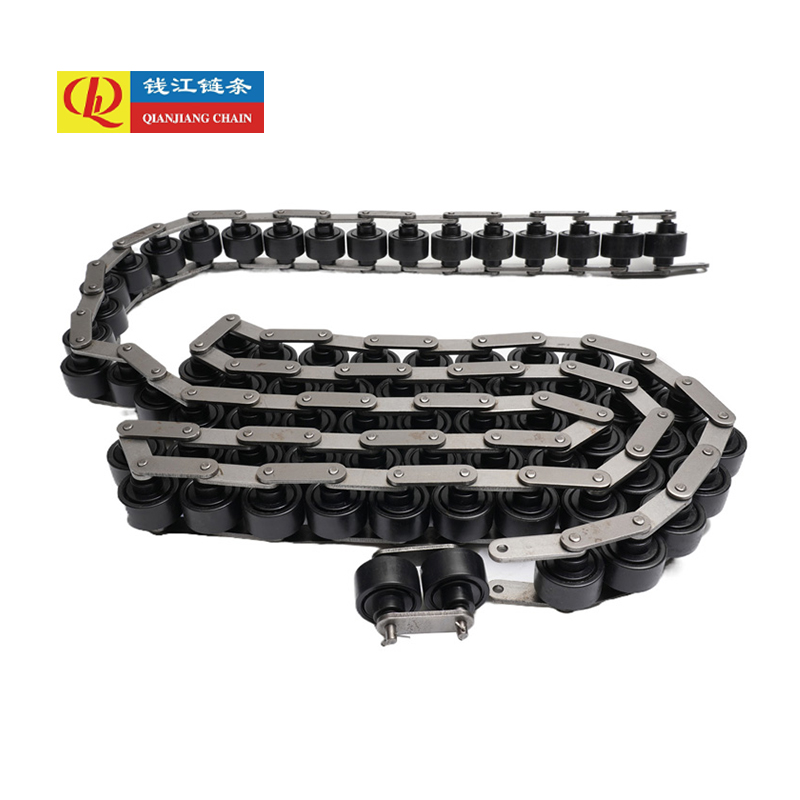
One of the most significant practical advantages of double plus chains over standard drive chains is the wide range of standardized and custom attachment options available. Attachments are special link plate variants with extended tabs, bent lugs, or threaded holes that allow external components — such as conveyor flights, pusher bars, carriers, or guide rollers — to be bolted or welded directly to the chain at regular intervals. The extended pin length and wider inner link dimensions of double plus chains provide more working space for attachment mounting than equivalent-strength single-pitch chains, simplifying attachment design and reducing fabrication costs.
Standard attachment types are designated by letter codes in ISO and ANSI standards — K1 and K2 attachments feature a single extended tab on the outer link plate, while A1 and A2 attachments provide extended tabs on the inner link plate. Extended pin attachments (type G or D) provide a pin that protrudes beyond the outer link plate on one or both sides, allowing the pin itself to serve as a pivot or mounting shaft for rollers, guide elements, or carrier brackets. For non-standard applications, most chain manufacturers offer custom attachment fabrication services, producing link plates with specific hole patterns, tab geometries, or welded studs machined to the customer's exact specifications.
Lubrication Strategies for Maximum Double Plus Chain Life
Lubrication is the single most influential maintenance practice affecting double plus chain service life. The pin-bushing joint is a boundary lubrication interface — the surfaces are in direct contact under load, and the lubricant film must be continuously replenished to prevent metal-to-metal wear that leads to chain elongation, increased dynamic loads, and ultimately chain failure. The appropriate lubrication method depends on the chain's operating speed, load level, temperature, and environmental exposure.
- Manual lubrication: Applying oil to the chain with a brush or oil can at regular intervals — typically every eight hours of operation for lightly loaded, slow-speed drives. Manual lubrication is only practical for accessible chains operating at low duty cycles; it relies entirely on operator discipline and is inadequate for continuous-duty applications where the chain cannot be safely accessed during operation.
- Drip lubrication: A gravity-fed or wick-type oil dispenser delivers a controlled flow of lubricant onto the chain continuously during operation. Drip lubrication is effective for moderate-speed, moderate-load applications and provides consistent lubrication delivery without operator intervention, though it requires periodic refilling of the oil reservoir and adjustment of the drip rate to match the chain's consumption.
- Oil bath or slinger disc lubrication: The lower run of the chain passes through an oil reservoir, or a disc attached to a rotating shaft flings oil onto the chain. This method provides generous lubricant supply suitable for high-speed, heavily loaded drives but requires an enclosed chain case to contain the oil and prevent contamination from external debris.
- Automatic spray lubrication: A pump-driven lubricator delivers precisely metered oil pulses to the chain through spray nozzles at timed intervals. Automatic spray systems are the preferred solution for heavy-duty double plus chain applications where manual lubrication is impractical and oil bath enclosures are not feasible due to the chain's conveying function. Modern systems use programmable timers and oil flow sensors to optimize lubricant delivery and detect pump failures before chain damage occurs.
Recognizing Wear and Knowing When to Replace Double Plus Chains
Chain elongation — the gradual increase in chain pitch caused by cumulative wear at every pin-bushing joint — is the primary indicator of chain wear and the standard measurement used to determine when replacement is required. As pins and bushings wear, the effective pitch of each link increases slightly; these small increments accumulate across all the links in the chain, causing the chain to climb outward on the sprocket teeth rather than seating correctly in the tooth root. This climbing behavior increases dynamic loads on both the chain and sprocket, accelerates wear, generates noise, and ultimately leads to tooth jumping or chain disengagement under load.
The standard replacement criterion for roller chains — including double plus chains — is 3% elongation from the chain's nominal pitch length. A 3% increase in pitch means that a chain nominally measuring 1,000mm over a reference span now measures 1,030mm. This level of elongation is measured using a calibrated chain wear gauge or steel rule across a defined number of links under a specified reference tension to eliminate catenary sag errors. Most chain manufacturers provide chain wear gauges calibrated specifically for their chain series, making field measurement straightforward even for maintenance personnel without specialized metrology training. Proactive replacement at or before the 3% elongation threshold preserves sprocket condition, preventing the accelerated tooth wear that occurs when a stretched chain erodes the flanks of sprocket teeth and necessitates sprocket replacement in addition to chain replacement.
News
-
I. Introduction Conveyor systems form the backbone of modern industrial automation, enabling the eff...
READ MORE -
1. Introduction 1.1 Definition and Basic Concept of Coupling Chains Coupling chains are mechanical d...
READ MORE -
1. Introduction to Leaf Chains Leaf chains are a type of mechanical chain used in a variety of indus...
READ MORE

 +86-13805752016
 +86-571-82875104/82875108
 [email protected]
 No. 80 QianNong West Road, Xiaoshan District, Hangzhou City, Zhejiang Province,China
Copyright © Hangzhou Qianjiang Chain Industries Co., Ltd. All Rights Reserved.
|
 浙公网安备33010902004043号