
 Eng
Eng  中文简体
中文简体Submit feedback
What is the difference between a silent chain and a roller chain?
Update:17-04-2026
Posted by Admin
Content
- 1 Understanding the Basics: What Are These Two Chain Types?
- 2 Construction and Design Differences
- 3 Noise and Vibration: The Most Obvious Practical Difference
- 4 Speed and Load Capacity Comparison
- 5 Lubrication Requirements and Maintenance Demands
- 6 Where Each Chain Type Is Most Commonly Used
- 7 Wear, Elongation, and Service Life
- 8 Cost Considerations and Choosing the Right Chain
Understanding the Basics: What Are These Two Chain Types?
Both silent chains and roller chains are power transmission components used to transfer mechanical energy between sprockets in machinery, vehicles, and industrial equipment. Despite sharing the same fundamental purpose, they differ significantly in construction, operating characteristics, and ideal application environments. Understanding these differences helps engineers, maintenance professionals, and equipment designers select the right chain for a given drive system — avoiding premature wear, excessive noise, and costly downtime.
Roller chains have been the dominant power transmission chain since Hans Renold patented the design in 1879. They are constructed from alternating inner and outer link plates connected by pins, bushings, and cylindrical rollers. Silent chains, also known as inverted tooth chains or Morse chains, use a series of toothed link plates that mesh directly with the sprocket teeth in a manner resembling a gear drive. This fundamental structural difference is the root cause of nearly every performance distinction between the two types.
Construction and Design Differences
The physical construction of a roller chain follows a well-established pattern. Each link consists of two parallel inner plates held together by a hollow bushing. Over this bushing sits a freely rotating cylindrical roller. Two outer plates connect adjacent inner links via hardened steel pins that pass through the bushings. The roller's ability to rotate on the bushing reduces friction as it seats into the sprocket tooth valley, and the entire assembly is precision-manufactured to tight tolerances defined by international standards such as ISO 606 and ANSI B29.1.
Silent chains take a fundamentally different approach. Instead of rollers, a silent chain is made up of multiple rows of flat, toothed link plates stacked side by side and joined by pins. The teeth on these plates are shaped — typically with an involute or straight-flank profile — to mesh smoothly with the sprocket in the same way gear teeth engage. Guide plates or guide links run along the center or edges of the chain to maintain lateral alignment on the sprocket. Because there are no rollers or bushings to impact the sprocket, the engagement is a smooth sliding and meshing action rather than a seating impact.
Noise and Vibration: The Most Obvious Practical Difference
The name "silent chain" directly reflects its most celebrated advantage over the roller chain. When a roller chain engages a sprocket, each roller impacts the sprocket tooth as it seats into the tooth valley. This repeated impact generates the characteristic rattling or clattering noise associated with roller chain drives, which becomes more pronounced at higher speeds. The phenomenon is sometimes called "chordal action" — the slight rise and fall of chain speed as links pivot onto the polygonal sprocket — and it contributes to both noise and vibration throughout the drive system.
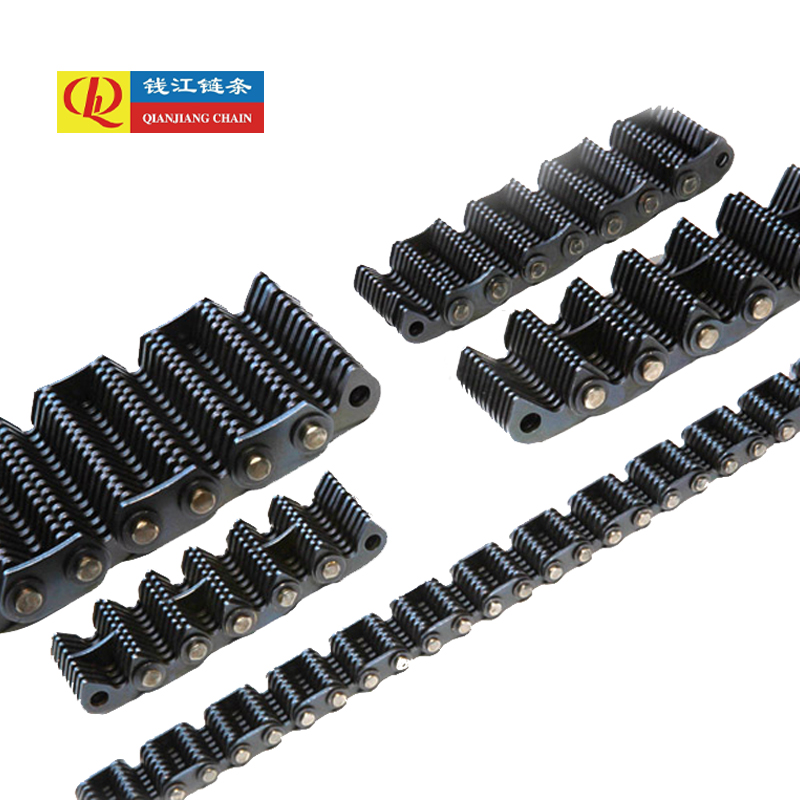
Silent chains largely eliminate this impact noise because the toothed plates mesh gradually and continuously with the sprocket, distributing the engagement load across multiple teeth simultaneously. The result is a significantly quieter and smoother drive, even at high operating speeds. This makes silent chains the preferred choice in noise-sensitive environments such as automotive engine timing systems, office printing equipment, textile machinery, and food processing lines where operator comfort or product quality is affected by mechanical noise.
Speed and Load Capacity Comparison
Speed capability and load handling are two of the most critical selection criteria for any chain drive. The table below provides a general comparison of typical operating parameters for silent chains and roller chains:
| Parameter | Silent Chain | Roller Chain |
| Typical Max Speed | Up to 12,000 RPM | Up to 6,000 RPM (standard) |
| Noise Level | Low | Moderate to High |
| Load Distribution | Across multiple teeth | One roller at a time |
| Width / Compactness | Wider for same power | Compact, narrow options |
| Cost | Higher | Lower |
| Lubrication Requirement | Continuous oil bath preferred | Drip, bath, or periodic |
| Shock Load Tolerance | Good | Very Good |
| Typical Applications | Engine timing, textile, printing | Conveyors, bikes, agriculture |
Silent chains can operate at significantly higher pitch line speeds than standard roller chains because the smooth meshing action generates less dynamic shock loading at elevated RPMs. However, roller chains excel in applications involving heavy shock loads, contaminated environments, or where the drive system is exposed to abrasive conditions — situations where a roller chain's robust, sealed-roller construction offers better resilience and easier maintenance.
Lubrication Requirements and Maintenance Demands
Lubrication needs differ considerably between the two chain types, and this has a direct impact on maintenance schedules and system design complexity. Roller chains can be lubricated in several ways depending on speed and load: manual periodic lubrication with a brush or oil can for low-speed drives, drip lubrication via a wick or drip nozzle for medium-speed drives, and oil bath or oil stream lubrication for high-speed or heavy-duty drives. In dry or contaminated environments, O-ring or X-ring sealed roller chains encapsulate grease inside each link, eliminating the need for external lubrication for extended periods.
Silent chains are considerably more demanding in their lubrication requirements. Because the toothed link plates slide and mesh against the sprocket teeth, and because multiple pin joints articulate simultaneously during every revolution, continuous and thorough lubrication is essential to prevent accelerated wear. Most silent chain drives are enclosed in an oil-tight housing with a dedicated oil bath or forced lubrication system. Attempting to run a silent chain with inadequate lubrication results in rapid wear of the link plate teeth, loss of pitch accuracy, and eventual drive failure — often much faster than a similarly neglected roller chain. This makes silent chain drives less suitable for open or partially enclosed drive environments.
Where Each Chain Type Is Most Commonly Used
Matching the chain type to the application is ultimately what determines long-term performance and cost-effectiveness. The distinct characteristics of each chain have led to clear industry preferences across different sectors.
Typical Silent Chain Applications
- Automotive engine timing: Silent chains drive the camshaft from the crankshaft in many petrol and diesel engines, where precise timing, quiet operation, and long service intervals are non-negotiable requirements.
- Textile machinery: Looms and spinning equipment require smooth, high-speed drives that do not generate vibration which could affect fabric quality or break delicate yarns.
- Printing presses: The precision and low vibration of silent chains help maintain registration accuracy between print stations at high production speeds.
- Machine tool spindle drives: CNC machining centers use silent chains where vibration from a standard roller chain could compromise surface finish quality on machined components.
Typical Roller Chain Applications
- Bicycles and motorcycles: The roller chain's compact design, ease of replacement, and tolerance for partial lubrication make it the universal choice for human and engine-powered two-wheelers.
- Agricultural machinery: Combines, balers, and tractors operate in harsh, dusty environments where the ruggedness of roller chains and their simple field repairability are essential.
- Industrial conveyors: Roller chains handle the continuous, moderate-speed operation of conveyor systems in warehouses, food processing plants, and manufacturing lines.
- Construction equipment: Excavators, forklifts, and lifting equipment use heavy-duty roller chains that can absorb significant shock loads and resist contamination from dirt and grit.
Wear, Elongation, and Service Life
All chains elongate over time as pin and bushing contact surfaces wear, and monitoring this elongation is the primary way to judge when a chain needs replacement. Roller chains elongate as the pins wear into the bushings, increasing the effective pitch length of each link. Industry guidelines typically recommend replacing a roller chain when it has elongated by 2% or more, as beyond this point the chain rides up on sprocket teeth and accelerates sprocket wear. Elongation is easy to measure directly using a chain elongation gauge or a steel rule across a fixed number of links.
Silent chains wear differently. The primary wear mechanism is the gradual erosion of the link plate tooth flanks and the sprocket tooth surfaces where they contact. As this material is lost, the chain pitches outward on the sprocket, effectively climbing the teeth, which changes the drive geometry and reduces transmission accuracy. Worn silent chains may also develop increased noise — partly defeating their primary design advantage. Inspection of a silent chain drive requires examining both the chain and sprocket tooth profiles, as sprocket wear often progresses faster than chain wear in under-lubricated systems. Silent chains that operate within sealed, well-lubricated housings can achieve service lives comparable to or exceeding those of roller chains in equivalent applications.
Cost Considerations and Choosing the Right Chain
From a pure procurement standpoint, silent chains are considerably more expensive than roller chains of equivalent power capacity. The complex multi-plate link construction, tighter manufacturing tolerances, and lower production volumes compared to the ubiquitous roller chain all contribute to a higher unit cost. The enclosed lubrication system required for most silent chain drives adds further cost and design complexity to the overall installation. For budget-constrained applications where noise is not a critical concern, roller chains almost always offer the better cost-to-performance ratio.
However, total cost of ownership — factoring in noise attenuation measures, vibration dampening components, and the productivity impact of operating in a noisy environment — can favor the silent chain in appropriate applications. When making the final selection, engineers should evaluate the following key decision factors:
- Speed requirements: If pitch line speeds exceed 5–6 m/s consistently, the silent chain's smoother engagement becomes a significant performance advantage.
- Noise sensitivity: Applications in occupied spaces, precision instruments, or consumer products justify the additional cost of a silent chain drive.
- Enclosure feasibility: If the drive cannot be fully enclosed for oil bath lubrication, a roller chain with appropriate sealing or a sealed roller chain variant is the more practical choice.
- Shock load profile: Heavy, intermittent shock loads favor roller chains, which absorb impact energy through the rolling contact between roller and sprocket rather than through direct tooth engagement.
- Maintenance capability: If on-site maintenance resources are limited, the simpler roller chain — which can be inspected, measured, and replaced with basic tools — offers a practical operational advantage over the more specialized silent chain.
News
-
I. Introduction Conveyor systems form the backbone of modern industrial automation, enabling the eff...
READ MORE -
1. Introduction 1.1 Definition and Basic Concept of Coupling Chains Coupling chains are mechanical d...
READ MORE -
1. Introduction to Leaf Chains Leaf chains are a type of mechanical chain used in a variety of indus...
READ MORE

 +86-13805752016
 +86-571-82875104/82875108
 [email protected]
 No. 80 QianNong West Road, Xiaoshan District, Hangzhou City, Zhejiang Province,China
Copyright © Hangzhou Qianjiang Chain Industries Co., Ltd. All Rights Reserved.
|
 浙公网安备33010902004043号