
 Eng
Eng  中文简体
中文简体Home / News / Industry News / What Is a Chain Drive? Types, Selection Criteria, and Industrial Applications
Submit feedback
What Is a Chain Drive? Types, Selection Criteria, and Industrial Applications
Update:09-10-2026
Posted by Admin
Content
When a conveyor line stops because a drive chain has stretched beyond its limit, the cost is not limited to a replacement part. The real cost is downtime, missed deadlines, and a decision made in a hurry that often repeats the same failure months later. The best way to avoid that cycle is to understand what a chain drive is, why it behaves the way it does, and what to check before specifying a chain for a new machine or replacing one in the field. Chain drives are still one of the most reliable ways to transmit mechanical power, but their service life depends on choices made during selection.
What Is a Chain Drive?
A chain drive is a mechanical power transmission system that transfers rotary motion from one shaft to another using a chain that engages with toothed sprockets. The driving sprocket is mounted on the input shaft, while the driven sprocket is fixed to the output shaft. As the input shaft rotates, the chain links are pulled around the sprocket teeth, and this engagement turns the driven sprocket at a fixed speed ratio, with no slipping.
A conventional chain drive consists of the chain itself, a driving sprocket, a driven sprocket, and a method of maintaining tension. The chain is made up of alternating pin links and roller links, which create a flexible but strong connection. The fit between chain rollers and sprocket teeth is deliberately designed so that the chain can transmit power in one direction while still allowing slight articulation at each joint.
The reason a chain drive is chosen for so many industries is its positive drive. Unlike a belt, which can slip under heavy torque, a chain maintains its grip using mechanical engagement. This is why chain drives are common in conveyors, motorcycles, agricultural machinery, and many other machines where speed consistency is important.
How a Chain Drive Works
The chain is wrapped around the driving and driven sprockets. When the driving sprocket rotates clockwise, the chain links on the connected side are pulled into tight engagement with the sprocket teeth. The same action takes place on the driven sprocket, causing it to rotate in the same direction. The tooth profile of the sprocket and the pitch of the chain are matched, so the linkage remains constant while the chain moves over the teeth.
The most important operating parameter is the speed ratio, which is calculated from the number of teeth on the two sprockets. For example, if the driving sprocket has 20 teeth and the driven sprocket has 40 teeth, the driven shaft rotates at half the speed of the input shaft while delivering twice the torque. This simple relationship is what makes a chain drive useful in both high-speed timing applications and heavy-duty lifting equipment.
Chain drives can reach mechanical efficiency above 98% when they are correctly tensioned and lubricated. However, efficiency drops quickly when the chain is too loose, too tight, or running dry. A chain that is too loose will jump teeth on the sprocket, causing production stops and possible damage. A chain that is too tight increases bearing loads and accelerates wear on both the chain and the sprocket.
Main Chain Types Used in a Chain Drive
The chain drive design changes with the application. The most common categories in industrial use are precision roller chains, conveyor chains, and sealed chains. Each type serves a different purpose, and the operating conditions determine which one is appropriate.
Precision roller chains
Precision roller chains, including A-series and B-series short pitch chains, are the general-purpose building blocks of industrial drives. A-series chains follow the American standard, while B-series chains follow the European standard. They are used in machine tools, packaging lines, and agricultural equipment. Their main advantage is a good balance between load capacity, speed capability, and cost. Selecting the right pitch and number of strands determines whether the chain will run quietly or need frequent replacement.
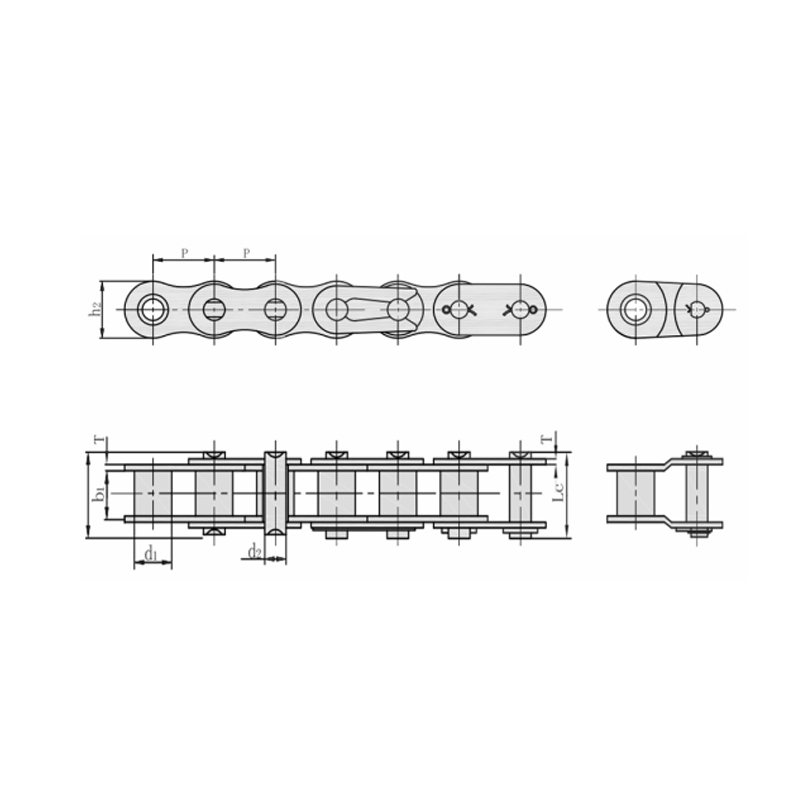 A-series short pitch precision roller chains for reliable power transmissionA-series precision roller chains offer high accuracy and smooth operation, making them essential for conveyors, material handling, and industrial machinery. Their precise link alignment enhances load distribution, reducing wear and maintenance.View Product →
Conveyor chains
Conveyor chains are designed for lower operating speeds and higher torque levels. They are often fitted with attachments, such as extended pins or centre holes, to push or carry products. Double pitch conveyor chains with attachments are common in packaging lines, sorting systems, and material handling equipment. Because they allow longer centre distances than standard roller chains, they reduce the number of intermediate supports and simplify machine layout.
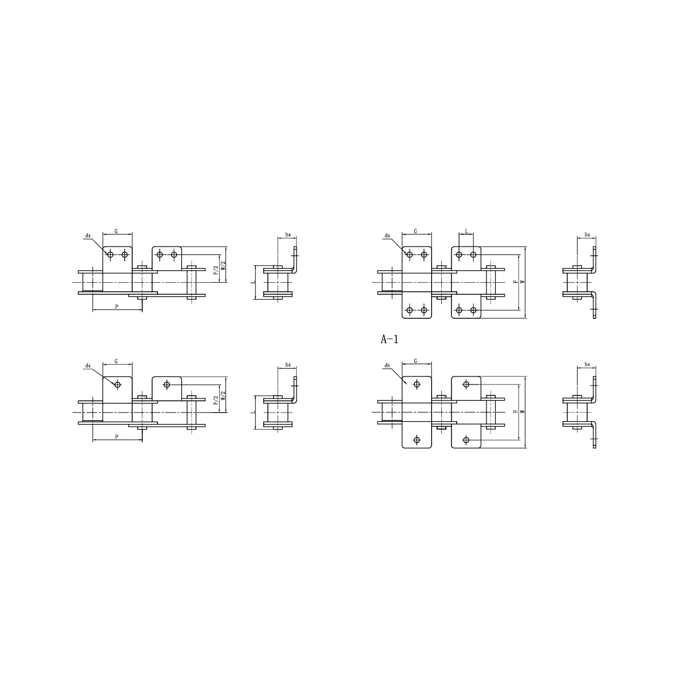 Double pitch conveyor chains with attachments for material handlingThese chains feature extended pitch and customizable attachments, suitable for transporting products in packaging, sorting, and assembly lines. They provide a lightweight, cost-effective solution with low maintenance needs.View Product →
Sealed chains and oil-seal chains
Sealed chains use rubber O-rings or X-rings fitted between the pin link plates and roller link plates. These rings retain factory-applied lubricant inside the joint, protecting the pin and bush from wear. In outdoor vehicles, dusty environments, or high-speed machines, a sealed chain lasts longer than an open chain, because the lubricant is not immediately lost to dirt or water. Industrial oil-seal chains serve the same purpose in complex machine lines or other equipment where centralised lubrication is not practical.
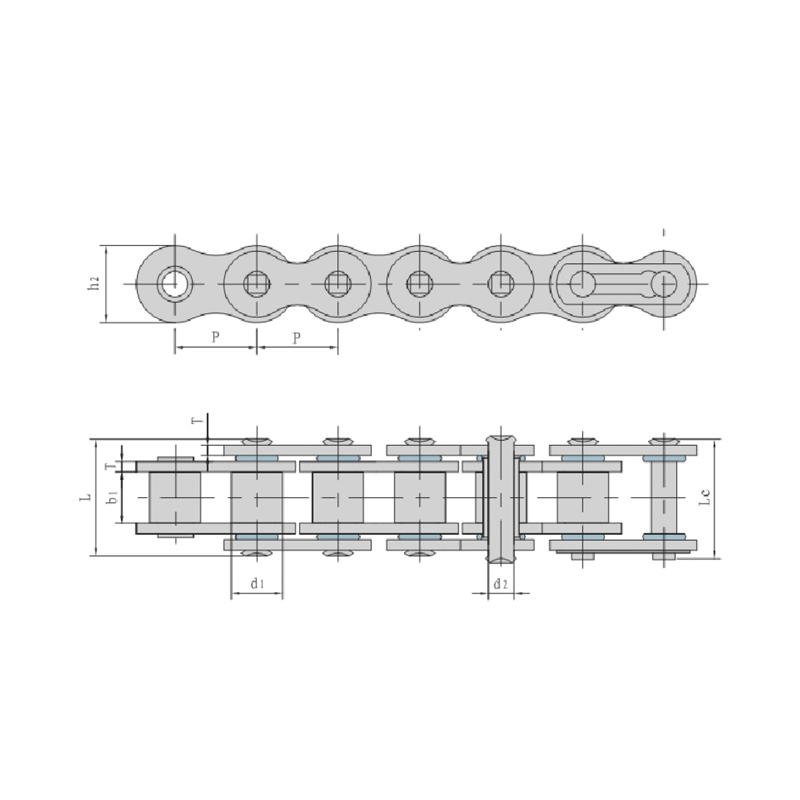 Mechanical transmission sealed chains for harsh environmentsSealed chains incorporate O-rings or X-rings to retain lubricant, protecting against dust, dirt, and moisture. This extends chain life and reduces maintenance in industrial, agricultural, and automotive applications.View Product →
Other chain types also appear in specialised drives. Leaf chains are used in lifting and counterweight applications. Silent chains, also known as inverted tooth chains, reduce noise in precision drives. Stainless steel chains are used in food processing and chemical environments where corrosion resistance is a priority.
How to Choose a Chain Drive
Choosing a chain drive is not only about picking a chain from a catalogue. It is about matching the chain construction to the operating duty. A few basic questions clarify most of the options.
- Load and torque: Determine the maximum torque that the drive must transmit. This is the primary factor for the chain pitch and tensile strength. Undersized chains fail through fatigue, while oversized chains increase cost and weight.
- Operating speed: The chain speed in metres per second determines whether a roller chain, a double pitch conveyor chain, or a sealed chain is the better fit. Standard roller chains can run faster than conveyor chains, but the speed limit changes with pitch and lubrication.
- Centre distance: If the shafts are far apart, a larger pitch chain adapts better and avoids excessive chain length. In such cases, a double pitch chain is often technically sounder.
- Service environment: Dust, water, heat, and chemicals all affect chain choice. A sealed chain offers protection against dirt, while a stainless steel chain is used where corrosion is the dominant risk.
- Lubrication: Chains need consistent lubrication. If a machine cannot accept automated lubrication, a sealed chain reduces the maintenance burden.
Let us consider one example. In a heavy-duty conveyor running at 1.5 metres per second with a 3-metre centre distance, a standard roller chain may already be operating near its speed limit. A double pitch conveyor chain will handle the same duty with more reliability, because the larger pitch reduces the articulation frequency that drives wear.
Another detail that is often ignored is the minimum number of teeth on the driving sprocket. Running with too few teeth increases the articulation angle at every joint, causing the chain to fatigue earlier. A practical rule is to keep the driving sprocket above 17 teeth whenever possible.
When an application falls outside the normal catalogue range, a manufacturer with experience in non-standard chains can advise on the right construction. This is where a company like Qianjiang Chain, which has produced heavy-duty roller chains and oil-seal chains in cooperation with the China Chain Transmission Research Institute, can offer practical support.
Advantages and Disadvantages of Chain Drives
| Advantages | Disadvantages |
|---|---|
| Positive engagement, with no slip even under high torque | Requires regular lubrication to prevent rapid wear |
| Compact and durable in dusty, wet, or hot environments | Can be noisy if tension and tooth alignment are not controlled |
| Suitable for long centre distances with a proper supports | Heavier than many belt drives, and the chain adds weight to the supporting structure |
| High efficiency, often above 98% with correct maintenance | Corrosion becomes a risk unless the chain is coated or stainless steel is used |
Maintenance and Common Failure Points
The most common failure of a chain drive is not a broken link. It is chain elongation caused by hinge wear. Each articulation of the chain joint removes a small amount of metal from the pins and bushings, and the chain gradually becomes longer. This elongation changes the chain pitch and prevents the rollers from seating correctly on the sprocket teeth. When a chain has stretched by about 3% of its original length, it is normally considered unsuitable for continued service.
Other common problems include a misaligned drive, which causes edge loading and accelerated sprocket wear; incorrect tension, which produces excessive noise and chain jumping; and the absence of adequate lubrication, which leads to wear on the inner surfaces of the chain.
The simplest way to extend the life of a chain drive is to check the drive chain regularly and to replace a stretched chain before it damages the sprockets. For replacement, understanding how to identify the quality of a drive chain helps to avoid purchasing a chain that will fail in a short time.
If the failed chain is in a stainless steel application or a washdown environment, cleaning and lubrication protocols are different. A useful guide is to review special application scenarios of stainless steel chains before specifying a replacement.
For equipment that uses a chain driven by multiple shafts, proper alignment and the use of matching sprockets will usually provide the longest service life. The chain, sprockets, and shaft-bearing system should be treated as one unit, not as separate parts.
Chain drive selection is a practical engineering decision. The technology is mature, but the reliability of the installation depends on matching the chain type to load, speed, centre distance, and environment. With proper lubrication and periodic inspection, a correctly selected chain drive can run for years above 98% efficiency. For engineers and buyers, the practical question is not whether a chain drive will work, but which chain construction should be specified for the exact duty.
News
-
I. Introduction Conveyor systems form the backbone of modern industrial automation, enabling the eff...
READ MORE -
1. Introduction 1.1 Definition and Basic Concept of Coupling Chains Coupling chains are mechanical d...
READ MORE -
1. Introduction to Leaf Chains Leaf chains are a type of mechanical chain used in a variety of indus...
READ MORE

 +86-13805752016
 +86-571-82875104/82875108
 [email protected]
 No. 80 QianNong West Road, Xiaoshan District, Hangzhou City, Zhejiang Province,China
Copyright © Hangzhou Qianjiang Chain Industries Co., Ltd. All Rights Reserved.
|
 浙公网安备33010902004043号