
 Eng
Eng  中文简体
中文简体Home / News / Industry News / What Do You Really Need to Know Before Buying and Maintaining Motorcycle Chains?
Submit feedback
What Do You Really Need to Know Before Buying and Maintaining Motorcycle Chains?
Update:04-06-2026
Posted by Admin
Content
- 1 Why the Motorcycle Chain Is One of the Most Critical Components on Your Bike
- 2 The Three Main Types of Motorcycle Chains
- 3 Understanding Chain Size and Compatibility
- 4 How to Check Chain Tension Correctly
- 5 Lubrication: What to Use and How Often
- 6 When to Replace Your Motorcycle Chain
- 7 Cleaning Your Chain the Right Way
Why the Motorcycle Chain Is One of the Most Critical Components on Your Bike
The drive chain on a motorcycle does one essential job: it transfers power from the gearbox output sprocket to the rear wheel sprocket, propelling the bike forward. Despite being a relatively simple mechanical component, the chain operates under significant stress — enduring tension, shock loads, heat, dirt, and constant flexing across thousands of kilometres. When a chain is in good condition and correctly maintained, it performs silently and efficiently. When neglected, it becomes a serious safety hazard. Chain failure at speed can lock the rear wheel, damage the swingarm, or even derail entirely — outcomes that are entirely preventable with the right knowledge and routine care.
Understanding how motorcycle chains work, how to distinguish between different types, and what a proper maintenance routine looks like is essential knowledge for any rider — whether you ride a commuter, a sportsbike, or an adventure tourer. This guide covers all of that in practical detail.
The Three Main Types of Motorcycle Chains
Not all motorcycle chains are the same. The differences between types affect durability, maintenance requirements, and suitability for different riding styles and power outputs.
Standard (Non-Sealed) Chains
Standard chains have no internal lubrication between the pins and bushings. They are lighter and less expensive than sealed alternatives, but they require much more frequent lubrication — in some cases after every ride in wet conditions. They are most commonly found on smaller displacement bikes, off-road motorcycles, and budget models. For high-mileage road use, they wear out significantly faster than sealed chains.
O-Ring Chains
O-ring chains incorporate small rubber O-rings between the inner and outer link plates, sealing grease inside each pin-bushing joint at the point of manufacture. This internal lubrication dramatically reduces wear at the critical contact points and extends chain life considerably compared to standard chains. The trade-off is a marginal increase in friction and weight, which is imperceptible on most road bikes but relevant to racing applications.
X-Ring and Z-Ring Chains
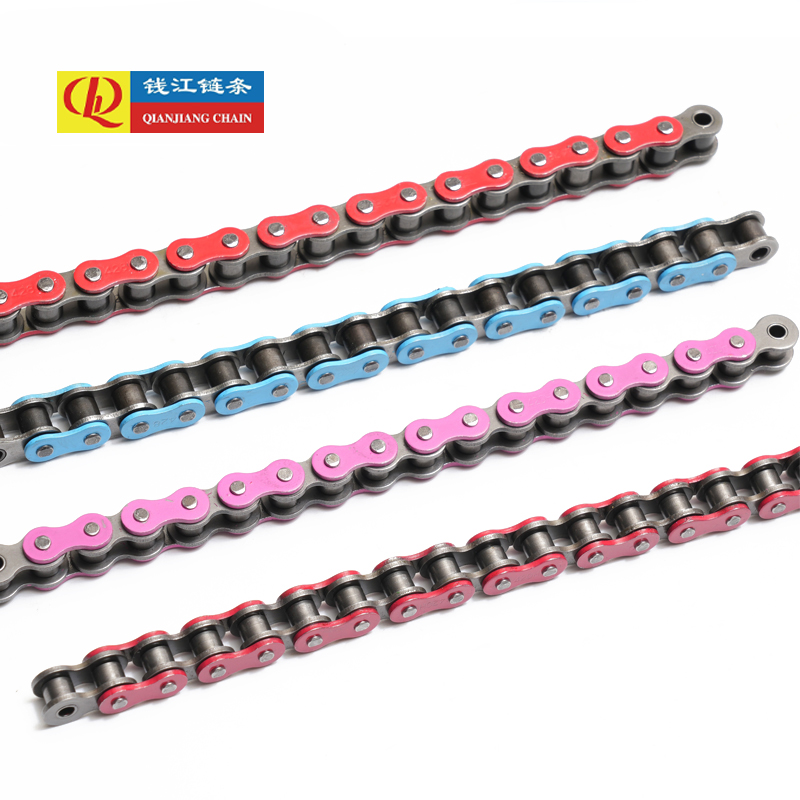
X-ring chains use X-shaped seals instead of round O-rings, which reduces the contact surface area between the seal and link plates. This lowers friction compared to O-ring designs while maintaining excellent sealing performance. Z-ring chains use a similar principle with a slightly different seal profile. Both are considered premium options, offering the best combination of longevity, low friction, and reliable internal lubrication. They are the standard fitment on most modern mid-to-large displacement motorcycles.
Understanding Chain Size and Compatibility
Motorcycle chains are sized by a standardised numbering system that encodes pitch (the distance between link pins) and width. The most common sizes found on road motorcycles are shown below:
| Chain Size | Pitch (mm) | Typical Application |
| 420 | 12.7 | Small bikes, 50–125cc |
| 428 | 12.7 | 125–250cc commuters and entry bikes |
| 520 | 15.875 | Mid-range and sportsbikes, 250–750cc |
| 525 | 15.875 | 600cc–1000cc sportsbikes and tourers |
| 530 | 15.875 | Large displacement, heavy tourers |
Always replace a chain with the exact size specified in your owner's manual. Fitting the wrong size risks incompatibility with existing sprockets and can cause accelerated wear or dangerous skipping under load. If you are upgrading to a lighter chain size (a common modification on sportsbikes — for example, converting from 530 to 520), sprockets must be replaced simultaneously to match the new chain pitch.
How to Check Chain Tension Correctly
Incorrect chain tension is one of the most common causes of premature chain and sprocket wear. A chain that is too tight places excessive load on the transmission output shaft bearing and the chain itself; one that is too loose risks slapping against the swingarm, skipping teeth, or derailing. Most manufacturers specify a free play of between 25mm and 35mm measured at the midpoint of the lower chain run, but this figure varies — always consult your specific model's service manual.
To check tension accurately, place the bike on its centre stand or paddock stand so the rear wheel is off the ground. Rotate the wheel slowly by hand and check the slack at multiple points around the chain. Because chains wear unevenly, some sections will be tighter than others. The tightest point should still fall within the manufacturer's specified range. If it does not, the chain is either worn unevenly — a sign it needs replacement — or the tension needs adjustment at the rear axle adjusters.
Lubrication: What to Use and How Often
Even sealed chains with internal grease require external lubrication on the outer surface of the rollers and between the inner and outer plates. Without it, surface corrosion and accelerated wear occur at the roller-sprocket contact point. Choosing the right lubricant and applying it correctly makes a significant difference to chain life.
- Dedicated chain wax or chain lube spray: These are the most practical options for regular road use. Wax-based products fling off less under high-speed rotation and resist washing off in rain better than oil-based alternatives. Apply after a ride while the chain is warm, not hot — warm metal improves penetration without burning off the lubricant.
- Avoid WD-40 as a primary lubricant: WD-40 is a water displacer and light penetrant, not a chain lubricant. It will clean the chain surface temporarily but provides no lasting film protection and can degrade O-ring seals over time.
- Frequency: Under normal conditions, lubricate every 500–800km. After riding in rain or through mud, clean and re-lubricate immediately. Chains dry out and corrode faster in wet conditions regardless of seal type.
- Application method: Apply lubricant to the inner edge of the chain (the side facing the sprockets) while rotating the rear wheel. This allows centrifugal force to distribute the lubricant outward during riding. Wipe away excess from the outer plates to reduce fling-off onto the tyre sidewall.
When to Replace Your Motorcycle Chain
Chains do not last indefinitely, and riding on a worn chain accelerates sprocket wear — a more expensive component to replace. The most reliable way to check for wear is to use a chain wear indicator tool, which measures pin-to-pin elongation. A chain that has stretched beyond 0.5% of its nominal length (often marked as the red zone on wear gauges) should be replaced. Without a specialist tool, a practical field check is to pull the chain away from the rear sprocket at the 3 o'clock position: if you can pull it far enough to expose more than half a sprocket tooth, it is worn.
Additional signs that replacement is overdue include stiff or kinked links that do not flex freely, visible rust or corrosion on the link plates or rollers, and uneven slack around the chain's circumference that cannot be resolved through tension adjustment. As a general rule, chains and sprockets should be replaced as a set — fitting a new chain on worn sprockets (or vice versa) causes rapid wear of the new component and wastes money.
Cleaning Your Chain the Right Way
Regular cleaning removes accumulated grit, road film, and old lubricant that would otherwise act as an abrasive compound between the chain and sprockets. The process is straightforward but should be done carefully to avoid damaging seals. Use a dedicated chain cleaner spray or kerosene applied with a stiff-bristled brush — a purpose-made chain cleaning brush with multiple sides simplifies the task considerably. Work around the full length of the chain, scrubbing the rollers, inner plates, and outer plates thoroughly.
Avoid high-pressure washing directly at the chain, as this can force water past the O-ring or X-ring seals and flush out internal grease. Similarly, avoid solvent-based degreasers that are known to degrade rubber, such as acetone or brake cleaner. After cleaning, allow the chain to dry fully before applying fresh lubricant. A clean, well-lubricated chain not only lasts longer — it also runs more quietly and delivers power more efficiently, benefits that are immediately noticeable on any bike.
News
-
I. Introduction Conveyor systems form the backbone of modern industrial automation, enabling the eff...
READ MORE -
1. Introduction 1.1 Definition and Basic Concept of Coupling Chains Coupling chains are mechanical d...
READ MORE -
1. Introduction to Leaf Chains Leaf chains are a type of mechanical chain used in a variety of indus...
READ MORE

 +86-13805752016
 +86-571-82875104/82875108
 [email protected]
 No. 80 QianNong West Road, Xiaoshan District, Hangzhou City, Zhejiang Province,China
Copyright © Hangzhou Qianjiang Chain Industries Co., Ltd. All Rights Reserved.
|
 浙公网安备33010902004043号