
 Eng
Eng  中文简体
中文简体Submit feedback
What Are Precision Roller Chains and How Do You Choose the Right One?
Update:06-08-2026
Posted by Admin
Content
What Makes Precision Roller Chains Different
Precision roller chains are mechanical power transmission components built to tight manufacturing tolerances, allowing them to transfer torque smoothly between sprockets with minimal backlash and vibration. Unlike standard duty chains, precision roller chains are manufactured with controlled pin, bushing, and roller dimensions, which reduces friction losses and extends operating life under repetitive loading. These chains are widely used in conveyors, packaging machinery, printing equipment, agricultural machinery, and industrial automation lines where consistent motion accuracy directly affects product quality.
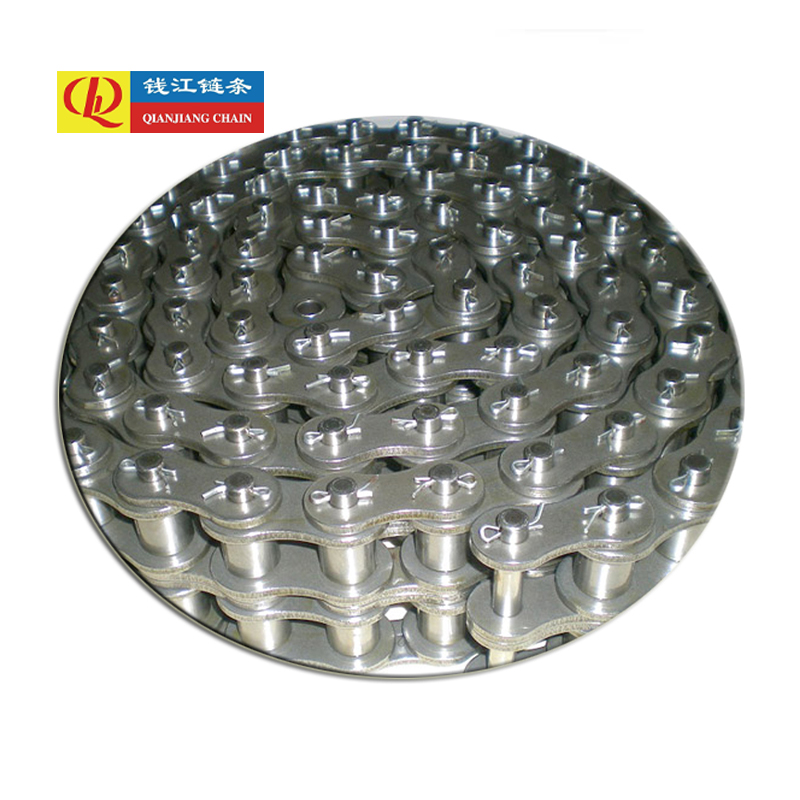
The core structure of a precision roller chain includes inner plates, outer plates, pins, bushings, and rollers. Each roller rotates freely around its bushing, which reduces sliding friction against the sprocket teeth during engagement. This design lowers wear on both the chain and the sprocket, making precision roller chains a cost-effective choice for high-cycle applications where downtime is expensive.
Key Specifications to Understand
Before purchasing a precision roller chain, it helps to understand the specifications that determine compatibility and performance. Chains are identified using a standardized numbering system that indicates pitch size, and each number corresponds to a specific set of dimensions defined by ANSI or ISO standards.
Pitch and Chain Number
Pitch refers to the distance between the centers of two consecutive pins. This measurement determines how the chain engages with a sprocket, so pitch must match exactly between the chain and sprocket for proper operation. The table below shows common ANSI chain numbers and their corresponding pitch sizes.
| Chain Number | Pitch (inch) | Typical Use |
| 40 | 0.500 | Light machinery |
| 50 | 0.625 | Conveyors, general industrial |
| 60 | 0.750 | Agricultural and packaging equipment |
| 80 | 1.000 | Heavy-duty drive systems |
Tensile Strength and Load Ratings
Every precision roller chain carries a rated tensile strength, which indicates the maximum load it can withstand before breaking, and a working load limit, which is the safe operating load for continuous use. Working load limits are typically a fraction of the rated tensile strength to account for shock loads, fatigue, and wear over the chain's service life. Selecting a chain with an adequate safety margin above your calculated load requirement helps prevent premature failure.
Choosing the Right Chain for Your Application
Selecting a precision roller chain involves more than matching pitch size. Speed, load, environment, and required precision all influence which chain construction and material will perform best over time.
Load and Speed Considerations
High-speed applications generate more heat and centrifugal force at the rollers and bushings, which accelerates wear if the chain is undersized. For applications running above a few hundred RPM, engineers typically select a chain one size larger than the minimum load calculation suggests, or switch to a double or triple strand configuration to distribute load across more contact points.
Environmental Factors
Operating environment plays a major role in material selection. The following list outlines common environmental conditions and the chain types best suited to each.
- Wet or corrosive environments: stainless steel or nickel-plated chains resist rust and chemical exposure.
- High-temperature environments: chains with heat-treated components and high-temperature lubricants maintain dimensional stability.
- Food and beverage processing: food-grade lubricants and stainless steel chains meet sanitary requirements.
- Dusty or abrasive environments: sealed bushing chains reduce contamination entering the pin-bushing interface.
Installation Best Practices
Correct installation directly affects how long a precision roller chain lasts. Sprockets should be checked for wear before installing a new chain, since worn sprocket teeth accelerate chain stretch even when the chain itself is new. Shaft alignment should be verified with a straightedge or laser alignment tool, as misalignment causes uneven load distribution across the chain width and leads to premature side-plate wear.
Chain tension should be set according to the manufacturer's recommended sag, typically allowing a small amount of slack on the non-driving side to accommodate thermal expansion and normal elongation. Overtightening a chain increases bearing loads and accelerates wear on both the chain and the shaft bearings, so tension should always be checked against specification rather than tightened by feel.
Maintenance and Lubrication
Routine maintenance is the single most effective way to extend the service life of a precision roller chain. Lubrication reduces friction between the pin and bushing, which is the primary source of chain elongation over time. The list below summarizes core maintenance practices for keeping chains running reliably.
- Apply lubricant directly to the pin-bushing interface, not just the outer surface of the chain.
- Clean chains periodically to remove dirt and debris that can act as an abrasive paste when mixed with lubricant.
- Inspect chain elongation regularly using a wear gauge, and replace the chain once elongation exceeds the manufacturer's recommended limit, typically around 2 to 3 percent.
- Replace chains and sprockets together when wear is significant, since a new chain running on worn sprockets wears out much faster.
Common Failure Modes and How to Avoid Them
Understanding why chains fail helps operators catch problems before they cause unplanned downtime. The table below outlines frequent failure modes, their typical causes, and preventive actions.
| Failure Mode | Common Cause | Preventive Action |
| Excessive elongation | Insufficient lubrication, abrasive contamination | Scheduled lubrication and cleaning |
| Roller cracking | Shock loading, misaligned sprockets | Alignment checks and load analysis |
| Corrosion | Exposure to moisture or chemicals | Stainless or coated chain selection |
| Sprocket tooth wear | Chain and sprocket size mismatch | Replace chain and sprocket as a set |
Precision roller chains deliver reliable, efficient power transmission when the pitch, load rating, and material are matched correctly to the application, and when installation and lubrication practices are followed consistently. Taking the time to select the right chain and maintain it properly reduces unplanned downtime, extends equipment life, and lowers overall maintenance costs across the operation.
News
-
I. Introduction Conveyor systems form the backbone of modern industrial automation, enabling the eff...
READ MORE -
1. Introduction 1.1 Definition and Basic Concept of Coupling Chains Coupling chains are mechanical d...
READ MORE -
1. Introduction to Leaf Chains Leaf chains are a type of mechanical chain used in a variety of indus...
READ MORE

 +86-13805752016
 +86-571-82875104/82875108
 [email protected]
 No. 80 QianNong West Road, Xiaoshan District, Hangzhou City, Zhejiang Province,China
Copyright © Hangzhou Qianjiang Chain Industries Co., Ltd. All Rights Reserved.
|
 浙公网安备33010902004043号