
 Eng
Eng  中文简体
中文简体Home / News / Industry News / The Essential Leaf Chain Guide: Types, Lacing, Selection, and Maintenance
Submit feedback
The Essential Leaf Chain Guide: Types, Lacing, Selection, and Maintenance
Update:28-09-2026
Posted by Admin
Content
Stand in front of a forklift truck and watch the mast move. Hidden inside the rails, a length of leaf chain is taking the entire load of the mast and forks. The same simple component raises lifting platforms, positions machine-tool counterweights, and moves loads in automated warehouses. A leaf chain is made of only two parts: precision link plates and hardened pins. There are no rollers and no bushings, which is exactly why it can be so strong and compact for lifting duties. In short, if the motion is straight-line pulling or lifting, a leaf chain is usually the right answer. For a broader reference on this chain family, see our complete guide to leaf chain types, applications, and maintenance.
What Is a Leaf Chain and How Does It Differ from Roller Chain?
By design, a leaf chain is a tension member, not a power-transmission element. Roller chains transmit torque between sprockets and tolerate continuous flexing around multiple teeth. Leaf chains run over a grooved sheave and are normally used with one end fixed and the other moving with the load. Because the plates interlock with the sheave groove, the chain provides precise positioning without the sliding resistance of a toothed drive.
From a maintenance perspective, the absence of rollers changes both the wear mechanism and the lubrication requirement. In a roller chain, wear takes place between the pin, bush, and roller. In a leaf chain, wear concentrates at the pin-to-plate interface and can be accelerated by dirt or lack of lubricant. The biggest practical difference is the failure mode: roller chain tends to elongate gradually; leaf chain can fatigue through the plates if it is repeatedly overloaded or misaligned.
| Aspect | Leaf chain | Roller chain |
|---|---|---|
| Construction | Link plates and pins only | Link plates, pins, bushings, and rollers |
| Primary function | Straight-line lifting and pulling | Power transmission between sprockets |
| Guiding element | Grooved sheave | Toothed sprocket |
| Main wear area | Pin-to-plate interface | Pin, bushing, and roller |
| Typical failure mode | Plate fatigue, pin fretting | Elongation and roller wear |
Leaf Chain Series: AL, LH-BL, and LL
Most manufacturers sort leaf chains into three familiar series. They share the same basic construction but differ in the thickness of the side plates, the diameter of the pins, and the available lacing combinations. The series you choose should match the load profile and the operating environment, not just the nominal size.
AL-series leaf chains are the most widely used for standard lifting and positioning applications. Their combination of high tensile strength and predictable fatigue life makes them a dependable choice for lift tables, elevators, counterweight systems, and mechanical handling equipment. We produce AL-series industrial-grade high-tensile leaf chains in standard and customized lacing, and they are available for OEM and aftermarket supply.
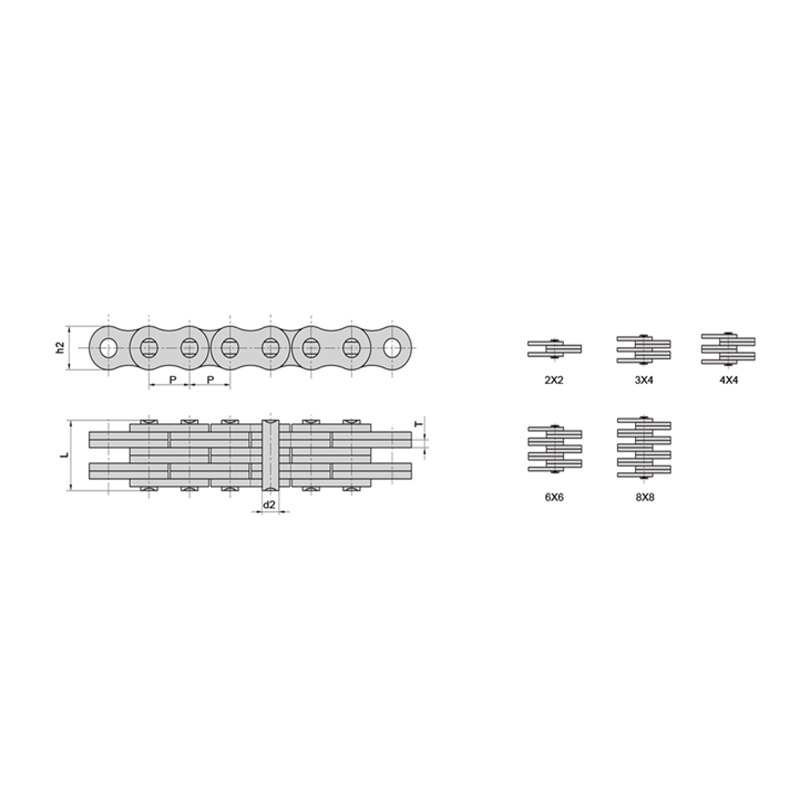 (AL Series) Industrial grade high tensile leaf chains Suppliers, FactoryHangzhou Qianjiang Chain Industries Co., Ltd is China wholesale (AL Series) Industrial grade high tensile leaf chains Suppliers and top F...View Product →
When the duty is heavier and shock loads are likely, LH-BL series leaf chains offer a larger pin-bearing area and a more wear-resistant plate structure. That extra material at the pin joint helps the chain survive repeated load reversals, which is why LH-BL chains are often specified for heavy counterweights, crane attachments, and aggressive handling applications. Our LH-BL series wear-resistant durable leaf chains are designed for these demanding conditions.
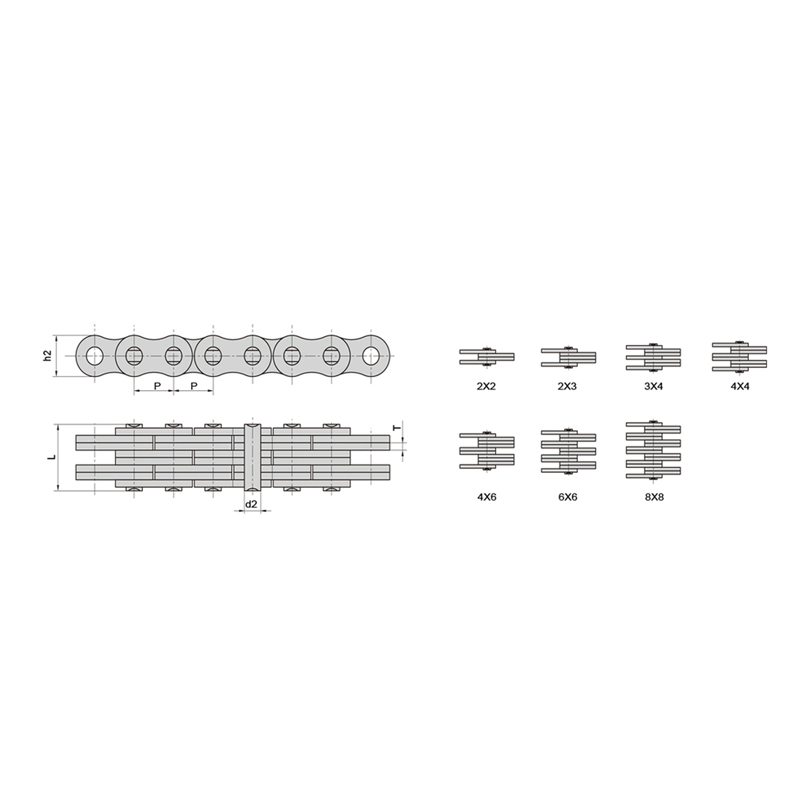 LH (BL Series) wear-resistant durable Leaf chains Suppliers, FactoryHangzhou Qianjiang Chain Industries Co., Ltd is China wholesale LH (BL Series) wear-resistant durable Leaf chains Suppliers and top Facto...View Product →
LL-series leaf chains take another approach to life-cycle cost. They are built for long-term stability with lower maintenance, using a wider pin-bearing contact area to distribute pressure more evenly. This makes them a strong candidate for continuous-duty lifting processes, palletizers, and automated handling systems where unscheduled stops are expensive. We stock LL-series low-maintenance high-stability leaf chains and can match the exact dimensions your equipment requires.
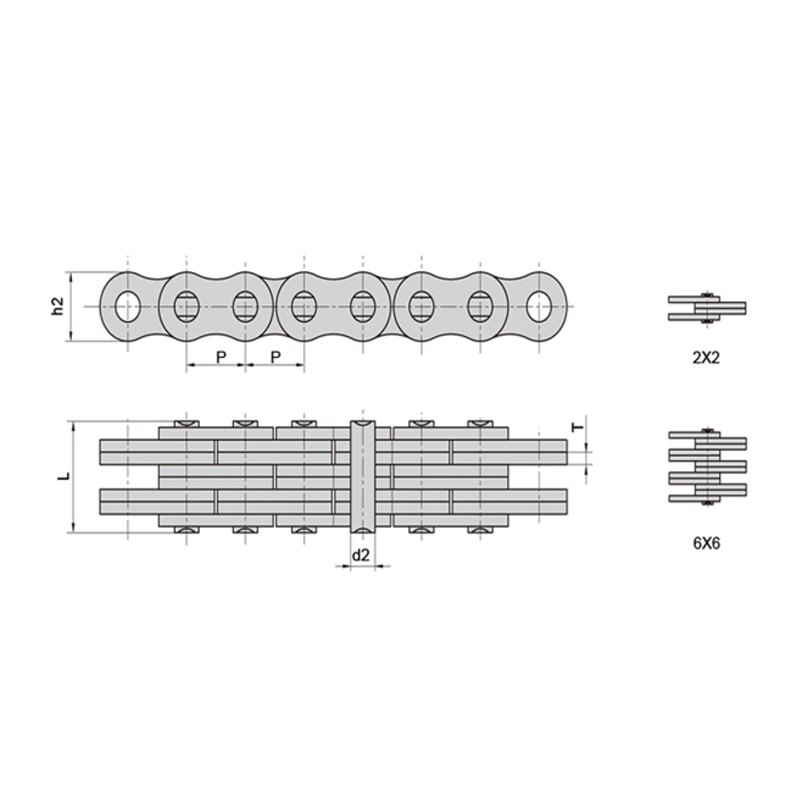 (LL Series) Low maintenance high stability leaf chains Suppliers, FactoryHangzhou Qianjiang Chain Industries Co., Ltd is China wholesale (LL Series) Low maintenance high stability leaf chains Suppliers and top ...View Product →
| Series | Key characteristic | Typical use |
|---|---|---|
| AL | Balanced tensile strength and compact size | Lift tables, elevators, positioning equipment |
| LH-BL | Large pins, high wear resistance | Heavy lifting, shock loads, counterweights |
| LL | Low maintenance, high stability | Continuous-duty lifting and automated handling |
Understanding Leaf Chain Lacing Combinations
The term lacing describes how the link plates are grouped across the width of a leaf chain. A lacing combination such as 2x2 or 3x3 indicates the number of plate sets in the cross-section and directly affects load capacity and bending flexibility. More plates mean a larger load-bearing area, but they also add weight and require a wider groove in the sheave.
Part numbers for leaf chain usually combine a series prefix with a numeric code. The code contains the pitch, pin diameter, and lacing combination, but the exact meaning is not perfectly uniform across all manufacturers. Before you order a replacement, compare the full part number with the drawing and measure the existing chain's width and pitch. If you need a non-standard lacing, a chain manufacturer with flexible tooling can often supply it, but the sheave and mast design must be compatible with the resulting chain width.
Choosing the Right Leaf Chain
Selecting a leaf chain is not as simple as matching the breaking load. The right choice depends on how many load cycles the chain will see, how the load is applied, and what environment it will work in. Use these considerations in your selection process:
- Load and safety factor: compare working load with the manufacturer's rating and apply a safety factor suited to the application.
- Fatigue life: frequent lifting causes cyclic stress; choose a lacing with enough bearing area for the expected cycle count.
- Sheave diameter: a smaller sheave increases bending stress in the plates; keep the sheave as large as the design allows.
- Attachment and end fitting: specify clevis, pin, or other end connection to match the machine frame.
- Corrosion and washdown environment: use a stainless steel leaf chain if moisture, chemicals, or frequent cleaning are present.
- Inspection requirement: plan for elongation checks and visual inspection at regular intervals.
If in doubt, ask the chain supplier for the fatigue curve and dimensional tolerances. A chain that passes a static tensile test can still fail early under cyclic lifting if the pin diameter or lacing is marginal. Better to start with a datasheet than to replace a chain after a sudden failure.
Installation and Maintenance Essentials
Installation requires more attention than many maintenance teams expect. The chain must run straight, without twisting, and the two chains on a lifting carriage should be matched in length and part number. Use proper end pins or anchors, and adjust the tension so that the chain is firm but not over-stressed.
Maintenance is straightforward. Clean the chain and re-lubricate the pin-to-plate joints with a good penetrating oil or an industrial chain grease. Check for cracked plates, bent pins, corrosion, and elongation. If one chain on a pair shows signs of fatigue, replace both sides at the same time to keep the load balanced. Never weld a leaf chain, apply heat, or attempt to straighten a damaged plate. When you follow a proper maintenance routine, a leaf chain can give years of quiet service.
Leaf chain is a mature and dependable product, but its performance depends on correct series selection, lacing, installation, and maintenance. Start by understanding the load cycle, match the right series and lacing, and work with a manufacturer that can provide the exact dimensions. When you do, leaf chain will not be the part that lets you down.
News
-
I. Introduction Conveyor systems form the backbone of modern industrial automation, enabling the eff...
READ MORE -
1. Introduction 1.1 Definition and Basic Concept of Coupling Chains Coupling chains are mechanical d...
READ MORE -
1. Introduction to Leaf Chains Leaf chains are a type of mechanical chain used in a variety of indus...
READ MORE

 +86-13805752016
 +86-571-82875104/82875108
 [email protected]
 No. 80 QianNong West Road, Xiaoshan District, Hangzhou City, Zhejiang Province,China
Copyright © Hangzhou Qianjiang Chain Industries Co., Ltd. All Rights Reserved.
|
 浙公网安备33010902004043号