
 Eng
Eng  中文简体
中文简体Submit feedback
Roller Chain Size Guide: How to Measure & Identify Chain Grade
Update:20-03-2026
Posted by Admin
Content
- 1 How to Identify Chain Grade: What the Numbers and Markings Tell You
- 2 How to Measure Roller Chain: The Three Critical Dimensions
- 3 How to Determine Chain Size from Measurements Alone
- 4 ANSI Roller Chain Dimensions: Complete Size Reference
- 5 Roller Chain Size Guide: Selecting the Right Chain for the Application
- 6 Industrial Chain Size Chart: Recognizing Wear and Knowing When to Replace
How to Identify Chain Grade: What the Numbers and Markings Tell You
Knowing how to identify chain grade is the starting point for any replacement, inspection, or load-rating decision. Roller chain grade is encoded directly into the chain number stamped or embossed on the side plates at regular intervals along the chain's length. This number is not arbitrary — it follows a structured convention established by the American National Standards Institute (ANSI) and adopted across the industrial chain market.
The chain number is typically a two- or three-digit figure. The first one or two digits indicate the pitch in eighths of an inch — so a chain marked "40" has a pitch of 4/8 inch, or 1/2 inch. The last digit encodes the roller and plate series: a "0" indicates a standard roller chain, a "1" indicates a lightweight series with a smaller roller diameter, and a "5" indicates a rollerless bushing chain. A chain marked "41," for example, is a lightweight 1/2-inch pitch chain, while "40" is the standard heavy series at the same pitch.
Additional suffixes carry further information. The suffix "-2" or "-3" after the chain number indicates a double-strand or triple-strand (multi-row) chain — for example, 50-2 is a double-strand No. 50 chain. The letter "H" denotes a heavy series with thicker side plates than standard, providing higher tensile and fatigue strength for demanding applications. If markings are worn or absent, dimensional measurement becomes the identification method — covered in the following sections.
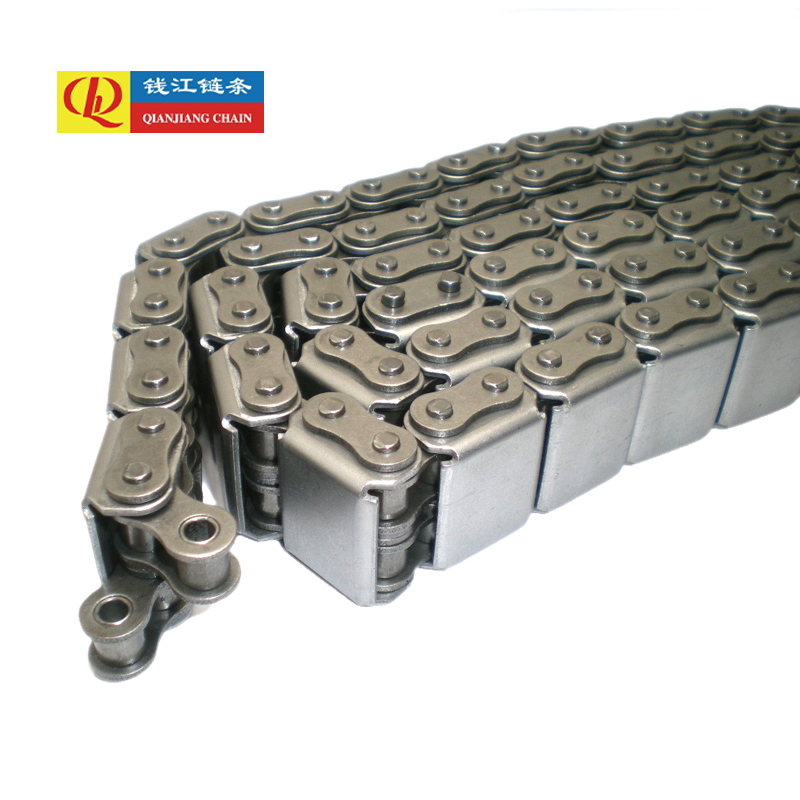
How to Measure Roller Chain: The Three Critical Dimensions
Understanding how to measure roller chain accurately requires three measurements: pitch, roller diameter, and inner width. Together these three values map directly to a specific ANSI chain designation and cannot be substituted independently — a chain that matches pitch alone but differs in roller diameter will not seat correctly in the sprocket and will wear both components prematurely.
Step 1 — Measure Pitch
Pitch is the center-to-center distance between adjacent pin centers. To measure accurately, count across a minimum of 10 links (pin center to pin center) and divide the total distance by the number of pitches spanned. Measuring across a single link introduces proportionally larger error from any pin or bushing wear. Use a digital caliper for precision; a steel rule introduces parallax error. Pitch is always expressed in inches for ANSI chain and millimeters for ISO/metric chain.
Step 2 — Measure Roller Diameter
Roller diameter is measured across the outer face of the roller perpendicular to the chain's running axis. Place the caliper jaws gently on opposite sides of a single roller — apply only light contact pressure, as rollers can indent calipers slightly and produce a low reading. If multiple rollers are accessible, average two or three measurements to account for any individual roller wear.
Step 3 — Measure Inner Width
Inner width is the clearance between the inner faces of the inner link plates — the dimension that determines whether the chain will clear the sprocket tooth width. Measure between the inner plate faces with the inside jaws of a caliper. This measurement is often overlooked when replacing chain, but a mismatch here causes lateral contact between the chain and sprocket tooth faces, accelerating side-plate wear and generating heat.
How to Determine Chain Size from Measurements Alone
Once pitch, roller diameter, and inner width are recorded, how to determine chain size becomes a straightforward lookup against ANSI standard dimensions. The pitch measurement is the primary filter — it narrows the field to a single chain number series. Roller diameter and inner width then confirm the specific designation within that pitch family (standard, lightweight, or heavy series).
A practical workflow: if measurements return a pitch of 0.625 inches (5/8 inch), the chain number begins with "5" — candidates are No. 50 (standard), No. 50H (heavy), and No. 51 (lightweight). Comparing the measured roller diameter against the tabulated values for each immediately identifies which variant is present. If the roller diameter matches No. 50 standard dimensions but the side plates appear thicker than expected, confirm plate thickness against the H-series specification — heavy series chains are frequently installed in applications that have experienced accelerated wear on standard chain.
For worn chain where exact dimensions are ambiguous, cross-reference against the sprocket tooth count and root diameter if the sprocket is still serviceable. Sprocket dimensions are engineered to specific chain numbers and provide an independent confirmation path when chain measurements fall between values due to wear elongation.
ANSI Roller Chain Dimensions: Complete Size Reference
The following ANSI roller chain dimensions table covers the standard series chain numbers most commonly encountered in industrial and agricultural applications. All dimensions are in inches. Heavy (H) series chains share the same pitch and roller diameter as their standard counterparts but have increased plate thickness and correspondingly higher tensile strength ratings.
| Chain No. | Pitch (in) | Roller Dia. (in) | Inner Width (in) | Avg. Tensile Strength (lbs) |
|---|---|---|---|---|
| 25 | 0.250 | 0.130 | 0.125 | 780 |
| 35 | 0.375 | 0.200 | 0.188 | 2,100 |
| 40 | 0.500 | 0.312 | 0.312 | 3,700 |
| 50 | 0.625 | 0.400 | 0.375 | 6,100 |
| 60 | 0.750 | 0.469 | 0.500 | 8,500 |
| 80 | 1.000 | 0.625 | 0.625 | 14,500 |
| 100 | 1.250 | 0.750 | 0.750 | 24,000 |
| 120 | 1.500 | 0.875 | 1.000 | 34,000 |
| 140 | 1.750 | 1.000 | 1.000 | 46,000 |
| 160 | 2.000 | 1.125 | 1.250 | 58,000 |
Roller Chain Size Guide: Selecting the Right Chain for the Application
A roller chain size guide approach goes beyond dimensional matching — the correct chain for an application must also be rated for the transmitted power, speed, and environmental conditions it will encounter. Selecting by pitch alone without accounting for these factors leads to either over-engineered (costly and heavy) or under-engineered (premature failure) installations.
The primary sizing inputs are design horsepower (the required transmitted power multiplied by a service factor for shock load, start-stop cycles, and mounting conditions) and small sprocket RPM. These two values, plotted against a horsepower rating table for the candidate chain number, determine whether the chain operates within its continuous-duty envelope. Most chain manufacturers publish these tables by chain number at standard lubrication conditions — boundary lubrication, oil bath, or pressurized — since lubrication method significantly affects the allowable power rating at a given speed.
Service Factor Guidelines
- Smooth load, 10+ hours/day: Service factor 1.0 — use rated chain capacity directly
- Moderate shock (conveyors, mixers, fans): Service factor 1.3–1.5 — multiply required HP by this factor before sizing
- Heavy shock (crushers, presses, reciprocating equipment): Service factor 1.7–2.0 — a meaningfully larger chain number is almost always indicated
- Reversing drives: Add 0.2–0.5 to the base service factor, as reversing loads stress chain joints differently than unidirectional operation
When calculated design horsepower falls near the boundary between two chain numbers, always select the larger. The incremental cost difference between adjacent ANSI sizes is modest, while the consequences of operating a marginal chain at near-capacity — accelerated elongation, pin and bushing fatigue, and eventual link plate cracking — are disproportionately expensive in both downtime and replacement labor.
Industrial Chain Size Chart: Recognizing Wear and Knowing When to Replace
Referencing an industrial chain size chart during maintenance is only part of the replacement decision — understanding wear elongation limits is equally important. Roller chain does not fail suddenly in most applications; it elongates progressively as pin and bushing surfaces wear, increasing the effective pitch beyond the original specification. This elongation causes the chain to ride higher on sprocket teeth, concentrating contact stress on tooth tips rather than the designed root area, which accelerates sprocket wear and eventually causes the chain to skip or jump under load.
The standard replacement threshold for roller chain is 3% elongation measured over a 12-inch span for chains up to No. 60, and over a 24-inch span for larger chains. In practice, this means:
- A No. 40 chain (0.500-inch pitch) over 24 links should measure 12.000 inches new; replace at or before 12.360 inches
- A No. 60 chain (0.750-inch pitch) over 16 links should measure 12.000 inches new; replace at or before 12.360 inches
- A No. 80 chain (1.000-inch pitch) over 12 links should measure 12.000 inches new; replace at or before 12.360 inches
When replacing worn chain, always inspect and measure the mating sprockets before installing new chain. A sprocket with hooked or asymmetrically worn teeth will accelerate wear on a new chain to the point of premature failure within a fraction of the new chain's normal service life. If sprocket tooth profile has deviated visibly from the original geometry, replace both chain and sprockets together — the cost of the sprocket is negligible against the labor of a second chain replacement in short order.
News
-
I. Introduction Conveyor systems form the backbone of modern industrial automation, enabling the eff...
READ MORE -
1. Introduction 1.1 Definition and Basic Concept of Coupling Chains Coupling chains are mechanical d...
READ MORE -
1. Introduction to Leaf Chains Leaf chains are a type of mechanical chain used in a variety of indus...
READ MORE

 +86-13805752016
 +86-571-82875104/82875108
 [email protected]
 No. 80 QianNong West Road, Xiaoshan District, Hangzhou City, Zhejiang Province,China
Copyright © Hangzhou Qianjiang Chain Industries Co., Ltd. All Rights Reserved.
|
 浙公网安备33010902004043号