
 Eng
Eng  中文简体
中文简体Home / News / Industry News / O-Ring vs X-Ring Chain: Which One Should You Choose for Your Motorcycle?
Submit feedback
O-Ring vs X-Ring Chain: Which One Should You Choose for Your Motorcycle?
Update:03-04-2026
Posted by Admin
Content
- 1 What Are Sealed Chains and Why Do They Matter?
- 2 How O-Ring Chains Work
- 3 How X-Ring Chains Work
- 4 O-Ring vs X-Ring Chains: Direct Comparison
- 5 Chain Pitch and Sizing: Getting the Right Fit
- 6 Chain Strength Ratings and What They Mean
- 7 Maintenance Requirements for Sealed Chains
- 8 Connecting Links and Chain Joining Methods
- 9 Which Sealed Chain Should You Choose?
What Are Sealed Chains and Why Do They Matter?
A sealed chain is a drive chain in which each pin-and-bushing joint is fitted with a small elastomeric seal that traps grease inside the roller link during manufacture. In an unsealed chain, this joint is exposed to air, water, road grit, and sand — all of which wash out factory lubrication within a few hundred kilometres and begin abrading the metal surfaces directly. A sealed chain, by contrast, retains its internal lubricant for the life of the chain, dramatically reducing internal wear even when external lubrication is neglected. The result is a chain that lasts significantly longer, runs more quietly, and maintains tighter pitch consistency over its service life compared to an equivalent non-sealed chain.
Sealed chains are the standard fitment on virtually all modern motorcycles above 125cc, as well as many ATVs, agricultural equipment, and performance go-karts. The two dominant sealed chain designs on the market today are the O-ring chain and the X-ring chain, each using a differently shaped seal to achieve the same fundamental goal of retaining internal grease and excluding contaminants from the pin-bushing interface. Understanding the practical differences between these two types is essential for making an informed purchasing decision when replacing a chain.
How O-Ring Chains Work
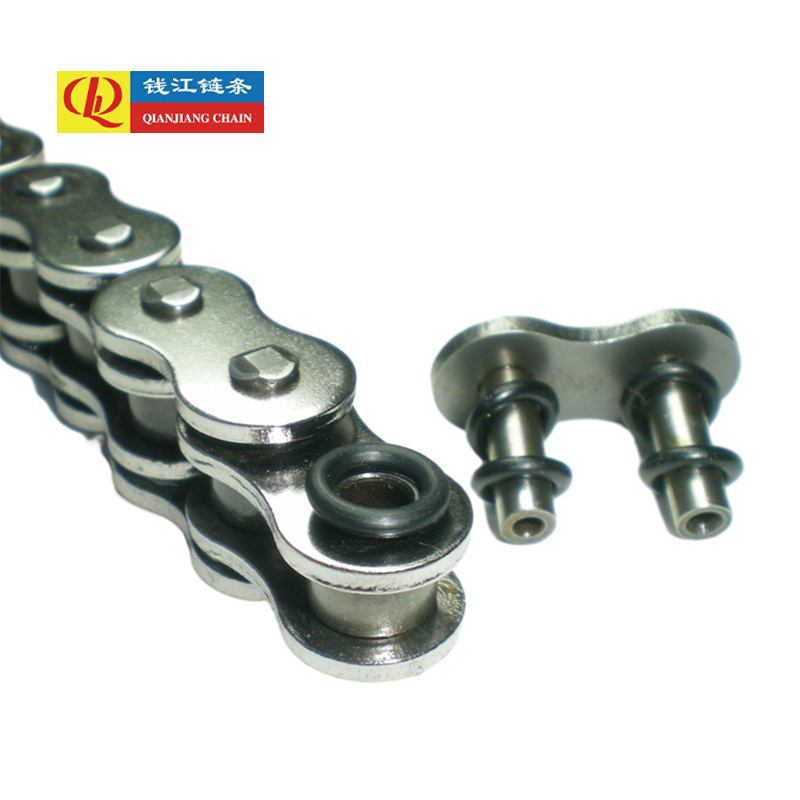
The O-ring chain takes its name from the circular cross-section elastomeric rings fitted between the inner and outer link plates at each pin joint. When the outer plate is pressed onto the pin during manufacturing, it compresses the O-ring against the inner plate, creating a radial seal that prevents grease from escaping outward and blocks water and grit from entering the joint. The factory-packed grease — typically a high-viscosity lithium or molybdenum disulfide grease — remains trapped inside the bushing-pin interface where it is needed most, lubricating the surfaces that flex and rotate under load with every revolution of the chain.
The O-ring itself is typically made from nitrile rubber (NBR) or neoprene, materials chosen for their resistance to petroleum-based lubricants, ozone, and the temperature range experienced in a motorcycle chain application. The ring sits in a groove machined into the inner plate face, and compression of the ring between the inner and outer plates creates the sealing contact. One inherent limitation of the circular cross-section design is that the O-ring contacts the mating plate face along a relatively narrow band, meaning the sealing contact area is limited. Under the continuous flexing and side-load forces experienced in service, this contact zone can wear slightly, and the seal can generate measurable friction as the chain articulates around sprockets.
How X-Ring Chains Work
The X-ring chain uses a seal with an X-shaped or quad-lobe cross-section in place of the simple circle. When compressed between the inner and outer link plates, this X profile creates two sealing contact lips on each face — one on each lobe of the X — rather than the single contact band of a conventional O-ring. This dual-lip geometry produces two sealing lines per face, making the seal more resistant to contaminant ingress and grease loss without requiring higher compression force to achieve an equivalent sealing effect.
The critical practical benefit of the X-ring profile is reduced friction. Because the X-ring contacts the plate surface on two narrow lips rather than a broad compressed band, the contact area in motion is smaller and the frictional resistance to articulation is lower. Chain manufacturer testing consistently demonstrates that X-ring chains generate between 10% and 18% less friction than O-ring chains of the same pitch and roller width. This translates directly into less power loss through the drive chain, lower operating temperatures for both the chain and sprockets, and reduced wear on the seals themselves. X-ring seals are also typically made from more advanced elastomer compounds — often hydrogenated nitrile (HNBR) — which offer improved resistance to heat, oil, and mechanical fatigue compared to the standard NBR used in most O-ring chains.
O-Ring vs X-Ring Chains: Direct Comparison
While both chain types serve the same fundamental sealing purpose, there are meaningful differences in performance, longevity, and cost that should influence which type you select for a given application. The table below provides a direct side-by-side comparison of the key characteristics.
| Characteristic | O-Ring Chain | X-Ring Chain |
| Seal Cross-Section | Circular | X / Quad-lobe |
| Sealing Contact Points | 1 per face | 2 per face |
| Friction vs Unsealed | Moderate increase | Lower increase |
| Typical Seal Material | NBR / Neoprene | HNBR / Advanced NBR |
| Service Life | Good (15,000–25,000 km) | Excellent (20,000–35,000 km) |
| Power Loss | Slightly higher | Lower |
| Typical Cost Premium vs Non-Sealed | Moderate | Higher |
| Best Application | Commuter, budget builds | Sport, touring, performance |
Chain Pitch and Sizing: Getting the Right Fit
Both O-ring and X-ring chains are available across the full range of standard drive chain pitches used in motorcycles and power sports equipment. Chain sizing follows a standardised numbering system where the first one or two digits indicate the chain pitch in eighths of an inch, and the last two digits indicate the roller width in eighths of an inch. Common motorcycle chain sizes include 420, 428, 520, 525, 530, and 630, with 520 and 530 being the most prevalent on mid-displacement and large-displacement motorcycles respectively.
When replacing a sealed chain, it is critical to match both the pitch and the roller width exactly to the original specification. Fitting a chain of the incorrect pitch will not engage the sprocket teeth correctly and will cause rapid wear of both the chain and sprockets. Fitting a chain with an incorrect roller width may not clear the sprocket flanges or may run with excessive lateral play. Always verify the chain size printed on the original chain or listed in the motorcycle's service manual before ordering a replacement. Most O-ring and X-ring chains from reputable manufacturers are also available in specific link counts, so measure the original chain's link count rather than estimating.
Chain Strength Ratings and What They Mean
Sealed chains — both O-ring and X-ring — are available in standard, heavy-duty, and ultra-heavy-duty strength grades from most manufacturers. The key strength specification is the minimum tensile strength, measured in kilonewtons (kN) or pounds-force (lbf), which defines the static load at which the chain will fail under direct tension. For a 520-pitch chain, standard grades typically offer 26–30 kN tensile strength, while heavy-duty variants reach 32–38 kN, and ultra-performance chains from manufacturers such as DID, RK, and Regina can exceed 40 kN in the same pitch.
For most street motorcycles, a standard or heavy-duty X-ring chain of the correct pitch is entirely adequate. High-horsepower superbikes, heavily loaded touring motorcycles, and off-road competition machines where the chain is subjected to shock loads from hard acceleration, jumps, and rough terrain benefit from heavy-duty or ultra-heavy-duty specifications. The additional cost of a higher-strength chain is modest relative to the cost of sprocket replacement if a chain stretches rapidly or fails prematurely under sustained high loads.
Maintenance Requirements for Sealed Chains
One of the most common misunderstandings about sealed chains is that they require no lubrication or maintenance. While the internal grease is sealed for life and cannot be supplemented or replaced, the external surfaces of the chain — the rollers, outer plates, and side faces — still require regular lubrication to prevent surface corrosion and to reduce friction between the roller and sprocket tooth contact surfaces. External lubrication also helps cushion the impact of the chain engaging each sprocket tooth and reduces the operating temperature of the entire drive system.
The correct lubricant for a sealed chain must be compatible with the elastomeric seal material. Many petroleum-based chain waxes and aerosol lubricants contain solvents that attack and swell NBR or HNBR seals over time, accelerating seal deterioration and premature lubricant loss from the joints. Always use a lubricant specifically labelled as safe for use with O-ring and X-ring chains. The following maintenance practices will maximise the service life of any sealed chain:
- Lubricate every 500–800 km under normal conditions, or after every ride in wet weather. Apply lubricant to the inner edge of the chain — the side facing the sprocket — while slowly rotating the rear wheel so the lubricant is carried around the full chain loop.
- Clean the chain with a soft brush and a dedicated chain cleaner that is confirmed safe for sealed chains. Avoid pressure washers directed at close range onto the chain, as high-pressure water can force past seals and wash grease from the joints.
- Check chain tension regularly — typically every 500 km — and adjust according to the manufacturer's specified slack measurement at the midpoint of the lower chain run. An overly tight chain accelerates bearing and seal wear; an excessively slack chain risks jumping the sprocket under hard acceleration.
- Inspect the chain visually for stiff links, damaged or missing seals, corrosion on the side plates, and cracks or deformation of any link. A chain with a stiff link that does not flex freely through the sprocket must be replaced immediately as it will cause vibration, rapid sprocket wear, and risks sudden failure.
- Measure chain stretch with a ruler or dedicated chain wear gauge. Most manufacturers recommend chain replacement when stretch reaches 1% to 1.5% beyond nominal pitch length, measured over a fixed number of links — typically 20 links. Fitting a new chain to worn sprockets will cause the new chain to wear rapidly, so always inspect sprockets when replacing a chain.
Connecting Links and Chain Joining Methods
Sealed chains require a connecting link that is compatible with the seal type — an O-ring connecting link for an O-ring chain, and an X-ring connecting link for an X-ring chain. Using the wrong seal type in the connecting link creates an asymmetric seal compression that leaks lubricant from the joint and allows grit ingress at the most mechanically loaded point in the chain. Most sealed chain manufacturers supply a matching connecting link in the chain box, but always verify this before installation.
There are two main types of connecting link for sealed chains: the clip-type master link and the rivet-type connecting link. The clip-type master link uses a spring clip to retain the outer plate and is suitable for street use but should always be installed with the closed end of the clip facing the direction of chain travel so that chain tension cannot push the clip off. The rivet-type connecting link uses a press tool to flare the pin ends and permanently secure the outer plate — this is the stronger option and is mandatory on high-power motorcycles above approximately 100 kW, where clip-type links are not recommended due to the risk of clip displacement under shock loading. Always follow the chain manufacturer's joining method recommendation for the specific application.
Which Sealed Chain Should You Choose?
For budget-conscious commuter motorcycle owners riding in moderate conditions and accumulating moderate annual mileage, a quality O-ring chain from a reputable manufacturer such as DID, RK, EK, or Regina represents excellent value. It will comfortably outlast an unsealed chain by a factor of two to three and requires no more maintenance effort. For sport riders, touring motorcyclists covering high annual mileage, and anyone operating a high-displacement motorcycle where drivetrain efficiency and longevity are priorities, the X-ring chain's lower friction, superior sealing, and longer service life justify the modest additional cost without reservation. The price difference between a comparable O-ring and X-ring chain from the same manufacturer is typically 15 to 30 percent — a cost that is recovered many times over in reduced sprocket wear and extended chain replacement intervals across a full season of riding.
News
-
I. Introduction Conveyor systems form the backbone of modern industrial automation, enabling the eff...
READ MORE -
1. Introduction 1.1 Definition and Basic Concept of Coupling Chains Coupling chains are mechanical d...
READ MORE -
1. Introduction to Leaf Chains Leaf chains are a type of mechanical chain used in a variety of indus...
READ MORE

 +86-13805752016
 +86-571-82875104/82875108
 [email protected]
 No. 80 QianNong West Road, Xiaoshan District, Hangzhou City, Zhejiang Province,China
Copyright © Hangzhou Qianjiang Chain Industries Co., Ltd. All Rights Reserved.
|
 浙公网安备33010902004043号