
 Eng
Eng  中文简体
中文简体Home / News / Industry News / How Do You Choose and Maintain the Right Motorcycle Chain for Your Ride?
Submit feedback
How Do You Choose and Maintain the Right Motorcycle Chain for Your Ride?
Update:08-05-2026
Posted by Admin
Content
- 1 Why Your Motorcycle Chain Is More Critical Than You Think
- 2 How Motorcycle Chains Are Constructed
- 3 The Three Main Types of Motorcycle Chains
- 4 Choosing the Right Chain for Your Motorcycle
- 5 Essential Motorcycle Chain Maintenance Practices
- 6 Signs That Your Motorcycle Chain Needs Replacing
- 7 Master Link vs. Rivet Link: Joining the Chain Correctly
- 8 Conclusion
Why Your Motorcycle Chain Is More Critical Than You Think
The motorcycle chain is one of the most mechanically fundamental components on any chain-driven bike, yet it is also one of the most neglected. It serves as the direct mechanical link between the engine's output — transmitted through the gearbox sprocket — and the rear wheel that propels the motorcycle forward. Every single watt of power your engine produces must pass through that chain before it reaches the road. A worn, poorly lubricated, or incorrectly tensioned chain does not merely reduce performance; it actively endangers rider safety by risking sudden chain snap, erratic power delivery, or accelerated sprocket wear that can lead to catastrophic drivetrain failure at speed. Understanding how motorcycle chains work, how to select the correct type, and how to maintain them properly is therefore not optional knowledge for any serious rider — it is a fundamental aspect of responsible motorcycle ownership.
How Motorcycle Chains Are Constructed
A motorcycle drive chain is a roller chain consisting of alternating inner and outer link plates connected by hardened steel pins. Each pin passes through a bushing pressed into the inner link plates, and a freely rotating roller sits over the bushing. When the chain engages the sprocket teeth, the rollers rotate to reduce friction and wear on both the chain and the sprocket. The quality of the steel used in the plates, pins, and rollers — as well as the precision of the manufacturing tolerances — determines how much load the chain can handle and how long it will last under real-world operating conditions.
Most modern motorcycle chains are measured by their pitch — the distance between the centers of adjacent pins — and their width. The pitch and width are encoded in the chain's size designation. For example, a 520 chain has a pitch of 5/8 inch (approximately 15.875 mm) and a width across the rollers of 2/8 inch. A 530 chain has the same pitch but a wider roller width of 3/8 inch, making it heavier and more durable. A 428 chain, commonly found on smaller displacement bikes and motorcycles under 250cc, has a 4/8 inch pitch. Selecting the correct chain size for your specific motorcycle is non-negotiable — an incorrect size will not engage the sprockets properly and will cause immediate and severe damage.
The Three Main Types of Motorcycle Chains
Not all motorcycle chains are created equal. The market broadly divides into three categories, each with distinct performance and maintenance characteristics that suit different riding applications.
Standard (Non-Sealed) Chains
Standard chains contain no internal lubrication between the pin and bushing. They are the lightest and least expensive option, and they were the norm on motorcycles until the 1970s. Without internal lubrication, the metal-to-metal contact between the pin and bushing wears rapidly, especially in wet or dusty conditions. Standard chains require very frequent lubrication — ideally after every ride in wet weather — and have a significantly shorter service life than sealed chains. They remain relevant primarily for closed-course racing where weight savings are prioritized over longevity, or for vintage motorcycle restoration where period-correct components are required.
O-Ring Chains
O-ring chains introduced a revolution in chain longevity when they became widely available in the late 1970s and early 1980s. Each pin-bushing interface is sealed by a rubber O-ring compressed between the inner and outer link plates, trapping a factory-applied grease lubricant inside the joint permanently. This internal lubrication prevents the rapid pin-bushing wear that plagues standard chains and dramatically extends service life — typically two to three times longer than an unsealed chain under equivalent conditions. The trade-off is a small increase in weight and a marginal increase in frictional losses due to the O-ring drag, though this difference is imperceptible in road riding. O-ring chains remain the most popular choice for general street riding on bikes from 125cc to large-displacement tourers.
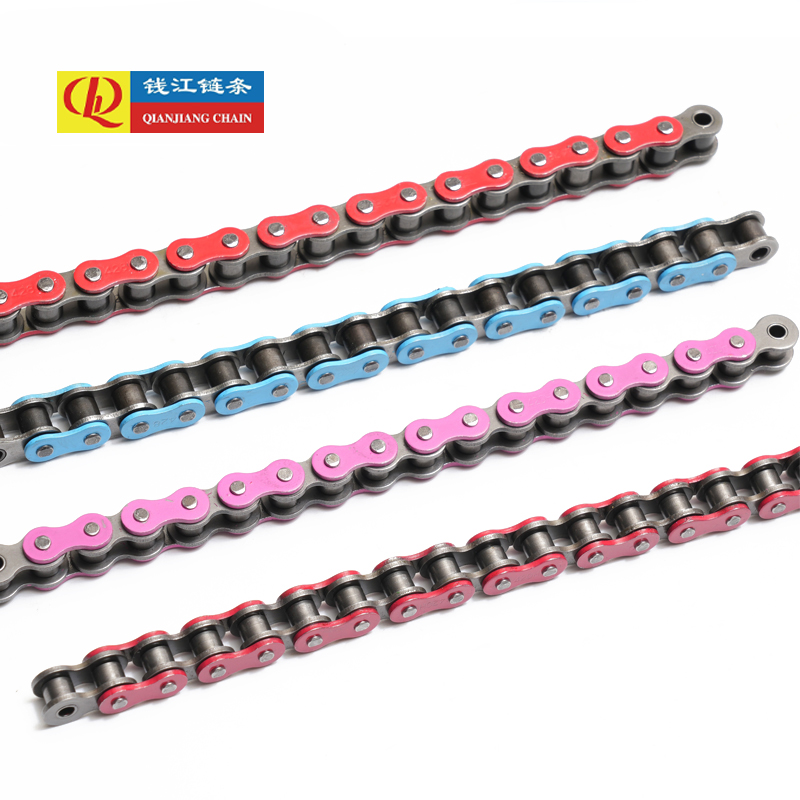
X-Ring and Z-Ring Chains
X-ring chains replaced the circular cross-section O-ring with an X-shaped (or quad-lip) seal. This geometry creates two sealing contact points instead of one, improving lubricant retention while simultaneously reducing the contact surface area between the seal and the link plate. The result is lower frictional drag compared to O-ring chains — typically 20 to 30% less — combined with superior sealing performance. Z-ring chains use a similar multi-lip geometry with slightly different proportions. Both types are the preferred choice for high-performance sport bikes, adventure touring machines subjected to harsh off-road conditions, and any application where maximizing chain life while minimizing power loss is the priority. They are more expensive than O-ring chains but typically last 20,000 to 30,000 kilometers or more with proper maintenance.
Choosing the Right Chain for Your Motorcycle
Selecting a replacement chain involves matching several parameters to your specific bike and riding style. The following table summarizes the key selection criteria and typical recommendations:
| Bike Type / Use Case | Recommended Chain Type | Typical Chain Size |
| 125cc–250cc commuter | O-Ring | 428 or 520 |
| 400cc–650cc mid-range street | O-Ring or X-Ring | 520 or 525 |
| 600cc–1000cc sport bike | X-Ring or Z-Ring | 520 or 525 |
| Large displacement tourer / cruiser | X-Ring | 530 or 532 |
| Off-road / enduro | O-Ring or X-Ring | 520 |
| Closed-course racing | Standard (non-sealed) | 520 |
Always verify the correct chain size and link count in your motorcycle's owner manual or service documentation before purchasing a replacement. Some manufacturers specify a minimum tensile strength rating for replacement chains, particularly on high-torque engines. Reputable chain brands such as DID, RK, EK, and Regina publish tensile strength data for each product line, making direct comparison straightforward.
Essential Motorcycle Chain Maintenance Practices
A well-maintained motorcycle chain will outlast a neglected one by a factor of three or more. The maintenance routine is simple but must be performed consistently to be effective.
Cleaning the Chain
Chain cleaning removes the accumulated road grime, old lubricant residue, and fine metal particles that act as an abrasive paste and accelerate wear. Use a purpose-made chain cleaner spray and a stiff-bristle chain cleaning brush — a three-sided brush that contacts all four surfaces simultaneously makes the job significantly faster. Never use petrol, diesel, or aggressive solvents on O-ring, X-ring, or Z-ring chains, as these chemicals will swell and degrade the rubber seals, destroying the factory lubrication inside the joint. Allow the chain to dry fully before applying fresh lubricant. Clean the chain every 500 to 800 kilometers under normal conditions, or after every wet or off-road ride.
Lubricating the Chain
Apply chain lubricant to the inner edge of the chain — the side that contacts the sprocket teeth — while slowly rotating the rear wheel. This allows the lubricant to penetrate the gap between the roller and the link plates by centrifugal action when the bike moves. Wax-based chain lubes are preferred for dry conditions because they shed dust and dirt rather than absorbing it; wet-condition lubes are heavier and more water-resistant but attract more contamination in dry use. Apply lubricant after cleaning and allow at least 10 minutes for the carrier solvent to evaporate before riding. Overapplication is counterproductive — excess lubricant flings off at speed, coating the rear tyre, which is both wasteful and potentially hazardous.
Checking and Adjusting Chain Tension
Correct chain tension is critical for both performance and longevity. A chain that is too tight places excessive load on the gearbox output shaft bearing and the swingarm pivot bearing, and can snap under the additional stress of suspension compression. A chain that is too loose risks jumping the sprocket, slapping the swingarm, or catching on adjacent components. The correct slack measurement — typically between 20mm and 30mm of vertical movement at the mid-point of the lower chain run — is specified in your owner's manual and must be checked with the bike on its side stand or a paddock stand with the suspension at normal ride height. Adjust tension using the chain adjusters at the rear axle, ensuring both sides are moved equally to maintain rear wheel alignment. Check alignment using the reference marks engraved on the swingarm.
Signs That Your Motorcycle Chain Needs Replacing
Even with perfect maintenance, motorcycle chains have a finite service life. Recognizing the warning signs of a worn-out chain prevents the far more expensive consequence of sprocket damage or, in extreme cases, a chain failure at speed. Replace your chain immediately if you observe any of the following:
- The chain has stretched beyond the adjustment range of the rear axle adjusters — you have run out of room to take up slack without repositioning the rear wheel.
- Stiff or seized links that do not flex smoothly around the sprocket, creating a jerking sensation during low-speed maneuvers or visible kinking when the chain passes over the sprocket.
- Visible side-to-side looseness (lateral slack) in the chain when pushed sideways — this indicates severe pin and bushing wear that no amount of lubrication can reverse.
- Hooked or shark-finned sprocket teeth — a worn chain stretches unevenly and causes asymmetric wear on sprocket teeth, reshaping them from symmetrical peaks into forward-hooked profiles.
- Rust on the outer link plates or rollers that does not clean off with chain cleaner — surface rust often indicates deep corrosion of the internal pin-bushing interface.
- The chain measures beyond 1% elongation using a chain wear indicator tool — a 12-link section of a new 520 chain measures 190.5mm; if the same 12-link section on your chain measures 192.4mm or more, it is at or past its replacement threshold.
Always replace the chain and both sprockets — front and rear — as a matched set. Installing a new chain on worn sprockets will cause the new chain to wear at an accelerated rate because the worn sprocket tooth profile no longer matches the new chain's geometry precisely. The cost of replacing all three components simultaneously is substantially less than the cost of replacing them separately within a few thousand kilometers of each other.
Master Link vs. Rivet Link: Joining the Chain Correctly
When installing a new motorcycle chain, it must be joined using either a clip-type master link or a rivet-type connecting link. Clip master links are quicker to install and remove without special tools, making them popular for track use where the chain may be changed frequently. However, the clip must be installed with the closed end of the clip facing the direction of chain travel — installing it backwards allows the clip to be flung off by centrifugal force, causing immediate and catastrophic chain separation. For this reason, most motorcycle manufacturers and chain suppliers recommend rivet-type connecting links for road use. A rivet link is permanently secured by peening the pin ends with a chain riveting tool, creating a joint that is as strong as any other link in the chain. Rivet links require a dedicated chain press and riveting tool to install correctly — attempting to peen the pins with a hammer and punch risks creating an asymmetric joint that will fail prematurely under load.
Conclusion
The motorcycle chain is a deceptively simple component that demands consistent attention and informed decision-making. Choosing the correct chain type and size for your bike and riding conditions, following a disciplined cleaning and lubrication schedule, maintaining proper tension, and recognizing the signs of wear before they become safety hazards are all skills that every rider should develop. A quality X-ring or O-ring chain from a reputable manufacturer, properly installed and maintained, will deliver tens of thousands of kilometers of reliable, efficient power transfer — protecting your sprockets, your gearbox bearings, and ultimately your safety every time you ride.
News
-
I. Introduction Conveyor systems form the backbone of modern industrial automation, enabling the eff...
READ MORE -
1. Introduction 1.1 Definition and Basic Concept of Coupling Chains Coupling chains are mechanical d...
READ MORE -
1. Introduction to Leaf Chains Leaf chains are a type of mechanical chain used in a variety of indus...
READ MORE

 +86-13805752016
 +86-571-82875104/82875108
 [email protected]
 No. 80 QianNong West Road, Xiaoshan District, Hangzhou City, Zhejiang Province,China
Copyright © Hangzhou Qianjiang Chain Industries Co., Ltd. All Rights Reserved.
|
 浙公网安备33010902004043号