

 Eng
Eng  中文简体
中文简体Double-pitch roller chains represent essential power transmission components in countless industrial applications where extended pitch lengths provide advantages over standard roller chains. The 2060, 2080, and 2082 series—along with their heavy-duty H-series variants—offer engineers and maintenance professionals versatile solutions for conveying, elevating, and power transmission requirements across diverse industries. Understanding the specifications, performance characteristics, and appropriate applications for each chain type enables optimal equipment design and reliable long-term operation. This comprehensive guide examines the technical details, comparative advantages, and practical selection considerations for these widely-used double-pitch roller chain families.
Understanding Double-Pitch Roller Chain Fundamentals
Double-pitch roller chains derive their name from having twice the pitch (distance between pin centers) of standard roller chains while maintaining similar roller diameters and plate thicknesses. This design philosophy creates chains optimized for applications requiring longer spans between sprocket teeth, reduced sprocket costs through fewer teeth for equivalent circumference, and lower overall system costs when high speeds or extreme loads are not primary concerns. The extended pitch reduces the number of chain joints per unit length, decreasing manufacturing costs and providing economic advantages in appropriate applications.
The numbering convention for double-pitch chains follows a logical pattern that conveys essential dimensional information. The first two digits indicate the chain pitch in eighths of an inch multiplied by ten. For example, 2060 chain has a pitch of 3 inches (60 ÷ 10 = 6 eighths of an inch = 3 inches). The suffix "H" denotes heavy-duty construction with larger rollers and thicker side plates compared to standard versions, providing increased load capacity and wear resistance for demanding applications. This standardized numbering system enables quick identification of chain specifications and ensures consistent nomenclature across manufacturers.
Double-pitch chains excel in conveying applications where material handling occurs at moderate speeds across extended distances. Their longer pitch reduces the number of engagement points between chain and sprockets, creating smoother, quieter operation compared to standard pitch chains operating at similar linear speeds. The reduced articulation frequency also decreases wear on both chains and sprockets, extending component life and reducing maintenance intervals. However, the extended pitch limits maximum speed capabilities and creates larger polygonal action (chordal rise and fall) as the chain engages sprockets, making double-pitch chains unsuitable for high-speed precision applications.
2060 and 2060H Roller Chain Specifications and Characteristics
The 2060 roller chain series features a 3-inch pitch with roller diameter of 0.750 inches in standard configuration, providing moderate load capacity suitable for light to medium-duty applications. The standard 2060 chain utilizes side plates approximately 0.156 inches thick with a maximum allowable load around 4,880 pounds when properly applied with adequate safety factors. This specification makes 2060 chain ideal for package conveying, light product handling, and low-speed power transmission where economy takes precedence over maximum capacity.
The 2060H heavy-duty variant increases roller diameter to 1.000 inch while maintaining the same 3-inch pitch, significantly enhancing load capacity and wear resistance. The "H" designation indicates thicker side plates measuring approximately 0.188 inches, reinforced pins of larger diameter, and overall more robust construction throughout. These enhancements increase maximum allowable load to approximately 7,030 pounds, representing a 44% improvement over standard 2060 chain. The larger rollers also provide increased bearing surface area on sprocket teeth, distributing loads more effectively and reducing wear rates on both chain and sprockets.
Applications ideally suited for 2060 chain include packaging lines, light assembly conveyors, agricultural equipment for crop handling, and overhead conveying systems for parts or components weighing several hundred pounds. The relatively compact dimensions allow integration into space-constrained equipment while the 3-inch pitch provides adequate strength for these moderate-load applications. Industries commonly employing 2060 chain include food processing, pharmaceutical manufacturing, electronics assembly, and warehousing operations where gentle product handling at controlled speeds is essential.
When selecting between standard 2060 and 2060H variants, engineers should consider not only immediate load requirements but also operating environment factors. The 2060H's larger rollers and heavier construction provide superior resistance to shock loading, abrasive contamination, and harsh operating conditions that accelerate wear in standard chains. While 2060H costs approximately 30-50% more than standard 2060, the extended service life and reduced maintenance frequency often justify the premium in demanding applications. For clean, controlled environments with predictable loading, standard 2060 delivers excellent value and reliable performance.
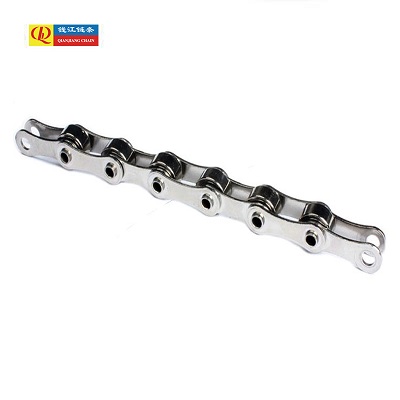
2080 and 2080H Roller Chain Specifications and Performance
The 2080 roller chain family features a 4-inch pitch, representing the next step up in size and capacity from the 2060 series. Standard 2080 chain employs 1.000-inch diameter rollers with side plates approximately 0.188 inches thick, providing maximum allowable loads around 7,850 pounds in properly designed applications. This increased capacity compared to 2060 chain reflects both the larger pitch and more substantial component dimensions throughout the chain construction.
The 2080H heavy-duty variant increases roller diameter to 1.250 inches while maintaining the 4-inch pitch, creating a significantly more robust chain suitable for severe-duty applications. Side plate thickness increases to approximately 0.219 inches, and all internal components are proportionally strengthened to handle the increased loads. Maximum allowable load for 2080H chain reaches approximately 11,100 pounds, making it suitable for heavy conveying, material handling, and moderate power transmission applications where reliability under sustained loading is critical.
| Chain Type | Pitch | Roller Diameter | Plate Thickness | Max Allowable Load |
| 2060 | 3.000" | 0.750" | 0.156" | 4,880 lbs |
| 2060H | 3.000" | 1.000" | 0.188" | 7,030 lbs |
| 2080 | 4.000" | 1.000" | 0.188" | 7,850 lbs |
| 2080H | 4.000" | 1.250" | 0.219" | 11,100 lbs |
| 2082 | 4.000" | 1.250" | 0.250" | 12,750 lbs |
| 2082H | 4.000" | 1.562" | 0.312" | 17,500 lbs |
Common applications for 2080 chain include pallet conveying systems, lumber handling equipment, aggregate processing conveyors, and industrial overhead conveyors for heavier components. The 4-inch pitch provides excellent economy for extended conveyor lengths where the reduced number of chain links and sprocket teeth compared to smaller pitch chains generates significant cost savings. Manufacturing facilities, distribution centers, sawmills, and recycling operations frequently employ 2080 chain for robust material handling at moderate speeds.
The selection decision between 2080 and 2080H typically hinges on operating environment severity and expected service life requirements. Applications involving continuous operation, abrasive materials, temperature extremes, or inadequate lubrication benefit substantially from 2080H's enhanced durability. The approximately 40% higher load capacity of 2080H compared to standard 2080 also provides critical safety margin in applications with occasional shock loads or overload conditions. Many maintenance professionals specify 2080H as standard for critical conveyors where unexpected failures create costly production disruptions, accepting the 35-60% price premium as insurance against downtime.
2082 and 2082H Roller Chain: Maximum Capacity Variants
The 2082 roller chain series represents the heaviest duty option within the 4-inch pitch family, featuring significantly increased component dimensions compared to 2080 variants. Standard 2082 chain employs 1.250-inch diameter rollers with side plates measuring approximately 0.250 inches thick—substantially heavier than 2080H construction. This robust design provides maximum allowable loads around 12,750 pounds, making 2082 suitable for severe-duty conveying and power transmission applications requiring maximum strength in a 4-inch pitch configuration.
The 2082H heavy-duty variant pushes capacity even further with 1.562-inch diameter rollers and side plates approximately 0.312 inches thick. All internal components including pins, bushings, and plates are proportionally strengthened to handle the extreme loads this chain encounters in the most demanding applications. Maximum allowable load for 2082H reaches approximately 17,500 pounds—more than double standard 2080 capacity and 2.5 times greater than standard 2060. This exceptional strength makes 2082H the choice for mining conveyors, heavy aggregate handling, bulk material processing, and other applications where chain failure creates significant safety hazards or operational consequences.
The substantial construction of 2082 series chains creates chains noticeably heavier and more expensive than lighter 4-inch pitch alternatives. A 10-foot section of 2082H chain may weigh 50-70% more than equivalent length 2080H chain, creating considerations for conveyor structural design and drive motor sizing. The increased weight also affects installation procedures, often requiring mechanical assistance for handling and tensioning during initial installation or maintenance activities. These practical considerations must be balanced against the superior load capacity and durability 2082 series provides in applications justifying the additional cost and complexity.
Industries commonly specifying 2082 and 2082H chains include mining operations, cement production, steelmaking, forest products processing, and heavy manufacturing where conveyed loads routinely exceed several thousand pounds. The exceptional strength ensures adequate safety factors even under severe shock loading, abrasive conditions, and continuous operation that would quickly destroy lighter chains. While initial costs for 2082H chain may be 2-3 times higher than standard 2080, the extended service life and reduced failure risk often create favorable total cost of ownership in appropriate applications.
Material Options and Surface Treatments
Double-pitch roller chains are manufactured from various materials and can receive specialized surface treatments to enhance performance in specific operating environments. Understanding available options enables optimal chain selection for diverse application requirements ranging from clean rooms to corrosive industrial settings.
Standard Carbon Steel Construction
The vast majority of 2060, 2080, and 2082 series chains utilize carbon steel construction throughout all components. High-quality chains employ case-hardened pins and heat-treated plates that provide excellent wear resistance and fatigue strength at economical costs. Standard carbon steel chains perform reliably in typical industrial environments when protected from excessive moisture and corrosive contaminants through appropriate lubrication practices. The natural surface finish may be plain steel, lightly oiled for corrosion protection during storage and shipping, or receive basic surface treatments for enhanced durability.
For improved corrosion resistance without significant cost increases, many manufacturers offer zinc-plated or nickel-plated carbon steel chains. Zinc plating provides moderate corrosion protection suitable for mildly corrosive environments or outdoor applications with weather exposure. The plating adds minimal thickness while creating a sacrificial barrier that protects base steel from oxidation. Nickel plating offers superior corrosion resistance and creates an attractive bright finish valued in food processing and pharmaceutical applications where appearance matters alongside functional performance.
Stainless Steel Chains for Corrosive Environments
Stainless steel construction provides maximum corrosion resistance for chains operating in harsh chemical environments, food processing with frequent washdowns, marine applications, or other settings where carbon steel chains would corrode rapidly. Type 304 stainless steel represents the most common specification, offering excellent corrosion resistance in most industrial environments. Type 316 stainless steel provides enhanced resistance to chlorides and acidic conditions, justifying its premium cost in the most corrosive applications.
Stainless steel chains typically cost 3-5 times more than equivalent carbon steel chains, with 316 stainless commanding additional premiums over 304 material. The higher cost reflects expensive raw materials and the challenges of machining and heat-treating stainless steel components. Additionally, stainless steel's lower hardness compared to case-hardened carbon steel results in reduced wear resistance, potentially requiring more frequent replacement in abrasive applications despite superior corrosion resistance. Engineers must evaluate whether corrosion protection or wear resistance represents the primary performance requirement when selecting chain materials.
Specialized Coatings and Treatments
Advanced surface treatments extend chain performance beyond what base materials alone provide. Dacromet coating creates a zinc-aluminum flake barrier offering exceptional corrosion resistance approaching stainless steel performance at lower cost. This coating works particularly well in outdoor applications and mildly corrosive environments where stainless steel's full corrosion resistance exceeds requirements but standard carbon steel proves inadequate.
PTFE (Teflon) impregnated chains incorporate dry lubricant into the bearing surfaces, reducing friction and enabling operation in environments where liquid lubricants are prohibited or impractical. Food processing, pharmaceutical manufacturing, and clean room applications benefit from self-lubricating chains that eliminate contamination risks from conventional oils and greases. While PTFE treatment increases costs by 40-80% over standard chains, the elimination of lubrication systems and associated maintenance often justifies the investment in appropriate applications.
Application Selection Guidelines and Best Practices
Selecting the optimal double-pitch roller chain for specific applications requires systematic evaluation of operating parameters, environmental conditions, and performance requirements. Following structured selection procedures ensures reliable operation while avoiding over-specification that wastes resources or under-specification that leads to premature failure.
Load Calculation and Safety Factors
Proper chain selection begins with accurate determination of working loads the chain will experience during operation. For conveying applications, calculate total load including the weight of conveyed materials, carrier fixtures or pallets, and the chain itself distributed across all loaded chain sections. Add dynamic factors accounting for starting loads, stopping forces, and any shock or impact loading inherent to the application. Industry standards typically recommend service factors of 7-10 for smooth, continuous operation and 10-15 for applications with moderate shock or intermittent operation.
Dividing maximum allowable chain load by the service factor yields the recommended working load limit. For example, a conveyor with calculated working loads of 1,200 pounds and moderate shock loading (service factor 12) requires chain with minimum allowable load of 14,400 pounds (1,200 × 12). This calculation would indicate 2082H chain (17,500 lbs capacity) provides adequate strength with reasonable safety margin, while 2080H (11,100 lbs) would be inadequate and 2082 (12,750 lbs) marginal. Conservative selection with adequate safety factors prevents unexpected failures from load variations, wear-induced strength loss, and occasional overload conditions inevitable in real-world operation.
Speed Limitations and Operating Parameters
Double-pitch chains are inherently limited to moderate operating speeds due to their extended pitch creating larger chordal action and increased vibration at high velocities. Maximum recommended speeds typically range from 150-250 feet per minute depending on specific chain size, with lighter chains generally tolerating higher speeds than heavier variants. Operating beyond recommended speed limits accelerates wear, increases noise and vibration, and can cause chain jumping or erratic engagement with sprockets.
For applications requiring higher speeds, consider standard pitch chains (such as 60, 80, or 100 series) despite their higher cost per foot. The smaller pitch enables smoother operation at elevated speeds while reducing dynamic loads and vibration. Conversely, applications operating below 50 feet per minute may be excellent candidates for double-pitch chains where their economic advantages provide maximum value. Bucket elevators, inclined conveyors, and accumulation systems typically operate at speeds well-suited to double-pitch chain capabilities.
Environmental Considerations
Operating environment significantly impacts chain selection and expected service life. High temperature applications above 200°F may require special heat-resistant lubricants and potentially upgraded materials, as standard chains experience strength degradation at elevated temperatures. Extreme cold below 0°F can cause conventional lubricants to thicken excessively, requiring synthetic lubricants formulated for low-temperature service. Thermal cycling between temperature extremes accelerates lubricant breakdown and can cause dimensional changes affecting chain-to-sprocket engagement.
Abrasive contaminants like dust, sand, or product particles create severe wear conditions demanding heavy-duty H-series chains with their larger bearing surfaces and enhanced durability. Frequent cleaning or exposure to wash water requires corrosion-resistant materials or protective coatings. Chemical exposure necessitates verification that chain materials and lubricants resist attack from specific substances present. Systematically documenting all environmental factors during the selection process ensures the chosen chain withstands actual operating conditions rather than just meeting basic load requirements.
Sprocket Selection and Chain-Sprocket Interaction
Proper sprocket selection and design directly affects chain performance, service life, and system reliability. Understanding sprocket design principles and chain-sprocket interaction helps optimize overall conveyor or drive system performance.
Minimum Tooth Count Requirements
Roller chain sprockets should incorporate sufficient teeth to ensure smooth power transmission and adequate chain wrap angle. Industry standards recommend minimum 12 teeth for drive sprockets in normal service, with 17-21 teeth preferred for reduced chain loading and extended service life. Smaller sprockets create higher dynamic loads as each chain pitch engages and disengages more frequently, and the tighter wrap radius increases stress on chain components. Driven sprockets may use fewer teeth (minimum 12) since they experience lower loads, though larger sprockets improve chain wrap and reduce wear.
The extended pitch of double-pitch chains creates larger sprocket diameters compared to standard pitch chains with equivalent tooth counts. A 12-tooth sprocket for 2080 chain (4-inch pitch) has a pitch diameter of approximately 15.3 inches, while a 21-tooth sprocket measures approximately 26.7 inches pitch diameter. These larger dimensions must be accommodated in equipment design, though they also provide advantages through reduced angular speed for equivalent linear chain speed and decreased chain articulation frequency contributing to extended service life.
Sprocket Material and Hardness
Sprocket materials should provide hardness and wear resistance appropriate to application severity and expected service life. Standard sprockets use medium carbon steel (1045 or similar) that can be induction hardened to create wear-resistant tooth surfaces while maintaining tough, ductile cores. Case hardening provides surface hardness of 50-58 HRC while the core remains softer to absorb shock loads without brittle fracture. This combination delivers excellent service life in most industrial applications at reasonable cost.
Severe-duty applications benefit from flame-hardened or through-hardened steel sprockets offering maximum wear resistance. Stainless steel sprockets match stainless chains in corrosive environments, though their lower hardness compared to hardened carbon steel results in faster wear requiring more frequent replacement. Cast iron sprockets provide economical options for light-duty applications operating at low speeds where wear rates are minimal. The material cost savings offset faster wear in applications where sprocket replacement remains infrequent even with softer materials.
Proper Chain-Sprocket Engagement
Optimal chain performance requires proper engagement between chain rollers and sprocket teeth. New chains should engage smoothly without excessive tightness or looseness, with rollers seating fully into tooth gaps. Worn chains develop elongation from pin and bushing wear, causing the chain to ride higher on sprocket teeth and concentrate loads on tooth tips rather than distributing forces across tooth profiles. This condition accelerates both chain and sprocket wear, creating a degenerative cycle leading to premature system failure.
Monitor chain elongation through periodic measurement and replace chains when elongation reaches 2-3% of original length. For 2080 chain with 4-inch pitch, 3% elongation equals 0.12 inches per pitch, easily measured with precision tools or specialized chain wear gauges. Replacing chains before excessive elongation develops protects expensive sprockets from accelerated wear and prevents sudden failures from severely worn chains jumping teeth or breaking under load. Many operations maintain spare chains to minimize downtime during planned replacements and enable immediate installation when wear limits are reached.
Lubrication Requirements and Maintenance Practices
Proper lubrication represents the single most important factor determining roller chain service life, with adequately lubricated chains lasting 5-10 times longer than poorly lubricated or dry chains. Understanding lubrication requirements and implementing appropriate maintenance practices maximizes return on chain investment.
Lubrication Methods and Frequency
Double-pitch roller chains require lubrication of the pin-bushing interfaces where articulation occurs during sprocket engagement. Lubricant must penetrate between pins and bushings to create a protective film preventing metal-to-metal contact that causes wear. Manual lubrication using oil cans or brushes represents the most basic approach, suitable for slow-speed chains operating intermittently. Apply lubricant to the inner link plates adjacent to rollers where it can migrate into pin-bushing clearances through capillary action and chain flexing.
Drip lubrication systems provide continuous or intermittent oil feed to chain, ensuring consistent lubrication without manual intervention. These systems work well for continuously operating conveyors where lubrication reliability justifies the installation cost. Oil bath lubrication submerges the lower portion of chain in an oil reservoir, providing excellent lubrication for enclosed drives operating at moderate speeds. Automatic spray systems use timed nozzles to periodically apply lubricant to chain runs, combining coverage automation with lubricant economy by applying only when needed.
Lubricant Selection
Selecting appropriate lubricants requires consideration of operating temperatures, speeds, environmental conditions, and contamination concerns. Multi-grade petroleum oils with viscosity grades of SAE 20-50 work well for general industrial applications operating at ambient temperatures. Higher viscosity oils (SAE 50-90) suit slower speeds and higher loads, while lower viscosity oils (SAE 10-30) accommodate higher speeds and lower temperatures. Synthetic lubricants extend temperature ranges and provide enhanced performance in extreme conditions, though their higher cost limits use to applications where conventional oils prove inadequate.
Food-grade lubricants formulated to NSF H1 specifications are mandatory in food processing and pharmaceutical applications where incidental contact with products may occur. These specialized lubricants use food-safe base stocks and additives while providing adequate chain protection. Dry lubricants including PTFE or graphite suit applications where liquid oils attract contaminants or present contamination risks, though they generally provide shorter service life than liquid lubrication and require more frequent reapplication.
Preventive Maintenance Procedures
Systematic maintenance extends chain life and prevents unexpected failures. Implement regular inspection schedules examining chains for elongation, visible wear, corrosion, damaged components, and proper tension. Check sprockets for tooth wear, particularly hooking of tooth profiles that indicates advanced wear requiring replacement. Verify alignment between drive and driven sprockets to prevent side loading that accelerates wear and can cause premature chain failure.
- Measure chain elongation monthly in critical applications and quarterly in less demanding service to track wear progression and plan replacements
- Clean chains operating in contaminated environments to remove abrasive particles that accelerate wear and impede lubrication
- Maintain proper chain tension with moderate sag in the slack span—neither too tight (causing excessive bearing loads) nor too loose (risking chain jumping)
- Document chain installation dates, manufacturers, and specifications to establish performance baselines and identify superior products for future purchases
- Stock appropriate spare chains and connecting links to enable rapid replacement when failures occur or wear limits are reached
Cost Considerations and Economic Analysis
Evaluating chain options requires analysis beyond simple purchase price to encompass total cost of ownership including installation, maintenance, expected service life, and failure consequences. Understanding cost factors enables economically optimized selection decisions balancing upfront investment against long-term operational expenses.
Initial Purchase Price Comparisons
Standard double-pitch chains represent economical alternatives to standard pitch chains for appropriate applications, with per-foot costs typically 30-50% lower than equivalent capacity standard pitch chains. Within double-pitch families, standard variants cost significantly less than H-series heavy-duty versions—2060H typically costs 30-50% more than standard 2060, while 2080H commands 35-60% premiums over standard 2080. The heaviest duty 2082H variant may cost 2-3 times as much as standard 2080 chain, reflecting its substantially more robust construction.
Specialty materials and treatments add significant cost premiums to base chain prices. Stainless steel chains cost 3-5 times more than carbon steel equivalents, while special coatings add 20-80% depending on treatment type and complexity. These premiums must be justified through extended service life, reduced maintenance requirements, or operational necessities like corrosion resistance or food-grade certification that have no lower-cost alternatives.
Service Life and Replacement Frequency
Chain service life varies enormously based on operating conditions, lubrication quality, and loading severity. Well-maintained standard 2060 chain in clean, moderate-load applications may deliver 3-5 years of service, while 2060H in similar conditions might last 5-8 years. Conversely, poorly lubricated chains in abrasive environments might fail within months regardless of initial quality. The heavier construction of H-series chains generally provides 50-100% longer service life than standard variants in equivalent applications, often justifying their higher initial costs through reduced replacement frequency and associated labor expenses.
Calculate annual ownership costs by dividing total installed cost (chain plus installation labor) by expected service life in years. A $800 standard 2080 chain lasting 3 years costs approximately $267 annually, while a $1,200 2080H lasting 6 years costs $200 annually—better value despite 50% higher purchase price. This analysis becomes increasingly important for difficult installations requiring extensive downtime or specialized labor for chain replacement, where installation costs may equal or exceed chain material costs.
Failure Cost Considerations
Unexpected chain failures create costs far exceeding chain replacement expenses through production downtime, emergency labor rates, potential equipment damage, and lost product. A chain failure shutting down a production line generating $5,000 per hour in value creates massive indirect costs dwarfing the chain's purchase price. These failure costs strongly favor conservative chain selection with adequate safety factors and premium materials in critical applications where failures carry severe consequences.
For non-critical applications with minimal failure consequences, economical standard chains with planned replacement schedules may optimize total costs. The key is matching chain specification to application criticality—specify premium chains for critical equipment and value chains for applications where failures create minimal disruption. This tiered approach allocates maintenance budgets effectively, investing in reliability where it matters most while avoiding over-specification of non-critical components.
Troubleshooting Common Chain Problems
Understanding common failure modes and their root causes enables effective troubleshooting that identifies and corrects problems before they lead to catastrophic failures or chronic reliability issues.
Excessive Wear and Elongation
Rapid chain elongation indicates inadequate lubrication, abrasive contamination, or overloading. Inspect lubricating systems to verify proper operation and adequate lubricant delivery to all chain sections. Examine the operating environment for sources of contaminating particles and implement guarding, sealing, or frequent cleaning to minimize abrasive intrusion. Review load calculations to ensure the chain is not operating beyond its capacity or experiencing shock loads exceeding design assumptions.
Uneven wear patterns where some sections show severe elongation while others remain near-new condition suggest localized problems like inadequate lubrication in specific areas, misalignment creating concentrated loads, or environmental differences along the chain path. Identify and correct the root causes creating uneven conditions rather than simply replacing the chain, which will experience similar premature wear without addressing underlying issues.
Noise and Vibration Issues
Excessive noise during operation typically indicates worn chains or sprockets, misalignment, inadequate lubrication, or excessive speed. Worn sprockets with hooked teeth create impact loads as chain rollers engage each tooth, generating characteristic clicking or clattering sounds that increase with severity. Check sprocket tooth profiles and replace worn sprockets along with chains to restore quiet operation. Misalignment between sprockets causes chain to run at an angle, creating side loads and noise as the chain tracks back and forth during engagement.
Vibration often results from uneven chain tension, worn chains jumping slightly on sprocket teeth, or resonance between chain natural frequency and operating speed. Verify proper chain tension adjustment and replace excessively worn chains. If vibration persists with new chains and proper tension, consider changing operating speed slightly to avoid resonant frequencies or adding damping through chain guides or tensioners that stabilize chain runs.
Chain Breakage and Component Failure
Catastrophic chain breakage from plate fracture or pin shearing indicates severe overloading, shock loads exceeding chain capacity, or fatigue failure from cyclic loading. Review operating conditions to identify overload events and implement guards, shock absorbers, or chain upgrades to prevent recurrence. Fatigue failures typically show beach mark patterns on fracture surfaces indicating progressive crack growth over many load cycles. These failures suggest the chain is operating near its capacity limits and should be upgraded to a higher strength variant or the loading reduced.
Roller or bushing failure where components crack, shatter, or separate from plates suggests impact damage, inadequate material quality, or extreme operating conditions. Verify chain manufacturers meet industry quality standards and specifications. Investigate potential impact events from product jams, foreign objects, or equipment malfunctions that create loads exceeding chain ratings. Implement protective measures or upgrade to heavier duty chains that tolerate occasional abuse better than marginal specifications.
 +86-13805752016
 +86-571-82875104/82875108
 No. 80 QianNong West Road, Xiaoshan District, Hangzhou City, Zhejiang Province,China
 浙公网安备33010902004043号